
Mallada boninensis
Mallada boninensis
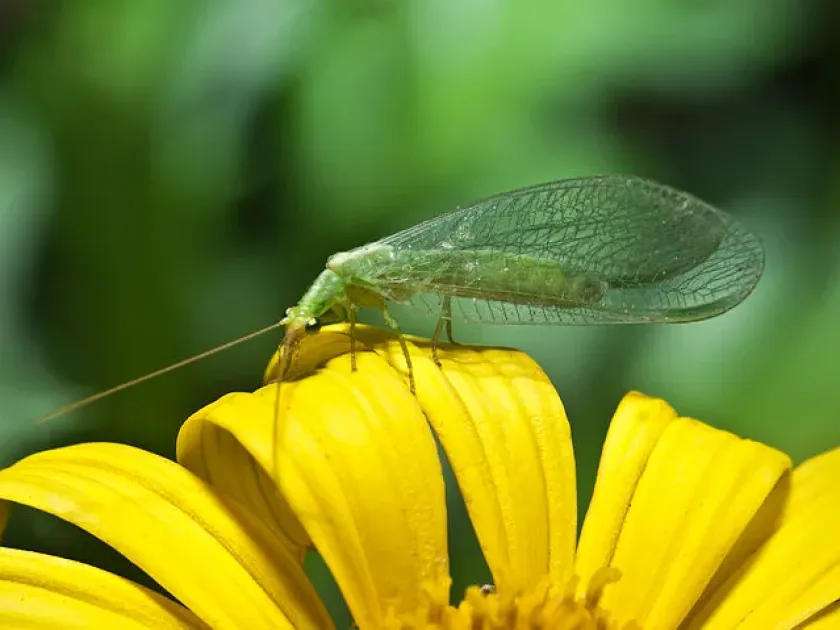
Description
How to identify
Mallada boninensis is a species of green lacewing belonging to the family Chrysopidae. It is characterized by its delicate, net-like wings and vibrant golden eyes, which are typical of the family.
Adult specimens measure between 10 and 15 mm in length. Their body coloration is usually pale green, which serves as effective camouflage within the foliage of host plants.
The larvae are specialized predators equipped with sickle-shaped mandibles, which they use to grasp their prey and inject digestive enzymes to liquefy the contents.
Development involves several stages: egg, three larval instars, and pupation within a white, silken cocoon often hidden under leaves or in crevices.
Identification often requires examination of wing venation patterns under magnification, as many lacewing species appear morphologically similar to the casual observer.
What it damages
It is crucial to classify Mallada boninensis as a beneficial insect rather than a plant pest. It does not cause damage to crops, plant tissues, or fruits.
The confusion regarding its status often arises because people encounter the larvae on infested plants and wrongly assume they are causing the damage.
In reality, the presence of these larvae indicates an active biological control process, as they are significant predators of aphids, whiteflies, and spider mites.
Indiscriminate use of broad-spectrum pesticides can eliminate these predators, ultimately leading to a resurgence of the actual agricultural pests they were managing.
Therefore, farmers should learn to recognize and protect this species to ensure sustainable pest management and reduce reliance on chemical inputs.
When it appears
The seasonal activity of Mallada boninensis begins in late spring and continues through summer, as temperatures consistently exceed 15°C.
They produce multiple generations throughout the growing season, allowing their populations to track the availability of prey like aphids on various crops.
The peak activity is generally observed during mid-summer when aphid colonies are most abundant in vegetable crops, orchards, and gardens.
Overwintering occurs as prepupae within silk cocoons, located in sheltered micro-habitats such as bark fissures, leaf litter, or debris.
Early spring warming triggers the emergence of adults, which immediately start seeking nectar and suitable sites for egg-laying.
Control measures
Control measures for Mallada boninensis should focus on conservation and enhancement of its population rather than eradication.
Management strategies should prioritize the reduction of insecticide applications, particularly those known to be highly toxic to beneficial arthropods.
Planting flower strips or nectar-rich borders can provide essential supplemental food for adults, significantly increasing their lifespan and fecundity.
Providing overwintering habitats, such as hedge rows or unmown field margins, helps maintain a stable population density across subsequent seasons.
Integrated Pest Management (IPM) practices should treat this species as a natural asset to be nurtured within the farm's agroecosystem.
Taxonomy
- Latin name
- Mallada boninensis
- Family
- Chrysopidae
- EPPO code
- CHROBO
Discussion
No discussions yet — be the first.