
Green lacewing
Chrysopa
Description
How to identify
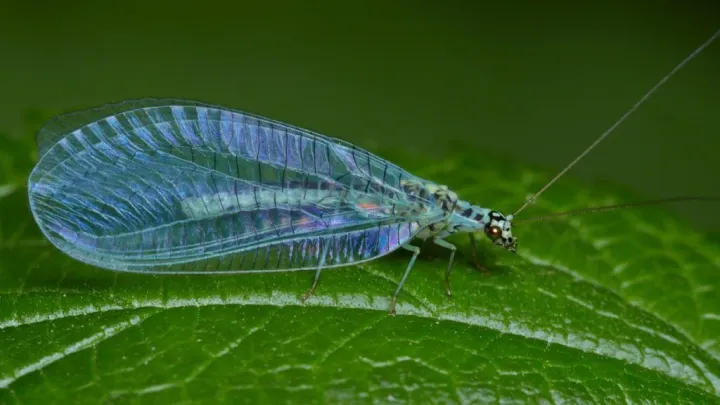
The Green lacewing (family Chrysopidae, order Neuroptera) is an insect characterized by delicate, net-like wing venation and shimmering golden eyes. The adult has a slender, light green body.
The larvae, often referred to as "aphid lions," have elongated, bristly bodies and large, sickle-shaped mandibles used to capture and consume prey.
The eggs of the lacewing are easily identified; the female deposits them on thin, long stalks attached to the leaf surface to protect the larvae from cannibalism.
Adults are mostly nocturnal, spending their days hidden within dense foliage, shrubs, or tall grasses to remain protected from predators.
It is crucial to recognize that the green lacewing is not a crop pest, but rather one of the most effective natural predators in agricultural ecosystems.
What it damages
This species causes no damage to plant tissues. Adult lacewings feed on nectar, pollen, and honeydew secreted by aphids, posing no threat to harvests.
The larvae are voracious predators that hunt colonies of aphids, spider mites, scale insects, and small caterpillars that actually damage crops.
A single larva can consume hundreds of aphids during its development phase, serving as an invaluable biological tool for crop protection.
There is absolutely no harm to plants associated with the presence of lacewings. Their presence indicates a healthy biological balance in the environment.
The misconception that they are pests arises from their constant presence on infested plants, where they are actively working to eliminate the pests.
When it appears
The activity cycle of the green lacewing begins in spring when average daily temperatures reach 10-12 degrees Celsius.
Depending on the climatic region, 2 to 4 generations can develop during the growing season, providing persistent pest control throughout the year.
As autumn approaches, adults enter diapause, seeking shelter in tree bark, leaf litter, or farm outbuildings to survive the winter months.
Hibernation typically occurs in the adult stage, allowing them to emerge promptly as soon as temperatures rise in the spring.
The spring emergence aligns perfectly with the early buildup of aphid populations, ensuring that the predator is present when the pest threat begins.
Control measures
Management strategies focus on preserving and attracting green lacewings rather than attempting to control them as pests.
Farmers should avoid broad-spectrum insecticides, which can be devastating to these beneficial predators and disrupt natural control.
It is recommended to plant nectar-rich floral strips such as dill, fennel, or buckwheat near fields to provide food sources for adult lacewings.
Maintaining uncultivated areas or hedge rows offers essential overwintering habitats for these insects to survive the cold season.
- Reducing reliance on non-selective chemical pesticides.
- Planting wildflower corridors to support local populations.
- Using selective biological pesticides that do not harm Neuroptera.
Taxonomy
- Latin name
- Chrysopa
- Family
- Chrysopidae
- EPPO code
- CHROSP
Discussion
No discussions yet — be the first.