
Green lacewing
Allochrysa
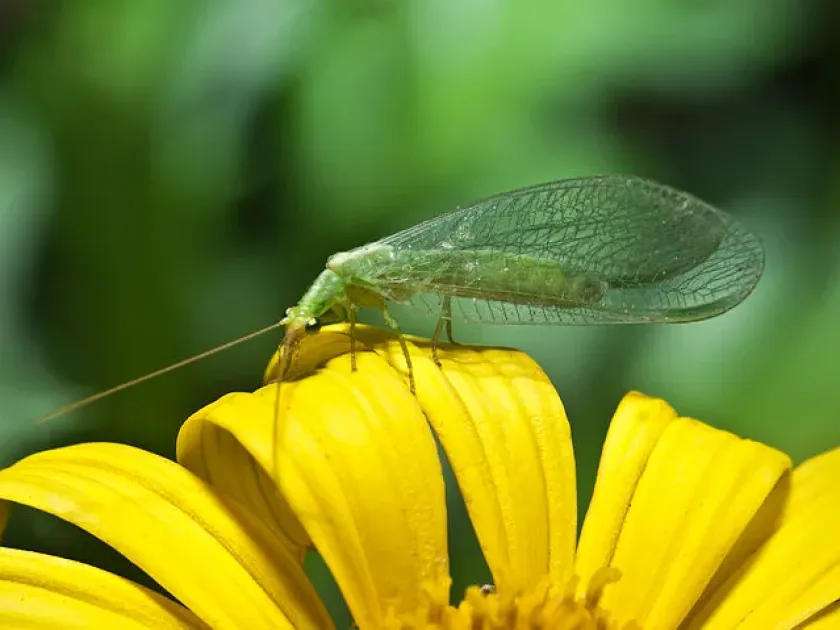
Description
How to identify
The green lacewing (family Chrysopidae, order Neuroptera) is a delicate insect known for its bright green body, large golden eyes, and intricate, lace-like wings.
The larvae are predatory and are commonly referred to as "aphid lions" due to their voracious appetite and sickle-shaped mandibles used for subduing prey.
A distinctive feature of the lacewing is the way the female deposits eggs; each egg is placed at the tip of a long, silk-like stalk to protect it from predation.
Adult lacewings are generally crepuscular or nocturnal, but they are often attracted to light sources at night, which can assist in their identification.
Systematically, these insects are essential components of the Neuroptera order, acting as top predators in many agricultural and horticultural ecosystems.
What it damages
The green lacewing is not a crop pest; it is a highly beneficial insect that serves as a cornerstone of integrated pest management (IPM) strategies.
The larvae feed extensively on aphids, spider mites, mealybugs, thrips, and the eggs of various lepidopteran pests, significantly reducing their populations.
Adult lacewings of many species feed primarily on nectar, pollen, and honeydew, which contributes to the pollination of diverse plant species in the field.
Farmers and gardeners benefit from the presence of lacewings because they provide free, natural pest suppression, reducing the need for chemical intervention.
Treating these insects as pests is a major misunderstanding; instead, they should be conserved and encouraged as primary agents of biological control.
When it appears
Lacewings emerge in early spring as temperatures rise, typically when the first colonies of aphids appear on early-season crops.
During the summer months, their activity peaks as they synchronize their life cycle with the rapid reproduction of their primary prey.
Depending on the climatic zone, lacewings can complete multiple generations within a single growing season, providing continuous natural protection.
As autumn approaches, adults seek overwintering sites, such as leaf litter, tree bark, or sheds, where they enter a state of diapause.
The timing of their appearance is highly consistent, making them reliable natural enemies that respond quickly to pest pressure in the field.
Signs of infestation
The primary sign of lacewing presence is the discovery of their unique stalked eggs attached to the undersides of leaves or along stems.
Visual spotting of larvae — characterized by their alligator-like shape and active movement among aphid colonies — indicates effective biological control.
Finding shriveled, empty aphid exoskeletons is a clear indicator that a lacewing larva has successfully consumed the pest colony.
The presence of adults, especially near blooming nectar-rich plants, confirms that the environment supports a breeding population of these predators.
A reduction in overall pest density without artificial chemical application is the most significant sign of a successful lacewing-led ecological balance.
Control measures
No control measures are necessary for green lacewings, as they are essential allies in protecting crops from harmful insect infestations.
To conserve and support lacewing populations, farmers should minimize the use of broad-spectrum insecticides that kill these beneficial predators.
If chemical treatment is unavoidable, using selective insecticides that spare natural enemies is the best practice for maintaining ecological stability.
Planting strips of nectar-producing flowers or cover crops provides the necessary food sources for adult lacewings, encouraging them to stay on the farm.
- Avoid non-selective insecticide spraying.
- Maintain habitat patches with native flowering plants.
- Implement IPM strategies to preserve natural biodiversity.
Taxonomy
- Latin name
- Allochrysa
- Family
- Chrysopidae
- EPPO code
- ALLCSP
Discussion
No discussions yet — be the first.