
Lacewing of the genus Mallada
Mallada
Description
How to identify
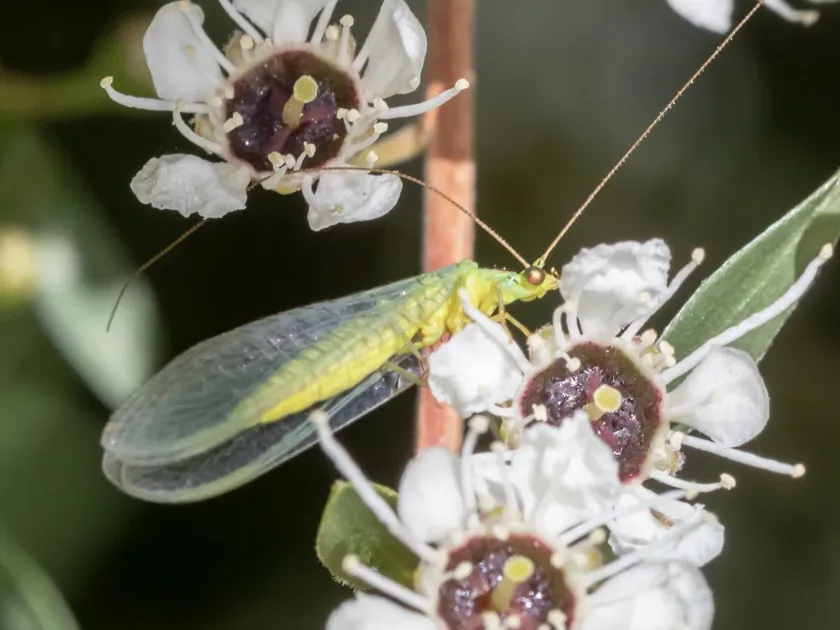
Lacewings belonging to the genus Mallada are members of the order Neuroptera and the family Chrysopidae. They are easily recognized by their delicate, lace-like wings and prominent, reflective golden eyes.
While the adults are often nectar feeders, the larvae of Mallada are ferocious predators, sometimes referred to as aphid lions due to their hunting habits.
The life cycle progresses through four distinct stages: egg, larva, pupa, and adult. The eggs are frequently laid on slender stalks to provide protection from predators or cannibalism.
They are primarily nocturnal insects, making them well-adapted to hunting in the cover of darkness across various agricultural landscapes.
Taxonomically, they are widely distributed, representing a significant component of the natural predator complex in temperate and tropical agricultural ecosystems.
What it damages
The Mallada genus is not a plant pest; rather, it is a highly beneficial biological agent. It provides ecosystem services by controlling populations of harmful insects.
The larvae are particularly known for consuming vast quantities of aphids, spider mites, mealybugs, and whitefly nymphs. Their predatory activity significantly lowers pest pressure.
These insects are utilized in Integrated Pest Management (IPM) programs, where they contribute to the reduction of synthetic pesticide use on commercial farms.
They are effective across a variety of crops, including citrus, stone fruits, viticulture, and various greenhouse-grown vegetables.
Their presence is an indicator of ecological health in an agricultural environment, directly correlating with improved crop yield through natural regulation of pests.
When it appears
The activity of Mallada lacewings is strongly regulated by temperature. Their season typically begins in late spring and continues through the autumn months.
Population growth is tightly synchronized with the presence of prey species. As pest populations spike, the lacewing population follows, providing natural regulation.
Overwintering usually occurs as adults or prepupae, finding shelter in leaf litter, tree bark crevices, or protected garden structures.
As spring temperatures rise, the adults emerge from diapause, mate, and begin searching for suitable egg-laying sites near pest colonies.
Mid-summer represents the period of highest activity, where larvae work constantly to reduce the populations of soft-bodied insects on the foliage.
Control measures
Since Mallada is a beneficial insect, no control or eradication measures are necessary. Instead, conservation biological control (CBC) is the recommended strategy.
Avoid the use of broad-spectrum insecticides that are known to have high toxicity to beneficial predators, as this disrupts natural pest management.
- Promote biodiversity by planting flowering cover crops to support adult lacewings.
- Use selective pest control products whenever possible.
- Minimize the removal of field margins and crop debris where they may overwinter.
- Regularly monitor the population to verify the natural suppression of pests before intervening with chemicals.
Supporting the Mallada population is a cost-effective method to maintain healthy crop conditions and achieve long-term sustainability in farming practices.
Taxonomy
- Latin name
- Mallada
- Family
- Chrysopidae
- EPPO code
- MLLDSP
Discussion
No discussions yet — be the first.