
Parallel tent caterpillar
Malacosoma parallela
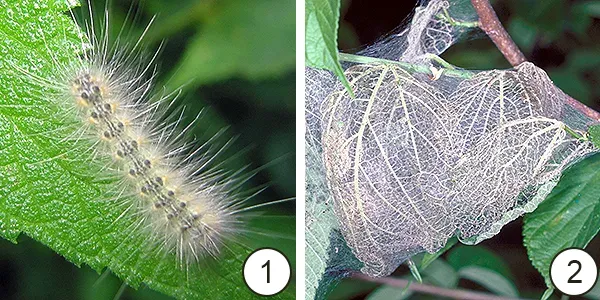
Description
How to identify
The Parallel tent caterpillar (Malacosoma parallela) is a moth species belonging to the family Lasiocampidae. These insects are recognized as significant pests of various deciduous trees.
Adult moths are typically nocturnal, with a wingspan and coloration that helps them blend into tree bark, making them difficult to spot during daylight hours.
The life cycle involves four stages: egg, larva, pupa, and adult. The overwintering phase usually occurs as eggs, which are deposited in ring-like clusters on small branches.
Larvae are social insects that build silk tents in the crotches of branches, which serve as protection and resting areas during the day or in bad weather.
The species has one generation per year, meaning that population levels are synchronized with specific host plant phenological stages.
What it damages
Larvae are voracious defoliators, feeding primarily on the leaves of various trees. This behavior can lead to significant biomass loss in orchards and ornamental plantings.
Key host plants include fruit-bearing trees such as apples, pears, and some stone fruit species. In cases of high infestation, entire branches can be stripped of leaves.
Severe defoliation stresses the host tree, leading to stunted growth and reduced photosynthetic capacity, which directly influences the quality and quantity of the fruit crop.
Persistent infestations year after year can weaken the tree, making it more susceptible to environmental stressors, such as drought or secondary disease attacks.
The economic impact is primarily related to yield losses and the cost of necessary pest management interventions required to preserve tree health.
Signs of infestation
The most distinctive sign of infestation is the presence of silken tent nests located in the forks of branches, often becoming visible in late spring.
Visible feeding damage, such as leaf skeletonization or ragged leaf margins, indicates that a colony of caterpillars is actively consuming the tree foliage.
Large quantities of frass (caterpillar droppings) accumulating on leaves or on the ground beneath the canopy are a clear indicator of larval presence.
The presence of egg masses, which appear as hardened dark bands encircling small twigs, allows for detection during the dormant winter season.
In mature infestations, the reduced vigor of the tree and visible thinning of the canopy compared to healthy adjacent trees are strong indicators of a problem.
Control measures
Mechanical control is effective during the winter when egg masses can be pruned and destroyed, or during spring when young tent nests can be manually removed.
Biological control using Bacillus thuringiensis (Bt) is highly effective against young larvae and has minimal impact on beneficial non-target insect species.
Chemical control should be reserved for severe outbreaks, applying insecticides specifically labeled for lepidopteran pests, while ensuring compliance with safety intervals.
Promoting natural biodiversity by creating habitats for parasitic wasps and birds can help manage populations and reduce the need for synthetic intervention.
- Pruning and destroying infected branches in early spring.
- Monitoring adult flight with pheromone or light traps.
- Applying microbial insecticides during the early larval development stages.
Taxonomy
- Latin name
- Malacosoma parallela
- Order
- Lepidoptera (butterflies)
- Family
- Lasiocampidae
- EPPO code
- MALAPA
Discussion
No discussions yet — be the first.