
Lackey moth
Malacosoma neustria
Description
How to identify
The lackey moth (Malacosoma neustria) belongs to the Lasiocampidae family. Adult moths have a wingspan of 30–40 mm with colors ranging from pale yellow to reddish-brown, typically with a darker band across the forewings.
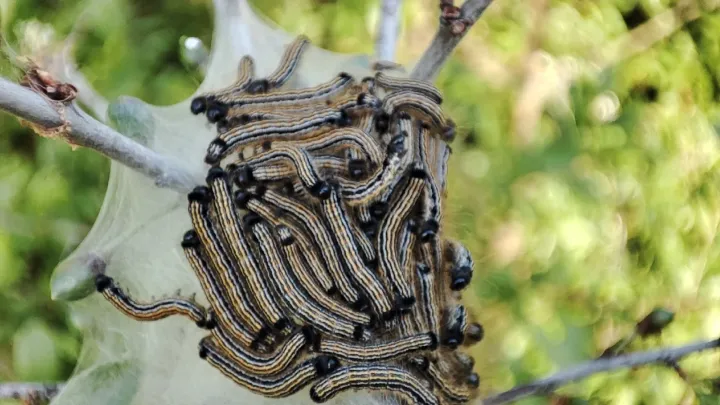
The larvae, or caterpillars, are highly recognizable due to their vibrant, striped appearance. They have a central white stripe flanked by black, blue, and orange lines along their bodies, which are covered in fine, short hairs.
A distinctive feature of this species is its egg-laying behavior. The female lays eggs in neat, band-like clusters encircling thin twigs, which look like a raised collar or ring, often cemented with a grayish foam.
Pupae are found within firm, yellowish silken cocoons. These are usually hidden in leaves that the caterpillar has folded together or in the crevices of tree bark near branch forks.
The species completes one generation per year. Its ability to overwinter in the egg stage makes it highly resilient and capable of surviving harsh winter conditions.
What it damages
The lackey moth is a major polyphagous pest that attacks a wide range of deciduous trees, causing significant damage to both commercial orchards and domestic gardens.
The primary hosts include apple, pear, plum, and cherry trees. However, they also infest apricot, peach, oak, hawthorn, and various other woody ornamental species.
Larvae feed gregariously, meaning they gather in large groups to feed. This feeding behavior can quickly lead to complete defoliation of branches or entire small trees.
Significant defoliation inhibits the tree's ability to photosynthesize, leading to reduced fruit yields and weakened vigor, which makes the tree more susceptible to secondary diseases.
Severe infestations in nurseries or young orchards can stunt growth, cause structural damage to branches, and even lead to tree death if defoliation occurs repeatedly over multiple seasons.
When it appears
The life cycle begins in early spring, synchronized with the bud-burst stage of host trees. Overwintering eggs hatch, and young larvae immediately begin feeding on fresh tissue.
The caterpillar stage lasts for approximately 6 to 8 weeks, depending on temperature and food availability. This is the period of greatest activity and damage to foliage.
Pupation typically occurs in early summer, often in June. During this phase, the caterpillars cease feeding and move to sheltered areas to weave their protective cocoons.
Adult moths emerge in mid-to-late summer (July and August). They are nocturnal, attracted to light, and focus their energy exclusively on mating and egg deposition.
After egg-laying, the insects complete their cycle, and the eggs remain dormant on the branches throughout the autumn and winter months.
Signs of infestation
The most visible sign in winter and early spring is the presence of egg rings on terminal twigs. These look like small, dark, raised collars around the stems.
During the spring, the formation of large, silky tent-like webs in branch forks is a clear indication of a lackey moth colony inhabiting the tree.
Defoliation is the most obvious sign of damage. The caterpillars eat the leaves entirely, leaving behind only the veins, which creates a skeletonized appearance.
Fecal droppings (frass) accumulating on the leaves below the nest are a strong indicator of heavy feeding activity by a large caterpillar population.
The presence of shed larval skins within the communal nests is another sign that the caterpillars have been molting and feeding at that site for a significant period.
Control measures
Mechanical removal is the most effective control method. During winter pruning, all twigs containing egg rings should be collected and incinerated.
If webs are discovered in the spring, they should be pruned off and destroyed manually. This is very effective if the infestation is caught early.
Biological controls, such as applications of Bacillus thuringiensis, are highly effective against young larvae and are safer for beneficial insects and pollinators.
Chemical insecticides should be used as a last resort when threshold levels are exceeded, ensuring treatments are applied before the caterpillars reach their final instar stages.
- Promote biodiversity in the orchard to attract natural predators like birds and parasitic wasps.
- Monitor moth flights using pheromone traps to predict future infestation levels.
- Maintain tree vigor through proper irrigation and nutrition to aid in recovery from damage.
- Clear surrounding hedgerows or scrub where the pest might also thrive.
Taxonomy
- Latin name
- Malacosoma neustria
- Order
- Lepidoptera (butterflies)
- Family
- Lasiocampidae
- EPPO code
- MALANE
Discussion
No discussions yet — be the first.