
Lappet moth
Malacosoma incurvum
Description
How to identify
The Lappet moth (Malacosoma incurvum) belongs to the Lasiocampidae family within the order Lepidoptera. The adult moths are characterized by yellow to brown wings with distinct darker bands.
The caterpillars are highly social and are known for building dense silken tents in tree branch crotches where they live and feed in large groups.
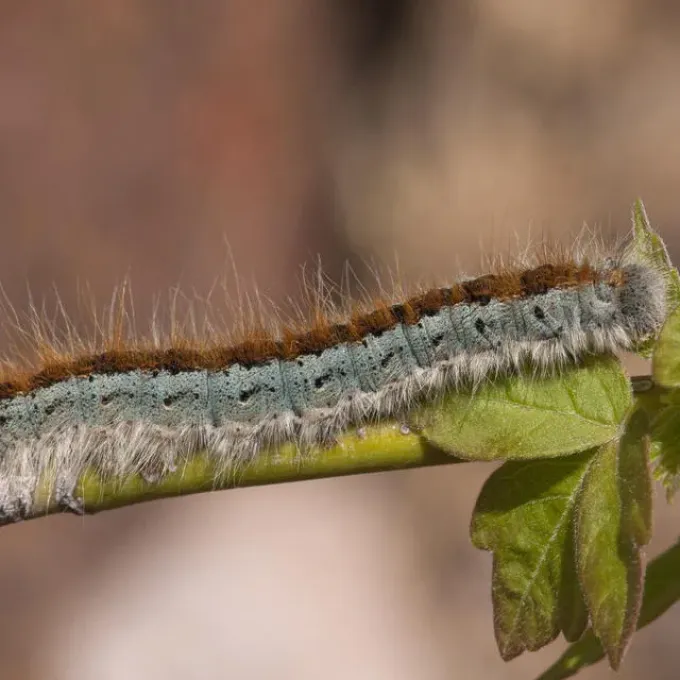
The bodies of the larvae are covered in thick setae, which act as a defense mechanism against predators and can be irritating to human skin upon direct contact.
Their coloration is typically vivid, featuring longitudinal stripes of blue, orange, and black, signaling to birds that they are unpalatable or toxic.
Females deposit eggs in distinctive masses that encircle thin twigs, forming a ring-like structure that helps protect the eggs throughout the dormant season.
What it damages
This pest primarily infests a variety of deciduous trees and shrubs, showing a particular preference for members of the Rosaceae family.
Major host plants include apple, cherry, and plum trees, as well as various ornamental species such as poplars and willows found in landscapes.
The larvae are voracious feeders and can cause severe defoliation, stripping a tree of its foliage in a relatively short period of time.
Extensive damage to the leaf canopy severely weakens the tree, resulting in reduced vigor, poor fruit quality, and increased susceptibility to diseases.
Repeated infestations over several seasons can eventually lead to the death of branches or, in severe cases, the entire host plant.
When it appears
Malacosoma incurvum typically completes one generation per year, overwintering in the egg stage in protective masses located on the twigs of host trees.
Larval emergence is highly synchronized with the spring budburst, ensuring that the young caterpillars have an immediate source of food.
The active feeding period for the caterpillars occurs throughout late spring and early summer, during which they grow rapidly through multiple instars.
Pupation takes place by mid-summer within durable silken cocoons, which are often hidden in folded leaves or crevices on the bark of the host tree.
Adult moths emerge in late summer to mate and lay eggs, completing the life cycle before the onset of the colder winter months.
Signs of infestation
The most prominent sign of infestation is the presence of large silken tent nests located at branch junctions, which become visible in early spring.
Accumulations of larval frass (droppings) on the leaves or the ground beneath the tree are strong indicators of an active feeding colony above.
Careful examination of the twigs during the winter or early spring reveals the characteristic ring-like egg masses encircling the branches.
Defoliated sections of the canopy or leaves that have been skeletonized are clear evidence of the caterpillars' feeding activities.
- Presence of silken tent nests in branch crotches.
- Large colonies of larvae actively feeding on foliage.
- Significant loss of leaf area or complete defoliation.
- Distinctive ring-shaped egg masses on twigs.
Control measures
Manual removal of silken nests during the early stages of infestation is a highly effective and eco-friendly way to manage populations.
Biological control using formulations of Bacillus thuringiensis is an excellent option for targeting young larvae while preserving beneficial insect populations.
Chemical intervention with systemic insecticides may be necessary in cases of severe outbreaks, provided they are applied during appropriate growth stages.
Encouraging natural predators, such as insectivorous birds and parasitic wasps, can significantly help to keep caterpillar numbers below economic thresholds.
Winter pruning of infested twigs containing egg masses is a preventative measure that reduces the initial population density for the following spring.
Taxonomy
- Latin name
- Malacosoma incurvum
- Order
- Lepidoptera (butterflies)
- Family
- Lasiocampidae
- EPPO code
- MALAAZ
Discussion
No discussions yet — be the first.