
Fragile Lappet Moth
Malacosoma fragilis
Description
How to identify
The Fragile Lappet Moth (Malacosoma fragilis) is a member of the Lasiocampidae family within the order Lepidoptera. This moth species is recognized for its distinct life cycle and its tendency to form colonial clusters during the larval stage.
Adult moths typically have a wingspan of 35–40 mm. Their coloration ranges from yellowish-brown to reddish-brown, with two darker, transverse lines crossing the forewings. Males are generally smaller and possess more prominent, feathery antennae compared to females.
Larvae, or caterpillars, are known for their striking appearance, often featuring longitudinal blue or orange stripes along their bodies, covered with fine, dense setae. This hair serves as a defense mechanism against certain predators.
The species completes one generation per year. Winter is spent in the egg stage, where the first-instar larvae remain dormant inside the protective, hardened egg mass, often arranged in ring-like formations around small twigs.
Larval emergence occurs in early spring, coinciding with bud break. The larvae are highly synchronized with the host plant's phenology, allowing them to capitalize on the emergence of tender foliage for rapid growth.
What it damages
This pest is a significant threat to various deciduous trees, particularly species such as aspen, poplar, and willow. In some regions, it may also impact orchard trees if they are planted in proximity to native host forests.
The primary form of damage is the widespread defoliation caused by the feeding larvae. Large colonies can strip a tree of its foliage entirely, forcing the tree to expend critical energy reserves to produce a second flush of leaves.
Such stress significantly hampers the growth rate of the host tree, reduces its vigor, and makes it highly susceptible to secondary attacks from wood-boring insects, which can lead to tree mortality after repeated infestations.
In ornamental settings, the presence of the moth's silken tent-like webs and larval excrement significantly degrades the aesthetic value of the trees, making them unsuitable for parks or urban landscapes.
Continuous defoliation over several consecutive years can lead to dieback of upper branches and structural weakness in the tree, posing a safety risk in high-traffic or residential areas.
Signs of infestation
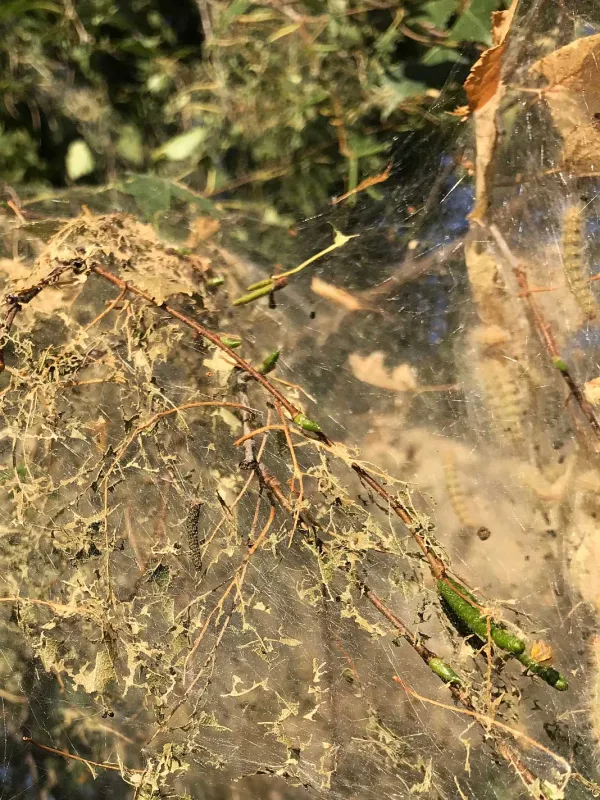
The most visible sign of an infestation is the presence of silken tent nests woven among the branches. These nests act as communal shelters for the larvae during the night or periods of inclement weather.
During the dormant season, the egg masses appear as thickened, grayish or brownish rings encircling twigs. Detecting these rings during winter pruning is the most effective way to prevent spring outbreaks.
As larvae grow, they begin skeletonizing the leaves, leaving behind only the veins. This creates a distinctive, ragged look to the canopy, which often appears sparse or withered even in mid-season.
The accumulation of frass (larval droppings) underneath the infested tree is a strong indicator of an active population. The quantity of frass is often proportional to the number of larvae feeding in the canopy.
In the final stages of the cycle, creamy-white or yellow cocoons become visible on leaves or within bark crevices. Finding these indicates that the larvae have completed their development and will soon emerge as adults.
Control measures
Mechanical control is highly effective for small-scale infestations. Winter pruning and removal of infested twigs containing egg rings, followed by the physical destruction of early spring tents, can prevent the need for chemical intervention.
Biological control using formulations of Bacillus thuringiensis (Bt) is a target-specific solution. This method effectively targets the larvae while remaining safe for beneficial pollinators and local wildlife.
Chemical applications using insecticides should be timed to match the early larval emergence. Systematic or contact insecticides can provide rapid relief if the colony density threatens the structural health of the tree.
Encouraging the presence of natural predators, such as insectivorous birds and parasitic wasps, plays a vital role in natural population suppression. Providing habitat for these species is a long-term management strategy.
- Scout for egg rings on twigs during winter dormancy.
- Remove and destroy silken larval tents early in the season.
- Apply biological insecticides when larvae are small and active.
Taxonomy
- Latin name
- Malacosoma fragilis
- Order
- Lepidoptera (butterflies)
- Family
- Lasiocampidae
- EPPO code
- MALAFR
Discussion
No discussions yet — be the first.