
Forest tent caterpillar
Malacosoma disstria
Description
How to identify
The Forest tent caterpillar (Malacosoma disstria) is a moth species belonging to the Lasiocampidae family. Despite its common name, it does not build typical silk tents, unlike its close relative, the Eastern tent caterpillar.
Adult moths are stout-bodied with a wingspan of approximately 40 mm, colored in shades of brownish-yellow with two dark lines across the forewings.
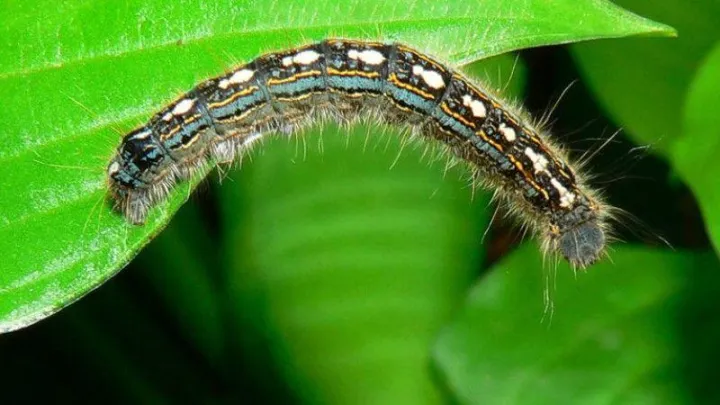
Larvae are easily distinguished by a row of keyhole-shaped white spots running down the center of their backs, set against a dark, hairy body that can reach 50 mm in length.
The life cycle consists of one generation per year. They overwinter as fully developed embryos within egg masses, which are glued around small twigs of host trees in a ring-like pattern.
Outbreaks of this species are cyclical and often depend on environmental factors, particularly the availability of host trees and favorable temperatures during the early spring development phase.
What it damages
This species is a major defoliator of hardwood trees. They feed collectively, which allows them to consume large amounts of foliage rapidly, especially in the early stages of larval development.
Primary hosts include aspen, sugar maple, oak, and ash, but they also frequently attack fruit-bearing trees such as apple, cherry, and plum, significantly impacting agricultural yield.
Heavy infestations can cause widespread defoliation, which stresses the trees and reduces their capacity to perform photosynthesis throughout the growing season.
Repeated defoliation over consecutive years leads to significant tree mortality, reduced growth increments, and increased susceptibility to secondary pests and various tree diseases.
- Aspen and Poplar
- Sugar Maple
- Oak species
- Fruit trees (Apple, Cherry)
Signs of infestation
Early spring activity is signaled by the emergence of tiny larvae from egg bands as soon as the buds of host trees begin to break and open.
A noticeable reduction in the canopy density is the primary sign of an ongoing infestation, as caterpillars consume almost all leaf tissue, leaving only the midribs.
Presence of abundant dark frass (droppings) on the ground or under the tree canopy is a clear indicator that the caterpillars are actively feeding in the upper branches.
During the winter, look for characteristic egg masses on the ends of small branches; these appear as hardened, brown, shellacked bands that encircle the twigs.
Adult moth activity during the mid-summer months, particularly near street lights or outdoor lighting, indicates that mating and egg-laying are taking place.
Control measures
The most effective mechanical control is to prune and destroy the egg bands during the dormant winter season, which significantly reduces the population for the coming spring.
Biological control methods, such as applying Bacillus thuringiensis (Bt), are highly effective when larvae are in their early instars and are safer for the surrounding environment.
Chemical control using insecticides should be considered only when the larval density is extremely high and threatens the health or survival of valuable or specimen trees.
Encouraging natural predators such as birds, parasitic wasps, and flies can help keep the population levels in check and prevent the cycle of mass outbreaks.
Integrated Pest Management (IPM) practices require monitoring tree health and environmental indicators to ensure that intervention occurs at the most vulnerable stage of the pest's life cycle.
Taxonomy
- Latin name
- Malacosoma disstria
- Order
- Lepidoptera (butterflies)
- Family
- Lasiocampidae
- EPPO code
- MALADI
Discussion
No discussions yet — be the first.