
Malacosoma constrictum
Malacosoma constrictum
Description
How to identify
Malacosoma constrictum, commonly known as the Pacific tent caterpillar, belongs to the Lasiocampidae family of moths. Adults are nocturnal insects characterized by yellowish-brown wings featuring two distinct dark, parallel lines running across the forewings.
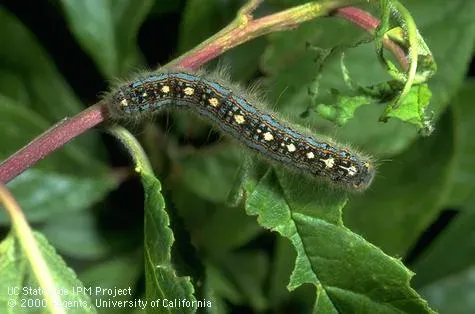
The larvae are easily identified by their striking pattern and dense covering of hairs. These setae are not only a physical defense mechanism but can also cause skin irritation upon contact with humans, requiring caution during handling.
This species is native to the western regions of North America. It is a specialist feeder, showing a distinct preference for various species of oaks, which dictates its presence in specific woodland and parkland habitats throughout its range.
The lifecycle follows a complete metamorphosis: egg, larva, pupa, and adult. The most critical period for plant health is the larval stage, during which the insect feeds voraciously on the foliage of host trees during the spring months.
Females deposit their eggs in firm, ring-like masses that encircle thin twigs. These egg masses are coated with a protective, hardening secretion that insulates the embryos against winter frosts and shields them from predators.
What it damages
The primary hosts for Malacosoma constrictum are various oak species, both deciduous and evergreen. In years of high population density, these caterpillars can cause extensive defoliation, significantly impacting forest health.
While oaks are the preferred host, larvae may also feed on neighboring deciduous trees and fruit orchards if host populations are dense. This transition can pose a threat to agricultural landscapes adjacent to infested woodland areas.
Young larvae emerge synchronously with the budding of host trees. By feeding on developing buds and tender leaves, they inflict maximum physiological stress on the tree just as it begins its most active growth phase of the year.
Massive defoliation impairs the tree's ability to photosynthesize, which in turn reduces energy reserves. Persistent infestations over multiple years can lead to stunted growth, branch dieback, and an increased susceptibility to secondary forest pathogens.
- Consumption of new buds and young foliage.
- Reduction in annual wood growth and vigor.
- Increased stress and vulnerability to wood-boring insects.
- Loss of aesthetic value in urban and residential landscapes.
When it appears
The biological activity of the Pacific tent caterpillar is highly seasonal. They overwinter in the egg stage, which remains dormant on the twigs of host trees throughout the cold months, waiting for spring temperatures to trigger development.
Egg hatch typically occurs in early to mid-spring, coinciding with the phenological timing of bud break in local oak species. This ensures that the newly emerged larvae have immediate access to high-quality, succulent forage.
Larval development proceeds through several instars over the course of a few months. During this time, they are gregarious, often moving together to find new feeding sites or to return to communal silk retreats within the tree canopy.
Pupation generally takes place in early summer. The caterpillars spin silk cocoons, often hidden within curled leaves or sheltered crevices in the bark, to undergo the final transformation into adult moths.
Adult emergence occurs in the mid to late summer. The adult moths are short-lived, with their sole biological imperative being to find mates and lay the next generation of eggs to secure the population for the coming winter.
Signs of infestation
The most reliable sign of an impending infestation is the presence of egg masses on tree twigs. These appear as small, dark, ring-like bands, often visible during the dormant winter season when trees are leafless.
Visible feeding damage is a clear indicator of active larvae. This often starts as minor leaf skeletonization but can quickly progress to complete defoliation of entire branches if the population density is high enough.
The presence of larval excrement, appearing as small, dark pellets accumulating on leaves below or on the ground, signifies an active feeding site above. This is often one of the first signs noticed by attentive observers.
Communal silk tents or webs are characteristic signs of this species. Although they may be less prominent than those of related tent caterpillars, these structures serve as shelters and are usually found near branch forks.
Direct sightings of the larvae themselves, which may be found aggregating on branches or descending from the canopy on silk threads during windy days, are clear indicators that the infestation is established.
Control measures
Mechanical control is highly effective if carried out during the dormant season. Pruning and destroying infested twigs containing egg masses can significantly reduce the potential caterpillar population for the following spring.
In residential settings, small populations of larvae can be managed by hand-picking or brushing off the nests. Always use protective gloves, as the caterpillar hairs can cause significant dermatitis upon contact.
Biological controls, specifically products containing Bacillus thuringiensis (Bt), are highly effective against early-instar larvae. This method is environmentally friendly and preserves the population of beneficial predatory insects.
Chemical intervention with contact insecticides should be reserved for severe outbreaks where there is a tangible threat to the long-term survival of high-value trees or forested areas, following all local safety guidelines.
Promoting overall tree health through adequate irrigation and nutrient management ensures that trees have sufficient vigor to tolerate and recover from moderate defoliation, mitigating the long-term impacts of the pest.
Taxonomy
- Latin name
- Malacosoma constrictum
- Order
- Lepidoptera (butterflies)
- Family
- Lasiocampidae
- EPPO code
- MALACO
Discussion
No discussions yet — be the first.