
Ground Lackey
Malacosoma castrense
Description
How to identify
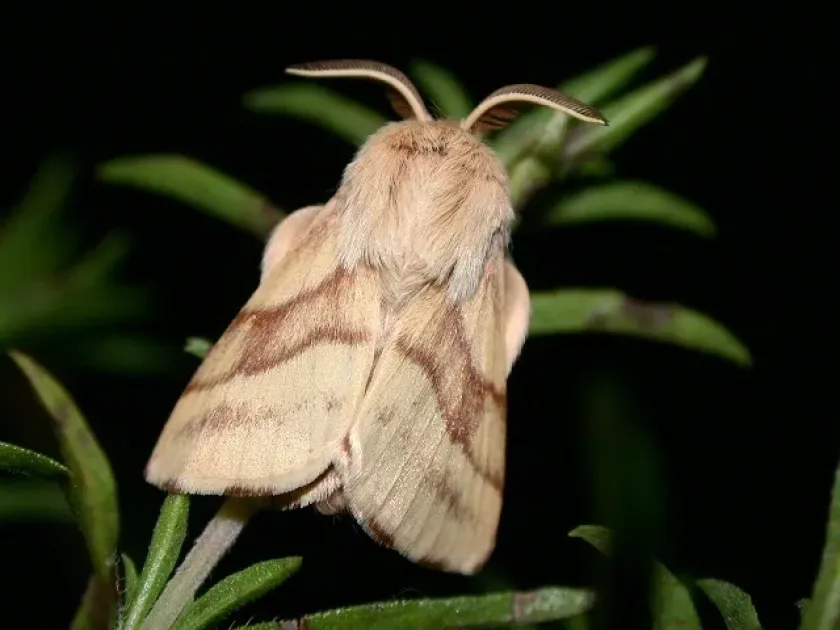
The Ground Lackey (Malacosoma castrense) belongs to the Lasiocampidae family, order Lepidoptera. The adult moth has a wingspan ranging from 30 to 45 mm, with coloration varying from light yellow to reddish-brown, featuring a darker cross-stripe on the forewings.
The larvae are highly distinctive, featuring vibrant longitudinal stripes in blue, red, and yellow, and are covered with dense hairs that serve as a defense mechanism against avian predators.
This species is known for its gregarious nature. In the early stages of their development, the caterpillars construct communal silk webs (tents) where they rest during the day or during unfavorable weather conditions.
The biology of this pest is adapted to dry and sunny habitats. Females deposit eggs in compact, cylindrical clusters, typically attached to the stems of herbaceous plants or the twigs of shrubs.
The life cycle consists of one generation per year. The species overwinters as first-instar larvae, which hatch from eggs in autumn and remain in a state of diapause until spring temperatures allow them to resume feeding.
What it damages
The larvae are generalist feeders (polyphagous), meaning they consume a wide range of plant species from various families, including Rosaceae and Fabaceae, leading to significant foliage loss.
In orchards, they frequently attack apple, pear, cherry, and plum trees. They consume the leaf blades until only the primary veins remain, which is a process known as skeletonization.
Beyond fruit trees, the Ground Lackey often attacks herbaceous plants like spurge and wormwood, but during periods of high population density, they readily migrate to agricultural crops.
Heavy infestation reduces the plant's photosynthetic capacity, which adversely affects the formation of fruit buds and the overall health and vigor of perennial trees and shrubs.
For young saplings, large caterpillar colonies can cause premature leaf drop, which weakens the plant's immune system and makes it more susceptible to frost and secondary diseases during the following winter.
When it appears
The active developmental phase of the larvae occurs during the spring and early summer. Upon emerging from hibernation in April and May, they begin intense feeding on opening buds and young leaves.
Pupation occurs in early summer, typically in June. The caterpillars spin dense, silken cocoons within which they transform into pupae and eventually emerge as adult moths.
The flight period of the adult moths takes place in mid-summer, usually during July or August. During this window, mating occurs, and females lay eggs for the next generation.
In autumn, the newly hatched larvae feed briefly before securing themselves to host plants or structures to begin their winter dormancy phase.
Therefore, the primary window of threat for orchard owners is between April and June, when the larvae are at their most active and destructive stage of growth.
Signs of infestation
The most visible indicator of an infestation is the presence of silk webs on branches or stems. These nests serve as shelters for the colonies and are often quite noticeable.
Skeletonized leaves, where only the leaf structure remains, serve as clear evidence of the caterpillars' feeding activity. Damage often starts at the leaf margins and progresses inward.
Large clusters of colorful, hairy caterpillars congregating on foliage or branches during the day are highly visible, as they often bask in the sun when not feeding.
The presence of frass (caterpillar excrement) appearing as small, dark, granular pellets beneath the tree canopy is a reliable indicator of a significant infestation above.
Finding firm, yellowish-white cocoons attached to twigs or within folded leaves in June confirms the completion of the pupation cycle and the presence of a established population.
Control measures
Mechanical removal is the most efficient control method for small gardens. Infested branches with silk nests should be pruned and destroyed to prevent the larvae from spreading further.
The use of biological agents, such as formulations of Bacillus thuringiensis, provides a safe and selective control method that effectively targets the larvae while sparing beneficial insects.
Chemical insecticides should be reserved for severe outbreaks where there is a risk of substantial crop loss or damage to young trees, always following local application guidelines.
- Regular spring inspection of foliage and branches.
- Manual removal of egg clusters in the late autumn.
- Encouraging natural predators such as birds and parasitoid wasps.
- Weeding areas near the orchard to remove alternative host plants.
Maintaining good orchard hygiene, including soil cultivation in the root zones and cleaning tree trunks, helps disrupt the life cycle and reduces the number of successful overwintering sites.
Taxonomy
- Latin name
- Malacosoma castrense
- Order
- Lepidoptera (butterflies)
- Family
- Lasiocampidae
- EPPO code
- MALACS
Discussion
No discussions yet — be the first.