
California tent caterpillar
Malacosoma californicum
Description
How to identify
The California tent caterpillar (Malacosoma californicum) is a moth species belonging to the family Lasiocampidae, widely recognized as a forest and orchard pest.
Adult moths typically have a wingspan ranging from 25 to 45 mm, with coloration varying from pale yellow to reddish-brown, often featuring light, transverse bands on the wings.
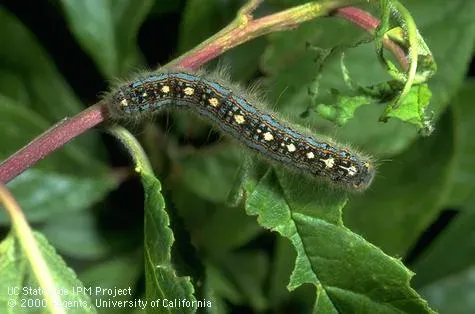
The larvae, or caterpillars, are known for their distinct appearance, often displaying a mix of blue, orange, and white patterns, and are covered with fine, irritating hairs.
The life cycle undergoes complete metamorphosis, passing through the egg, larval, pupal, and adult stages, with eggs serving as the overwintering life stage.
Female moths lay eggs in ring-like masses around small twigs, cementing them with a protective, frothy secretion that hardens to withstand environmental extremes.
What it damages
This pest affects a wide range of deciduous trees and shrubs, including commercially important fruit trees such as apple, cherry, and plum.
In woodland and landscape settings, the caterpillar frequently feeds on aspen, willow, poplar, and oak species, causing significant aesthetic and biological damage.
Caterpillars feed gregariously, initially skeletonizing leaves and eventually consuming entire leaves, which leads to severe canopy thinning.
Heavy infestations can lead to complete defoliation, forcing the tree to expend stored energy reserves to produce new leaves, which weakens the plant's overall health.
Persistent attacks over several years can result in branch dieback, increased susceptibility to secondary pests and pathogens, and potentially the death of the tree.
When it appears
The eggs overwinter on host plant twigs and hatch in the spring, coinciding with the timing of host bud burst to ensure immediate food availability.
Larval development proceeds through several stages, with the most intense feeding period occurring from late spring to early summer as temperatures rise.
Pupation occurs in early summer, where caterpillars spin silk cocoons either on leaves or in crevices of the tree bark to undergo transformation.
Adult moths emerge in mid-to-late summer, engaging in mating flights and egg-laying activities before completing their lifecycle.
The duration of each developmental stage is highly dependent on local weather conditions, particularly spring temperatures, which can accelerate or delay the emergence of larvae.
Signs of infestation
The most iconic sign of an infestation is the presence of silk tents or webs constructed by the caterpillars in the crotches of tree branches.
Accumulation of frass, which appears as small dark pellets on the ground or foliage beneath the infested areas, is a clear indicator of heavy feeding activity.
Egg masses can be spotted during the dormant season as dark, slightly shiny, band-like structures surrounding small twigs, providing an opportunity for early intervention.
Visual thinning of the tree canopy and a lack of foliage in the upper branches are symptoms that suggest advanced caterpillar development.
Nighttime observation of adult moths attracted to porch lights or other artificial illumination sources can provide an early warning of population trends for the following year.
Control measures
Mechanical control includes the removal and destruction of egg masses by pruning infested twigs during the dormant winter season.
For small infestations, manually removing and destroying silk tents when caterpillars are resting inside during the early morning is an effective non-chemical approach.
Biological insecticides, specifically those utilizing the bacterium Bacillus thuringiensis, are highly effective against young larvae and have minimal impact on non-target species.
Chemical control with registered insecticides should be timed to target early larval stages when the caterpillars are most vulnerable to treatment.
Promoting a healthy environment for natural predators, such as parasitic wasps, predatory bugs, and insectivorous birds, is a vital part of long-term integrated pest management.
Taxonomy
- Latin name
- Malacosoma californicum
- Order
- Lepidoptera (butterflies)
- Family
- Lasiocampidae
- EPPO code
- MALACL
Discussion
No discussions yet — be the first.