
Eastern tent caterpillar
Malacosoma americanum
Description
How to identify
The eastern tent caterpillar (Malacosoma americanum) is a moth species belonging to the Lasiocampidae family. Adult moths are reddish-brown with two distinct pale stripes running diagonally across their forewings.
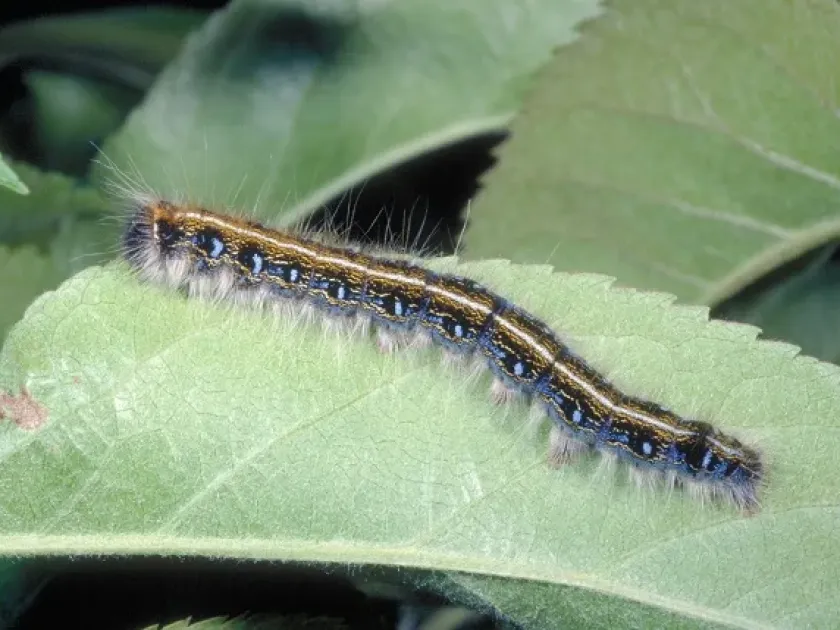
The larvae, or caterpillars, are easily identified by their black bodies featuring a continuous white stripe down the center of the back, flanked by blue and black markings on each segment.
Egg masses are deposited on small branches and appear as thickened, varnished, or glossy brown bands that encircle the twig, acting as protective shells against environmental factors.
Mature caterpillars reach lengths of approximately 50 to 65 millimeters, covered in sparse, fine hairs that grow longer along the sides of their bodies as they reach their final instar.
Cocoons are spun from white silk, often yellowish from the larval excrement, and are usually hidden within folded leaves, bark crevices, or protected areas in the lower branches.
What it damages
This pest prefers trees in the Rosaceae family, specifically wild cherry, apple, crabapple, and plum trees, but may also attack hawthorn, peach, and various ornamental trees.
Feeding larvae skeletonize the foliage, consuming the soft tissues between veins. During heavy infestations, they can strip a tree completely bare, causing significant stress to the plant.
Defoliation reduces the tree's ability to undergo photosynthesis, which is critical for storing energy reserves needed for healthy growth and winter survival.
While established, mature trees can usually recover from a single season of defoliation, repeated infestations lead to branch dieback, stunted growth, and increased susceptibility to diseases.
In nursery settings or young orchards, severe defoliation may kill saplings or permanently compromise their structural integrity, necessitating early intervention strategies.
When it appears
The life cycle is tightly synchronized with spring; eggs hatch in early spring precisely when the host trees begin to break bud and produce fresh, tender leaves.
Larvae are social insects, living in colonies within communal silken tents. These structures are built in the crotches of branches and are enlarged as the caterpillars grow.
Feeding occurs primarily at night or during the cooler parts of the day, with the caterpillars returning to their protective tent during periods of rest or inclement weather.
By late spring or early summer, the larvae finish their development, wander away from their nesting sites, and seek protected locations to spin cocoons and pupate.
Adult moths emerge in mid-summer, mate, and deposit their eggs on twigs, where they remain in a state of diapause throughout the fall and winter until the following spring.
Signs of infestation
The most diagnostic sign is the presence of large, white silken tents formed at the junction of branches, which become increasingly conspicuous as the season progresses.
Extensive stripping of leaves from branches, leaving behind only the stems and midribs, provides clear evidence of a localized caterpillar colony feeding actively in the area.
During the dormant season, the shiny, collar-like egg masses are readily visible on thin twigs, serving as the primary target for preventative removal during winter pruning.
The accumulation of granular dark frass (excrement) beneath the tent area often draws attention to the presence of the pest long before the defoliation becomes extreme.
Active movement of caterpillars along trunks or branches, especially in the late larval stages, indicates they are searching for pupation sites and preparing to complete their cycle.
Control measures
Mechanical removal of the tents by hand during the early morning or late evening, when caterpillars are clustered inside, is highly effective for small, accessible infestations.
Winter pruning is a crucial management step; simply clipping off and destroying twigs that harbor egg masses effectively prevents the next generation from emerging.
For larger infestations, microbial insecticides such as Bacillus thuringiensis (Bt) are highly specific and effective, targeting young larvae while preserving the beneficial insect population.
Chemical control using systemic or contact insecticides can be employed if infestations are severe, but should be timed carefully to reach the larvae while they are most vulnerable.
Encouraging natural predators such as birds, parasitic wasps, and predaceous beetles helps maintain a biological balance and suppresses the overall population density of the pest.
Taxonomy
- Latin name
- Malacosoma americanum
- Order
- Lepidoptera (butterflies)
- Family
- Lasiocampidae
- EPPO code
- MALAAM
Discussion
No discussions yet — be the first.