
Tent caterpillars
Malacosoma
Description
How to identify
The genus tent caterpillars (Malacosoma) belongs to the family Lasiocampidae in the order Lepidoptera. Adult moths are characterized by stout, hairy bodies and wingspans ranging from 30 to 45 mm, typically displaying shades of brown and tan.
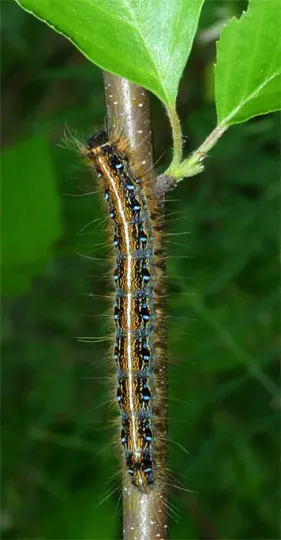
The larvae, or caterpillars, are known for their distinct appearance, often featuring colorful stripes and fine hairs. They are social insects that live in communal colonies, which is a key trait used for their identification in garden environments.
The life cycle is univoltine, meaning there is one generation per year. They overwinter as fully developed embryos within egg masses, which are laid in rings around small twigs, often appearing as shiny or dark brownish bands cemented to the bark.
In spring, larvae hatch in coordination with bud break. They remain together throughout their early developmental stages, expanding their communal web or "tent" as they grow and forage for fresh leaf tissue on the host tree.
Pupation occurs in late spring or early summer, inside tough, silken cocoons often spun within leaves or in bark crevices. The adult moths emerge in mid-summer, mate, and deposit their eggs for the following season.
What it damages
Tent caterpillars are significant pests of ornamental and fruit-bearing trees. Their preferred hosts include various species of apple, cherry, plum, pear, and peach, as well as several species of wild deciduous trees and shrubs.
Signs of infestation
The most visible sign of an infestation is the presence of large, silk-spun tents located in the crotches of tree branches. These structures provide protection for the colony and are sites of accumulated frass and debris.
Early signs include the skeletonization of leaves, followed by rapid defoliation as the larvae mature. Heavy infestations can strip a tree completely bare, leaving it vulnerable to secondary infections and reducing its overall vigor.
Control measures
Pruning out and destroying egg masses during the winter dormancy period is the most effective mechanical control measure. Additionally, tents can be physically removed or destroyed early in the season while the larvae are still concentrated.
Chemical control using insecticides should be timed for the early larval stages when they are most susceptible. Biological controls, such as applications of Bacillus thuringiensis, offer an eco-friendly alternative for managing populations without harming beneficial pollinators.
Taxonomy
- Latin name
- Malacosoma
- Order
- Lepidoptera (butterflies)
- Family
- Lasiocampidae
- EPPO code
- MALASP
Discussion
No discussions yet — be the first.