
Macrotermes gilvus
Macrotermes gilvus
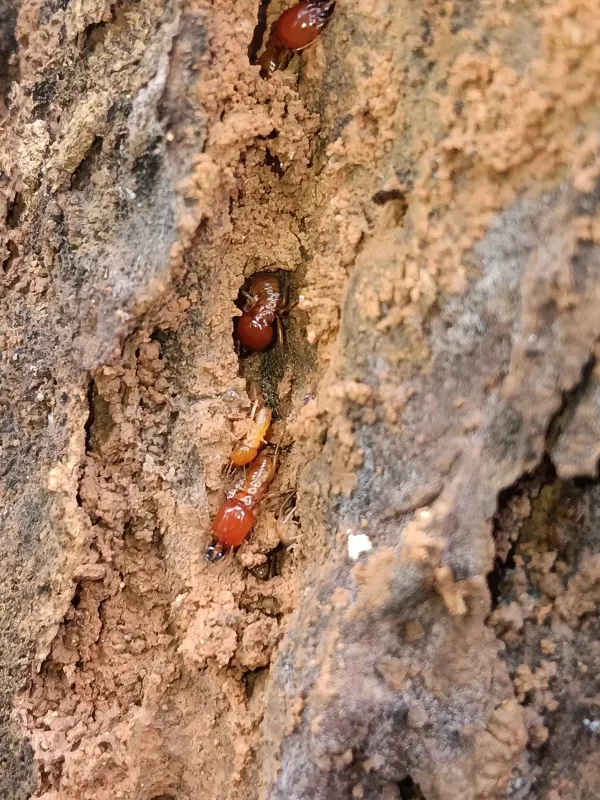
Description
How to identify
Macrotermes gilvus belongs to the order Isoptera and the family Termitidae. It is a highly social termite species, commonly found throughout the tropical regions of Southeast Asia.
The colony structure is strictly organized into castes: workers, soldiers, and reproductives. Each caste serves a distinct purpose, from foraging for food to defending the colony against predators.
Soldiers are identifiable by their brown, sclerotized heads and strong, menacing mandibles, which are used to protect the workers and the integrity of the nest.
This species builds large, visible mounds that act as sophisticated climate-controlled systems, allowing them to maintain the specific moisture and temperature levels needed for their fungus gardens.
New colonies are established through swarming events, where alates (winged termites) disperse after the start of the rainy season to find suitable nesting sites.
What it damages
This termite species is a significant pest for various crops, including oil palm, coffee, cocoa, sugarcane, rubber trees, and numerous fruit-bearing orchard trees.
The damage often starts below the ground as termites feed on the root systems, which impairs the plant's ability to absorb water and nutrients, eventually causing wilting and death.
In addition to living crops, they are notorious for destroying wood-based infrastructure, fences, and storage facilities located near agricultural fields.
In newly planted fields, they can cause substantial economic losses by killing off young seedlings before they are able to establish a deep root system.
They are particularly destructive during dry spells when natural deadwood and humus are scarce, forcing the colony to turn to the succulent tissues of living plants.
Signs of infestation
The most common sign of infestation is the presence of clay-like foraging tunnels, or galleries, on the trunks of trees or stems of crops, which protect the termites from dry air and predators.
Premature yellowing of leaves and sudden wilting of otherwise healthy-looking plants often indicate severe root damage caused by termites.
Surface excavations near the base of the plant often reveal termite activity and the characteristic soil-based mixtures used to reinforce their tunnels.
The discovery of termite mounds or soil heaps near the base of trees or bushes is a clear indicator that a mature colony is operating in the vicinity.
The emergence of large swarms of winged termites during the start of the rainy season is a vital warning sign that potential new colonies are forming nearby.
Control measures
Biological control methods, such as the use of the entomopathogenic fungus Metarhizium anisopliae, have proven effective in reducing colony populations without excessive chemical use.
Chemical control involving soil drenching with systemic insecticides like fipronil can provide a long-lasting protective barrier around the root zone of vulnerable crops.
Good agricultural practices, such as the removal of stumps, dead trees, and organic debris, reduce the primary food sources that support the initial growth of a termite colony.
Regular soil tillage can disrupt the subterranean tunnels of foraging workers, forcing them to relocate or inhibiting their feeding efficiency.
- Monitoring fields with bait stations to identify peak termite activity.
- Using slow-acting toxic baits that can be carried back to the mound to kill the queen.
- Applying physical barriers like sand or gravel around seedling bases.
Taxonomy
- Latin name
- Macrotermes gilvus
- Family
- Termitidae
- EPPO code
- MACMGI
Discussion
No discussions yet — be the first.