

Description
How to identify
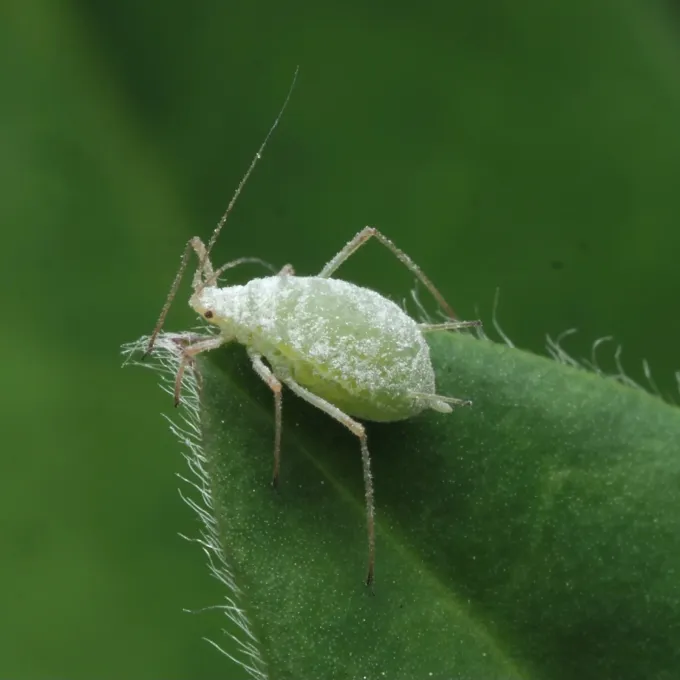
The lupine aphid (Macrosiphum albifrons) is a member of the order Hemiptera, family Aphididae. It is a relatively large aphid, with adults measuring between 3 to 4 mm in length.
A distinctive feature of this species is the heavy waxy secretion covering its body, which gives the insect a whitish, bluish, or grayish appearance. This specific trait is reflected in its scientific name, albifrons.
The aphid's body is elongated and equipped with long antennae and well-developed dark siphunculi. Colonies consist of both apterous (wingless) and alate (winged) individuals, allowing for local growth and rapid dispersal.
The life cycle involves an alternation of sexual and asexual reproduction. In many regions, this species is monoecious, overwintering primarily as eggs on perennial lupine species.
Due to their high reproductive potential, these aphids can quickly colonize large parts of host plants, covering stems and flower buds with dense populations.
What it damages
The primary hosts for Macrosiphum albifrons are various species of Lupinus, including both agricultural varieties and wild-growing species found in meadows and gardens.
The aphid feeds by sucking sap from tender plant tissues, which causes severe stress to the plant. Infestations are particularly damaging during the budding and flowering stages of the crop.
Beyond direct damage, the lupine aphid acts as a vector for various plant viruses, which can lead to systemic disease and complete crop failure in commercial lupine fields.
In ornamental settings, heavy infestation leads to disfigured flowers and stunted growth, effectively destroying the aesthetic value of the plants.
Prolonged feeding by the colony leads to yellowing (chlorosis) of the leaves and premature wilting, significantly reducing both biomass and seed yield in agricultural production.
When it appears
The active season begins in early spring when larvae emerge from overwintering eggs as soon as the host plants start their growth phase. These initial generations are parthenogenetic.
Population peaks typically occur in late spring and early summer when environmental conditions are optimal for rapid colony expansion. High temperatures can sometimes cause a temporary decline in activity.
Several generations are produced throughout the growing season. As the colony reaches high density, winged forms are produced to migrate to new host plants.
By autumn, as temperatures drop and day length decreases, sexual reproduction is triggered. Mated females then lay eggs, which serve as the overwintering stage.
The ability of the eggs to withstand winter temperatures ensures the survival of the species and the initiation of the next seasonal cycle as soon as conditions improve.
Signs of infestation
The earliest sign of infestation is the presence of pale, bluish-white clusters of aphids covering the tops of stems and the flower buds of lupine plants.
Typical symptoms include distorted, curled leaves and stunted growth of the main shoot. Infected buds often dry up and fall off before they have a chance to bloom.
Infested plants are often coated with honeydew—a sticky, sugary substance secreted by the aphids. This provides a substrate for sooty mold, which appears as a black, velvety layer on the leaves.
General plant decline, including yellowing or whitening of the leaves, is a common indicator of high aphid numbers and heavy sap extraction.
Monitoring the undersides of leaves and the flower spikes is essential for early detection, as the colonies initially hide in sheltered parts of the plant canopy.
Control measures
Cultural control includes crop rotation and the removal of wild lupine stands near fields, as these often serve as reservoirs for the pest during the off-season.
In cases of severe infestation, systemic insecticides are the most effective management tool. Products containing active ingredients like imidacloprid or deltamethrin are commonly used.
Integrated Pest Management (IPM) encourages the preservation of natural predators, such as ladybird beetles, lacewings, and hoverflies, which can significantly reduce aphid numbers.
Regular field scouting is critical. Early detection during the pre-flowering stage allows for localized treatments, which are more cost-effective and environmentally friendly than broad-spectrum spraying.
Monitoring for the presence of honeydew and sooty mold can help identify infested areas before the aphid populations reach levels that cause irreversible yield loss.
Reference
Connections · Lupine aphid
Most often together:
Marketplace
Products · 2

Biology
Taxonomy
- Latin name
- Macrosiphum albifrons
- Order
- Hemiptera (bugs, aphids, leafhoppers)
- Family
- Aphididae
- EPPO code
- MACSAL
Community
Discussion
No discussions yet — be the first.