
Japanese maple scale
Lopholeucaspis japonica
Description
How to identify
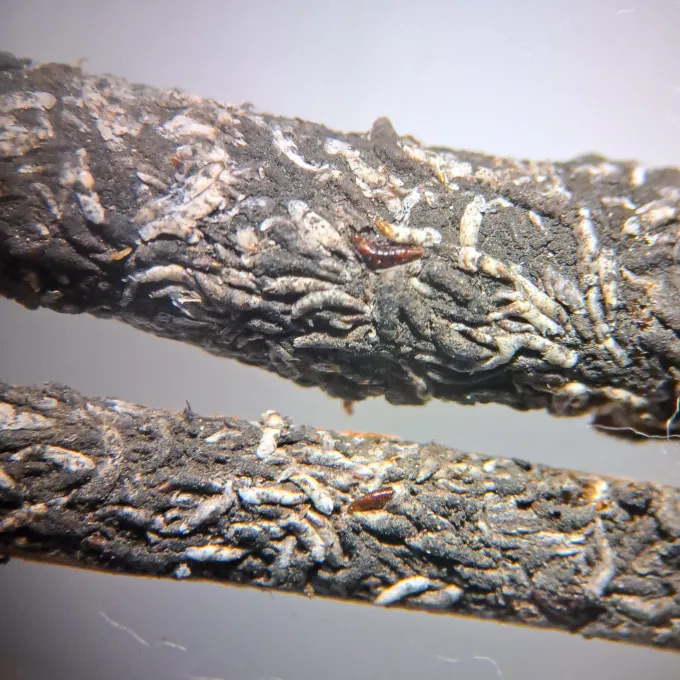
The Japanese maple scale (Lopholeucaspis japonica) belongs to the Diaspididae family. It is a small insect, where adult females are protected by an elongated, dense, dark brown or grayish shield, resembling a miniature stick or oyster shell in shape.
Males of this species are rarely encountered and are distinguished by their wings and a significantly shorter life cycle. Females are sedentary, attaching themselves firmly to the bark of plants, which makes them quite difficult to detect at first glance.
Using a magnifying glass is essential for accurate identification in the field, as colonies often blend in with the color of the bark. Fertilized females overwinter directly under their scales, remaining viable even in low temperatures.
The crawlers, which are the larval stage, have an oval shape and a light yellow color. They are mobile for only a short period after emerging from eggs, allowing them to disperse throughout the tree crown and move to neighboring plants.
The biology of this pest is closely tied to perennial woody plants. In temperate climates, the species is capable of producing one or two generations per year, depending on the regional temperature regime.
What it damages
This pest is polyphagous and infests a wide range of ornamental and fruit crops. Apple, pear, plum, and cherry trees are particularly susceptible, as are ornamental species like maples, lilacs, and horse chestnuts.
The pest attacks the bark of trunks and scaffold branches, forming dense layers. In cases of mass infestation, the scale covers the shoots with a continuous layer, leading to significant weakening of the plant and slowing down its growth.
By feeding on plant sap, the scale causes tissue necrosis in the bark. This disrupts normal nutrient flow, ultimately causing premature leaf drop and the dieback of individual branches, sometimes even leading to the death of the entire tree.
Weakened specimens become highly vulnerable to secondary infections, such as fungal diseases and bacterial bark cankers. Population outbreaks of the scale are particularly dangerous for young orchards.
The damage manifests not only in the direct exhaustion of the plant but also in the loss of aesthetic value for ornamental plantings. The bark in areas of heavy infestation cracks and loses its protective function, paving the way for pathogens.
When it appears
The active phase of crawler emergence usually coincides with the flowering period of fruit trees or shortly thereafter. This is the moment when the pest is most vulnerable to chemical treatments.
Generation development is often stretched over time due to varying maturation rates within the population. Summer is characterized by active feeding by females and egg-laying under the protective scale.
In autumn, population growth slows down as insects prepare for winter. During the winter, the pest remains in a state of diapause, residing under dense scales on the bark until the arrival of spring warmth.
For population monitoring, agronomists use visual branch inspection during the winter or pheromone traps during the peak activity period of the crawlers.
Weather conditions significantly affect female fertility; hot and dry summers promote faster development cycles and increase the damaging potential of the population in the following season.
Signs of infestation
The first sign of infestation is the presence of characteristic "sticks" or "growths" on the bark. In cases of severe infestation, the bark appears rough, and rubbing it with a finger leaves dark streaks behind.
The presence of the scale is indicated by chlorosis of the leaves, which is often confused with nutrient deficiencies. Leaves become smaller, lose their natural luster and color, and shoot growth is significantly stunted.
In areas of the bark where the colony is densest, one can observe cracks and the peeling of the outer cork layer. These areas become high-risk zones for winter frost penetration.
In late stages of infestation, dieback of branch tips (terminal dieback) is observed, which progresses from the periphery of the crown toward the trunk base.
In gardens with high scale populations, one can often notice increased ant activity, as they feed on the honeydew produced by associated pests, although the scale itself produces less honeydew compared to aphids.
Control measures
Effective management relies on a combination of cultural and chemical measures. An important step is the spring pruning of infested branches, which must be burned immediately to reduce the inoculum level.
Chemical control includes the application of systemic insecticides during the crawler emergence period. Preparations based on organophosphates or neonicotinoids show high efficacy if applied at the correct time.
For winter or early spring treatments before bud break, paraffin-based oil sprays are used. These create an airtight film on the scale surface, leading to the suffocation of the insects.
Biological control involves conserving natural enemies, such as ladybird beetles and parasitic wasps, which can significantly suppress scale population growth.
Regular monitoring and good horticultural practices aimed at maintaining overall tree health are key to long-term protection against this pest.
Taxonomy
- Latin name
- Lopholeucaspis japonica
- Order
- Hemiptera (bugs, aphids, leafhoppers)
- Family
- Diaspididae
- EPPO code
- LOPLJA
Discussion
No discussions yet — be the first.