
Brown locust
Locustana pardalina
Description
How to identify
The brown locust (Locustana pardalina) is a significant pest belonging to the Acrididae family. It is notorious for its phase polyphenism, meaning it can transition from solitary to gregarious behavior depending on population density.
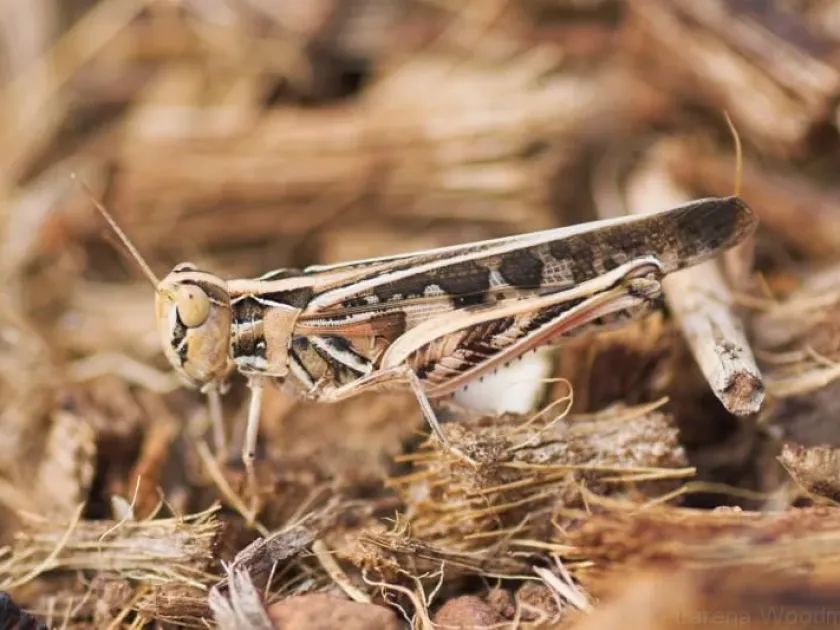
Adult locusts are typically brown to yellowish-brown in color, often featuring darker markings on their wings. Their robust physical structure and strong wings enable them to travel hundreds of kilometers in search of food.
The life cycle involves egg, nymph (hopper), and adult stages. In the gregarious phase, nymphs form dense bands, while adults congregate into massive swarms that pose a severe threat to agricultural regions.
Identification in the field often relies on observing the density of the insects; solitary individuals are rarely a problem, but the sudden appearance of high numbers of hoppers is a warning sign of an impending outbreak.
This species is well-adapted to the semi-arid environments of Southern Africa, where it maintains its populations in specific outbreak areas before migrating to cultivated lands.
What it damages
The brown locust is a highly polyphagous pest that consumes almost any green plant tissue. Its primary victims are cereal crops such as wheat, maize, and sorghum, which are essential for food security.
In addition to crops, swarms devastate rangelands and natural pastures, leading to severe fodder shortages. This loss forces livestock producers to cull herds or purchase expensive supplementary feed.
The feeding habit of the locust is destructive: it strips the leaves, stems, and grains, often consuming the entire plant down to the soil surface, leaving no residual value for the farm.
Because swarms are mobile, a single group of locusts can devastate multiple fields in a short timeframe, making it difficult for individual farmers to protect their lands without coordinated efforts.
The indirect damage includes the potential transmission of pathogens through waste and the stress caused to surviving plants, which may fail to produce any viable seed after such a severe defoliation event.
When it appears
The development and activity of the brown locust are driven by moisture and temperature. Eggs remain dormant in the soil during dry periods and hatch rapidly following sufficient rainfall.
Outbreaks are most common during the summer months when environmental conditions favor both rapid growth of the locust population and the availability of vegetation to sustain the swarms.
The generation time is relatively short, allowing for multiple overlapping cycles within a single season if the climatic conditions remain conducive, leading to an exponential increase in pest numbers.
Locust swarms are highly dependent on wind patterns for migration, which often dictates the timing and direction of their arrival in agricultural areas after a population buildup.
Winter survival is primarily achieved through egg pods protected within the soil. These pods can endure long periods of desiccation, ensuring the pest persists through seasons of low rainfall.
Signs of infestation
The earliest signs of an infestation include the presence of numerous small hoppers in grasslands or along field borders. These bands often move in a synchronized manner, creating visible gaps in vegetation.
A loud, distinctive humming or buzzing sound, combined with the darkening of the sky as a swarm passes, is a definitive indicator of a large-scale adult migration taking place.
Crop damage signs include irregular, skeletonized leaves and completely severed stems. The rapid disappearance of foliage from a field overnight is a classic hallmark of locust activity.
Increased activity of birds, such as storks or kites that prey on locusts, serves as a visual indicator of an underlying infestation that may not yet be obvious to human observers.
Field scouting for egg-laying sites in the soil after a swarm has passed is crucial, as identifying these areas allows for preventive action before the next generation of hoppers emerges.
Control measures
Control of the brown locust requires a proactive, strategic approach involving state monitoring and localized chemical intervention. Early detection is the most cost-effective method of prevention.
Chemical control involving approved insecticides is the primary tool for mitigating large swarms. Targeted application on hoppers before they reach the adult flying stage is highly effective.
Cultural methods, such as deep tillage or plowing, can destroy egg pods embedded in the soil, effectively reducing the population potential for the upcoming season in known outbreak areas.
Biological control using specific entomopathogenic fungi is increasingly being integrated into management programs as an environmentally sustainable way to manage population spikes.
- Regular monitoring of outbreak-prone areas
- Barrier spraying along the perimeter of fields
- Aerial application of insecticides for large swarms
- Coordination between neighboring farms and state authorities
Taxonomy
- Latin name
- Locustana pardalina
- Order
- Orthoptera (locusts)
- Family
- Acrididae
- EPPO code
- LOCUPA
Discussion
No discussions yet — be the first.