
Migratory locust
Locusta migratoria
Description
How to identify
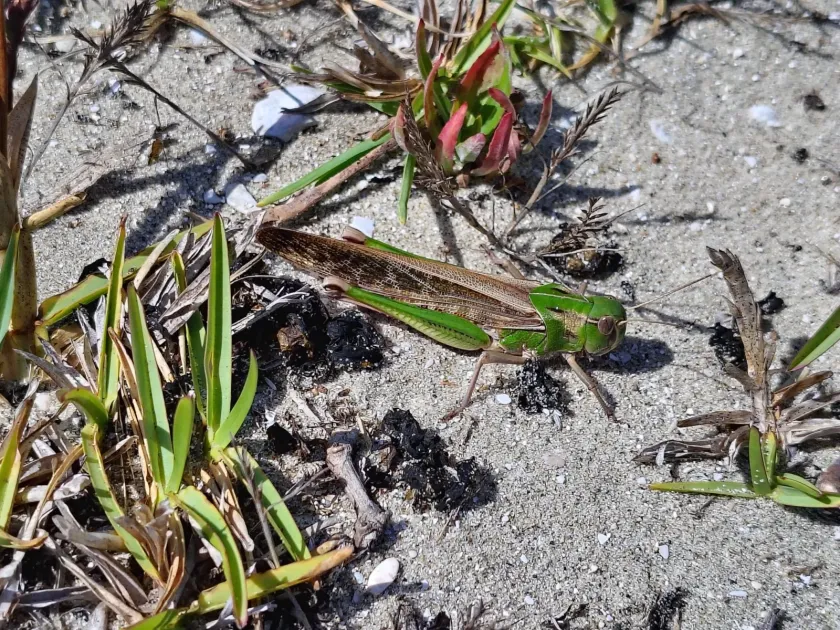
The migratory locust (Locusta migratoria) belongs to the order Orthoptera and the family Acrididae. It is a large insect with adults measuring between 60 and 80 mm.
Phenotypic plasticity is key; the solitary phase is lighter in color, whereas the gregarious phase exhibits a darker, high-contrast appearance with elongated wings for migration.
Nymphs undergo five instars, progressively increasing in size and developing wing pads. During these stages, they are highly mobile and tend to form dense groups.
Adults feature powerful hind legs for jumping and robust, chewing mouthparts capable of consuming significant amounts of plant biomass in a short period.
The coloration of adults ranges from greenish-yellow to grey-brown, providing camouflage in various habitats until the swarm behavior is fully triggered.
What it damages
The migratory locust is a severe polyphagous pest capable of consuming almost any green plant tissue, posing a major threat to global food security.
Cereal crops, including wheat, barley, and rye, are highly susceptible to infestation, often leading to total crop loss when swarms descend on a field.
Maize, millet, and sorghum are also frequently targeted, with locusts defoliating the plants and damaging stalks, effectively killing the crop prematurely.
Pasture lands and forage crops suffer immensely, which directly impacts livestock production by destroying essential food sources for cattle and sheep.
Industrial crops like sunflower and sugar beet can be decimated by both hopper bands and flying adult swarms, causing significant economic damage.
When it appears
The migratory locust generally has an annual life cycle, overwintering as eggs deposited in the soil within protective cases known as egg pods.
In spring, as soil temperatures reach 15–20 degrees Celsius, nymphs hatch in mass, usually appearing in May or early June depending on the regional climate.
The development from nymph to adult lasts approximately 40–50 days, involving five molts where the insect grows and prepares for its adult stage.
Fledging occurs in mid-summer, providing the locusts with the physiological capacity for long-distance migratory flights in search of fresh food sources.
Reproduction and egg-laying happen in late summer and early autumn, after which the adults expire, completing the cycle until the following season.
Signs of infestation
An early indicator of infestation is the discovery of large numbers of nymphs on sparse vegetation or along field margins where they aggregate.
Visible damage includes ragged leaf margins and completely stripped stalks, leaving only the primary veins of the plant visible in the field.
The accumulation of small, cylindrical fecal pellets on the soil surface is a reliable sign of a high-density population feeding in the vicinity.
In the gregarious phase, the most notable sign is the formation of dense, dark-colored bands of hoppers that move in unison across the landscape.
During hot, sunny days, mature swarms can be spotted in the sky as large, dark clouds that effectively block out the sun as they move over fields.
Control measures
Chemical control via insecticides (such as organophosphates or pyrethroids) is the primary method to combat outbreaks, targeting nymphs before they fledge.
Cultural control involves deep plowing of suspected egg-laying sites to bury or mechanically damage egg pods, significantly reducing the next generation's survival.
Constant monitoring using pheromone traps and field surveys is crucial for the early detection of swarm-forming behavior and timely intervention.
Biological control methods, such as utilizing entomopathogenic fungi or encouraging natural predators like birds, help suppress populations in an eco-friendly way.
- Mowing vegetation on field borders to remove food sources.
- Monitoring regional locust activity through official agricultural bulletins.
- Coordinating large-scale treatments with local government agencies.
Taxonomy
- Latin name
- Locusta migratoria
- Order
- Orthoptera (locusts)
- Family
- Acrididae
- EPPO code
- LOCUMA
Discussion
No discussions yet — be the first.