
Locust
Locusta
Description
How to identify
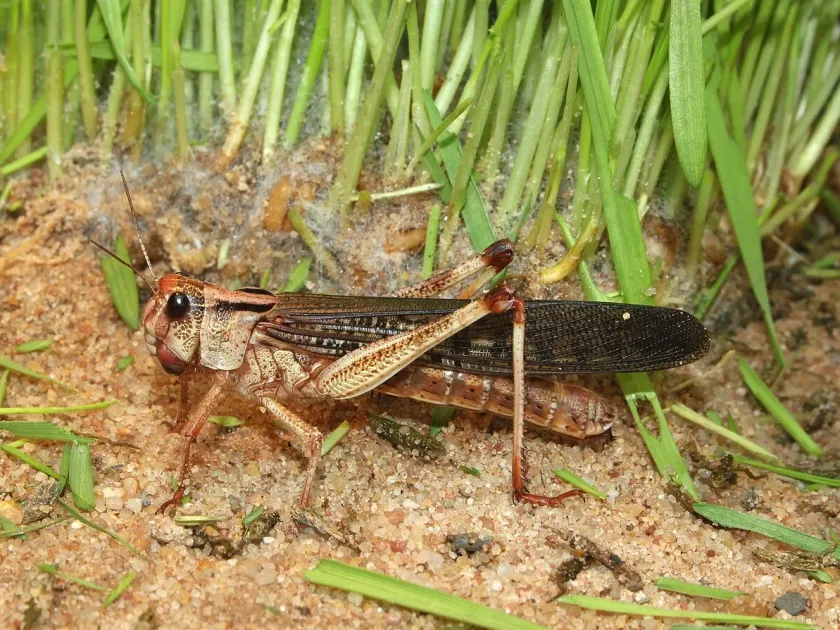
The locust (Locusta) is a destructive member of the family Acrididae (short-horned grasshoppers). These insects are known for their ability to transition between solitary and gregarious phases, which triggers mass swarming behavior.
Physically, adult locusts have large, strong hind legs and robust wings, enabling them to travel long distances in search of food. Their bodies are protected by a thick, durable exoskeleton that withstands environmental stress.
Depending on the species and population density, their coloration may change from green or brown in the solitary phase to bright yellow and black patterns when transitioning into the swarm phase.
The life cycle involves incomplete metamorphosis: egg, nymph (hopper), and adult. Nymphs look like miniature versions of adults but lack functional wings and reproductive organs until they reach maturity.
Eggs are laid in the soil within protective cases called egg pods. These pods protect the developing embryos from dehydration, cold, and predation, ensuring survival for the next season.
What it damages
Locusts are polyphagous, meaning they consume a wide range of plants. They pose a significant threat to cereal crops, including wheat, barley, rye, and maize, often destroying entire fields in a short period.
Beyond cereals, they frequently attack sunflower, cotton, sugar beet, and vegetables. Even grasslands and pastures are vulnerable, leading to severe shortages of fodder for livestock.
Hopper bands (groups of nymphs) consume green tissue aggressively, halting plant growth. This prevents the crops from reaching maturity and reduces the overall yield drastically.
Adult swarms are notorious for their ravenous appetite. An individual locust can consume its own body weight in plant material every single day, leading to total crop failure when thousands congregate.
In addition to direct consumption, the physical damage caused by feeding weakens the plant stem, making crops susceptible to diseases and causing them to break or wither prematurely.
When it appears
Hatching usually occurs in the spring when soil temperatures reach optimal levels (roughly 15-20°C). Favorable rainfall and warm weather during this time can lead to a boom in the population.
The nymph stage (hoppers) is active throughout late spring and early summer. During this time, they move across the landscape in bands, eating everything in their path while growing rapidly.
Adult flight typically occurs during the mid-to-late summer months. This is when swarms form and migrate to new areas, often following prevailing wind patterns that carry them across regional borders.
Egg-laying happens in the autumn, usually in dry, sandy, or compacted soils. These areas are carefully chosen by females to ensure the stability of the egg pods during the dormant winter period.
Depending on the climate, the number of generations per year varies. In tropical and sub-tropical regions, locusts may reproduce continuously throughout the year if moisture is available.
Signs of infestation
The earliest sign of a locust outbreak is the presence of numerous small hoppers jumping in fields. Initially, these populations may seem localized but can grow rapidly.
Visible feeding damage, characterized by large, ragged holes in leaves and stems, is a key indicator. In severe cases, the entire foliage is stripped, leaving only the bare stalks.
The presence of abundant fecal pellets on the soil surface is a reliable sign of a locust infestation. These pellets are usually uniform in size and accumulate quickly under feeding sites.
The sound of swarming locusts is unmistakable, often described as a loud rustling or humming noise. A large swarm in flight can be so dense that it visibly dims sunlight.
Characteristic paths or trails through fields where vegetation is completely cleared suggest that hopper bands have been moving through the area, signaling an immediate need for intervention.
Control measures
Effective management requires a combination of early monitoring, chemical intervention, and ecological practices to reduce the likelihood of swarm formation.
- Tilling the soil in egg-laying sites to destroy egg pods.
- Using contact and systemic insecticides during the early nymph stages.
- Employing biological agents, such as specialized fungi that target locust populations.
- Constant monitoring of potential breeding grounds during the spring season.
- Coordinated cross-border efforts to track and intercept migrating swarms.
Chemical control is the most reliable method during a full-scale outbreak. Modern pesticides applied via aircraft can cover large areas, stopping swarms before they reach critical crop zones.
Cultural methods, including crop rotation and field sanitation, help minimize the food supply for potential outbreaks, forcing populations to stay dispersed and less prone to swarming.
Communication between farmers and government plant protection services is vital to contain small outbreaks before they develop into unmanageable plagues.
Taxonomy
- Latin name
- Locusta
- Order
- Orthoptera (locusts)
- Family
- Acrididae
- EPPO code
- LOCUSP
Discussion
No discussions yet — be the first.