
Booklouse
Liposcelis entomophila
Description
How to identify
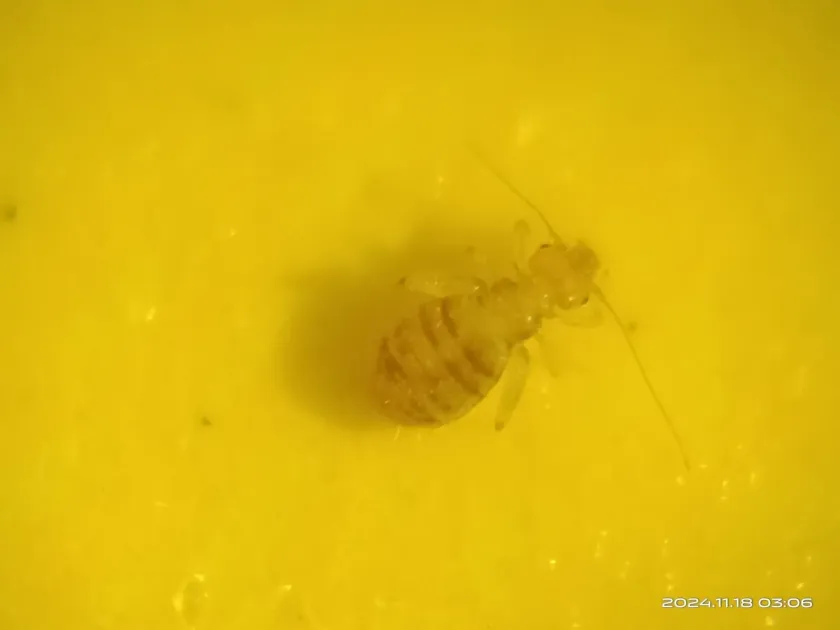
The booklouse (Liposcelis entomophila) belongs to the order Psocoptera, family Liposcelididae. These are minute insects, typically measuring between 1 and 2 mm in length.
They possess a pale, yellowish to brown body without wings, which is a characteristic feature of this species. Their anatomy is adapted for living in confined spaces and crevices.
The insect features chewing mouthparts, which it uses to feed on fungi, algae, and organic debris found in damp storage conditions.
Reproduction is primarily parthenogenetic, allowing populations to grow rapidly when environmental conditions are optimal for the species.
Under favorable conditions, such as temperatures around 25-30°C and high humidity, the life cycle from egg to adult can be completed in about three to four weeks.
What it damages
Booklice are primarily considered pests of stored products, as they feed on microscopic mold that grows on grains, flour, dried fruits, and paper goods.
While they rarely consume large quantities of grain directly, they cause significant contamination with their bodies and excrement, downgrading product quality.
By grazing on mold, they actually spread fungal spores throughout the storage facility, potentially accelerating the spoilage of entire product batches.
In agriculture, their presence in stored seeds can lead to germination failure if the pests damage the embryo or facilitate fungal colonization of the seed coat.
The damage caused by these insects makes products unmarketable, often leading to significant economic losses in warehouses and grain handling facilities.
When it appears
Booklice can be active throughout the year in indoor environments, provided that the temperature and humidity levels remain within their preferred range.
Population surges are most frequent during warm, humid months, especially in storage areas where moisture control is inadequate or lacking.
In winter, their activity decreases significantly if the ambient temperature drops, yet they remain viable in protected, sheltered micro-habitats.
Industrial storage facilities that maintain constant temperature and humidity often experience year-round pest pressure without seasonal breaks.
Mass outbreaks are often observed following periods of high outdoor humidity, which leads to increased moisture content inside buildings.
Signs of infestation
Due to their small size, booklice are often hard to see; however, observing their secondary signs can help in identifying an infestation early.
A dusty appearance on bags or packaging, caused by fungal growth and insect excrement, is a primary indicator of their presence.
The presence of fine "flour-like" material in corners or along the seams of packaging often suggests that these insects are breeding nearby.
A musty or moldy odor emanating from the storage area is another common indicator of an environment favorable to both mold and booklouse development.
- Visible activity on packaging materials.
- Damaged book bindings or paper labels.
- Presence of tiny black or brown spots on bags.
Control measures
The most effective strategy for managing booklouse populations is to keep the relative humidity in storage facilities below 60%.
Implementing strict sanitation practices, such as removing spilled grain, dust, and debris, is crucial to eliminate food sources and breeding sites.
Proper building maintenance, including the repair of leaks and improving ventilation, helps keep the microclimate dry and unsuitable for the pest.
When infestations are severe, chemical control methods such as specialized fumigation or contact insecticides may be necessary to suppress the population.
Regular monitoring of moisture content in stored goods and routine inspections of the storage area can prevent small infestations from becoming widespread.
Taxonomy
- Latin name
- Liposcelis entomophila
- Family
- Liposcelididae
- EPPO code
- LIPOEN
Discussion
No discussions yet — be the first.