
Booklouse
Liposcelis corrodens
Description
How to identify
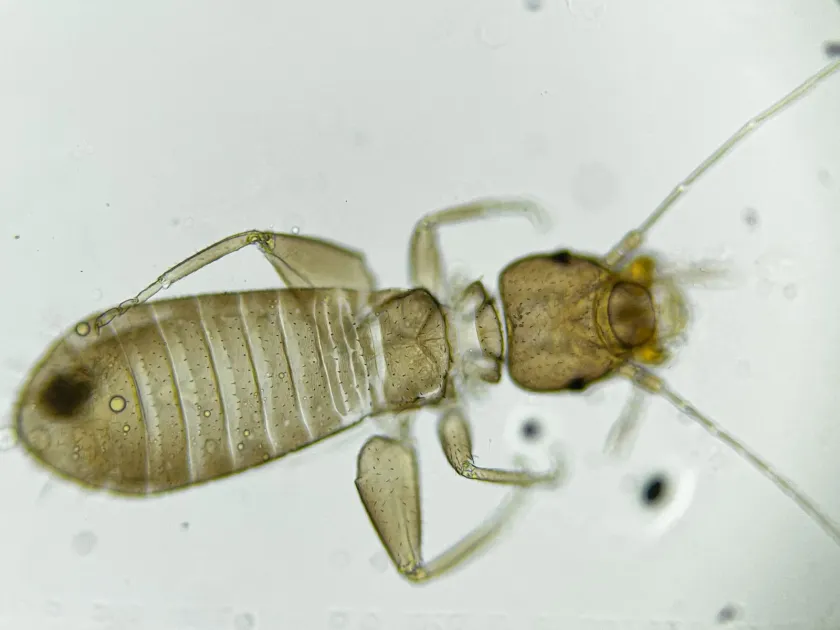
The booklouse (Liposcelis corrodens) is a tiny insect belonging to the order Psocoptera and the family Liposcelididae. They typically measure 1 to 2 millimeters in length.
These insects are wingless and have a dorso-ventrally flattened body shape, which allows them to hide and move easily within narrow crevices of grain or storage infrastructure.
Their coloration ranges from pale yellow to light brown, providing camouflage in dusty warehouse environments. They possess a chewing mouthpart designed for feeding on organic micro-debris.
The life cycle consists of the egg, nymph, and adult stages. Development is highly sensitive to environmental factors, thriving rapidly in warm and humid conditions.
Due to their small size and cryptic behavior, booklice are often overlooked until their populations reach high densities within stored commodities.
What it damages
Booklice are recognized as significant pests of stored products, including grain, flour, cereals, and animal feed, particularly when these are exposed to moisture.
They feed primarily on micro-fungi (molds) that grow on the surface of damp grain, but they can also cause direct damage by feeding on the grain germ, affecting viability.
Heavy infestations lead to serious contamination of food products with insect waste, molted skins, and body fragments, rendering the goods unacceptable for processing.
By moving through the grain mass, they facilitate the spread of fungal spores, which accelerates the deterioration and heating of the stored grain bulk.
Economic damage is also caused by the devaluation of grain quality and the loss of commercial standards due to the visible presence of live or dead insects.
Signs of infestation
Visible signs of infestation include a dust-like appearance on the surface of grain sacks or in accumulations of spilled flour near storage equipment.
A noticeable musty odor in the storage facility often indicates both the presence of mold and an associated population of booklice feeding on it.
A peculiar shimmering motion on the surface of the grain mass can be observed when the population density of these insects is exceptionally high.
Clumping of flour or feed particles, caused by fungal mycelium, often serves as a primary site for insect feeding and rapid multiplication.
The presence of empty egg shells and translucent nymphal skins in the dust near storage bins provides evidence of active breeding cycles.
Control measures
Maintaining low moisture content in stored grains, ideally below 13%, is the most effective cultural method to inhibit the growth of both mold and booklice.
Regular sanitation of warehouses is critical; removing grain dust and debris eliminates the primary food sources and hiding spots for the pests.
In cases of severe infestation, fumigation of the grain mass using professional-grade phosphine-based products is the standard chemical intervention.
Adequate ventilation and strict climate control within storage facilities prevent the localized humidity buildup that favors the development of booklice colonies.
Pre-harvest cleaning and decontamination of empty silos and storage areas help prevent the introduction of these pests to new batches of agricultural produce.
Taxonomy
- Latin name
- Liposcelis corrodens
- Family
- Liposcelididae
- EPPO code
- LIPOCO
Discussion
No discussions yet — be the first.