
Booklouse
Liposcelis bostrychophila
Description
How to identify
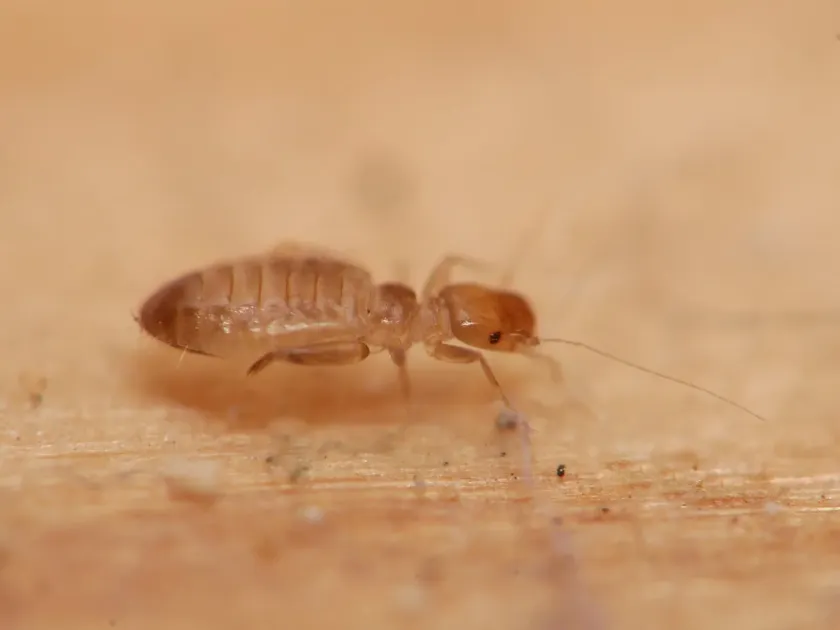
The booklouse (Latin: Liposcelis bostrychophila) belongs to the order Psocoptera and the family Liposcelididae. These are tiny, wingless insects, usually measuring between 1 and 2 mm in length, with a pale yellow or light brown coloration.
Their biology is heavily dependent on high humidity and the presence of microscopic fungi. A single female can lay up to 100 eggs in her lifetime, with the life cycle from egg to adult taking approximately 3 to 4 weeks depending on the temperature.
Booklice are extremely mobile and prefer dark, poorly ventilated environments with humidity levels above 60–70 percent. They are often parthenogenetic, allowing populations to grow rapidly even without males.
Temperatures between 20 and 30 degrees Celsius are optimal for their development. In dry environments, their reproductive cycle slows significantly, making moisture control the primary target for effective management.
Due to their microscopic size, they are often difficult to spot. Distinguishing them from other warehouse pests requires observing their specific body shape and the fact that they crawl rather than jump or fly.
What it damages
The primary damage caused by booklice involves the consumption of dry organic matter, such as grain, flour, cereal products, and pet food. They primarily feed on the microscopic molds that grow on these items when stored in humid conditions.
In agriculture, they pose a significant threat to seed storage facilities. By feeding on the germ or outer seed coats, they can drastically reduce germination rates, rendering the seed lots unusable for planting.
In libraries and archives, they damage books by feeding on starch-based glues in bindings, paper fibers, and the fungi that grow on damp materials. This leads to long-term degradation of documents and historical collections.
Apart from physical damage, their presence is an indicator of poor storage hygiene. They contaminate food products with their feces and exoskeleton fragments, making goods unsuitable for human or animal consumption.
Visible damage often manifests as subtle surface erosion on grain or paper, accompanied by a musty odor emanating from the storage area, indicating underlying mold growth that sustains the pest population.
Signs of infestation
The most common sign of an infestation is the presence of numerous tiny, fast-moving insects on shelves, inside food packaging, or near damp corners of a warehouse. They are often found in areas where condensation occurs.
The presence of mold or mildew, even in small quantities, is a major indicator that booklice are likely present. They graze on fungal colonies, leaving behind clean paths or small scratches on the substrate.
Infested grain or seed often contains fine dust-like residue, which is a mix of insect excrement and debris. This residue can lead to clumping or discoloration of the stored product.
Damage to the edges of paper or the outer layers of seeds appears as light scraping or pitting. If a musty smell is detected in a storage room, it is a strong signal to perform a thorough inspection.
Because these pests are most active during the night, using sticky traps is an effective diagnostic method to determine the scale of the infestation and monitor the effectiveness of control measures.
Control measures
The most effective strategy for managing booklice is the strict maintenance of low humidity levels, preferably below 50 percent. Without sufficient moisture, mold growth ceases, and the population collapses.
Sanitation is critical. Regularly clean storage areas to remove dust, spilled grains, and other organic debris that provides food and shelter for the insects. Improve ventilation to prevent localized humidity pockets.
For severe infestations in warehouses, fumigation with registered chemical agents, such as aluminum phosphide, may be necessary. These operations must be performed by certified professionals following safety protocols.
In domestic settings, focus on drying out the environment and discarding heavily infested items. Sealing storage containers and monitoring moisture levels with hygrometers will prevent future re-infestations.
- Maintain relative humidity below 50%.
- Clean storage areas frequently.
- Use airtight containers for seed storage.
- Install hygrometers to track environmental conditions.
Taxonomy
- Latin name
- Liposcelis bostrychophila
- Family
- Liposcelididae
- EPPO code
- LIPOBO
Discussion
No discussions yet — be the first.