
Booklouse
Liposcelis
Description
How to identify
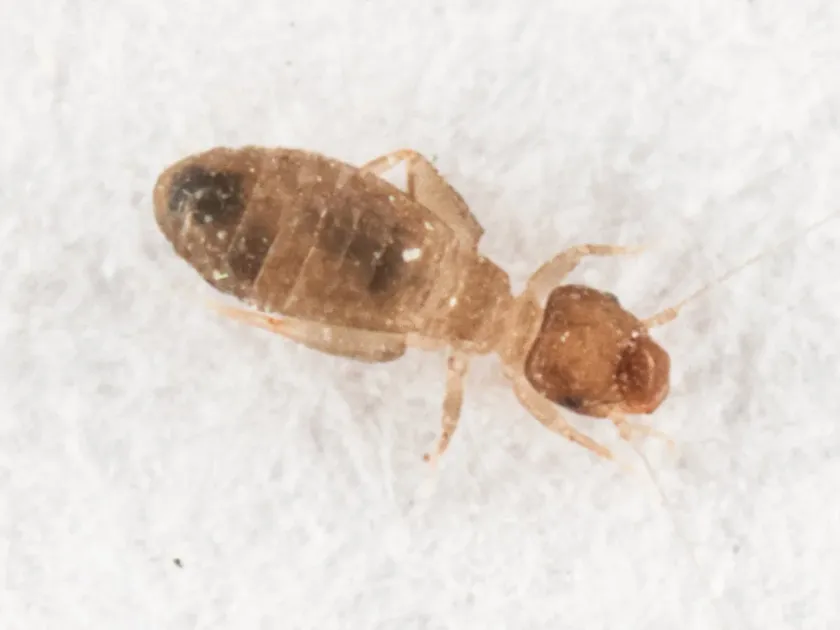
The booklouse (Liposcelis) belongs to the order Psocoptera and the family Liposcelididae. These are minute, wingless insects, typically measuring between 1 and 2 mm in length, with coloration ranging from translucent white to light brown.
They possess a flattened body shape and mandibulate mouthparts designed for scavenging organic debris. While they lack wings, their well-developed hind legs allow them to jump, and they are capable of rapid movement across surfaces.
The life cycle encompasses the egg, nymph, and adult stages. Under favorable conditions, particularly high humidity and stable moderate temperatures, they can complete their development cycle rapidly.
Liposcelis species are primarily scavengers that thrive in environments where fungi and molds are present. They are cosmopolitan in distribution, often hitchhiking on stored commodities.
Their physical appearance often leads them to be mistaken for dust or other debris, making early identification difficult without magnification.
What it damages
Booklice are considered significant stored-product pests, damaging various dry commodities such as grain, flour, cereals, seeds, and dried fruits. They thrive in environments where storage conditions are less than optimal.
They feed primarily on microscopic fungi and molds that grow on damp products. However, when populations explode, they may feed on the germ of the grain, significantly impacting its viability.
The primary economic impact stems from product contamination. Their bodies, exuviae (shed skins), and waste products render commodities unsalable and unsuitable for food production.
A heavy infestation causes a persistent musty odor, which degrades the quality and market value of the stored goods. This damage is often irreversible in large bulk storage units.
Furthermore, their presence is a reliable warning sign that moisture management in the storage facility has failed, risking much larger issues like rot and mycotoxin development.
Signs of infestation
The most common sign of a booklouse infestation is the presence of tiny, scurrying insects on surfaces near the stored products, such as bag seams, shelving, or wall corners.
A persistent musty or moldy smell in dry storage areas often indicates the presence of the fungal growth that booklice rely upon for their nutrition.
The accumulation of fine, dust-like material on or around grain containers may indicate that an active population of booklice has been processing the organic material nearby.
In retail or archival settings, one might observe tiny, irregular feeding scars on paper products or labels where the insects have grazed on molds or starch-based adhesives.
Frequent, unexplained allergic reactions among warehouse workers can sometimes be attributed to the presence of large numbers of these insects and their shed skins.
Control measures
The most effective strategy for managing booklouse populations is the strict regulation of moisture levels within storage facilities, as keeping relative humidity below 60% halts their development.
Good sanitation practices are crucial. Removing spillages, dust, and debris eliminates the food sources and shelter that allow these populations to become established.
When infestations become severe, chemical control via fumigation using phosphine or other approved gaseous treatments is necessary to penetrate deep into stored grain bulk.
Surface treatments with residual insecticides in empty warehouses help create a barrier, provided that the insecticides used are approved for use around food storage areas.
- Use dehumidifiers to maintain low humidity levels in warehouses.
- Implement "First-In, First-Out" (FIFO) inventory management to prevent long-term storage.
- Regularly inspect and clean pallets, racks, and dark corners of storage rooms.
- Install tight-sealing doors and screens to minimize the ingress of pests.
Taxonomy
- Latin name
- Liposcelis
- Family
- Liposcelididae
- EPPO code
- LIPOSP
Discussion
No discussions yet — be the first.