
Booklouse
Liposcelis decolor
Description
How to identify
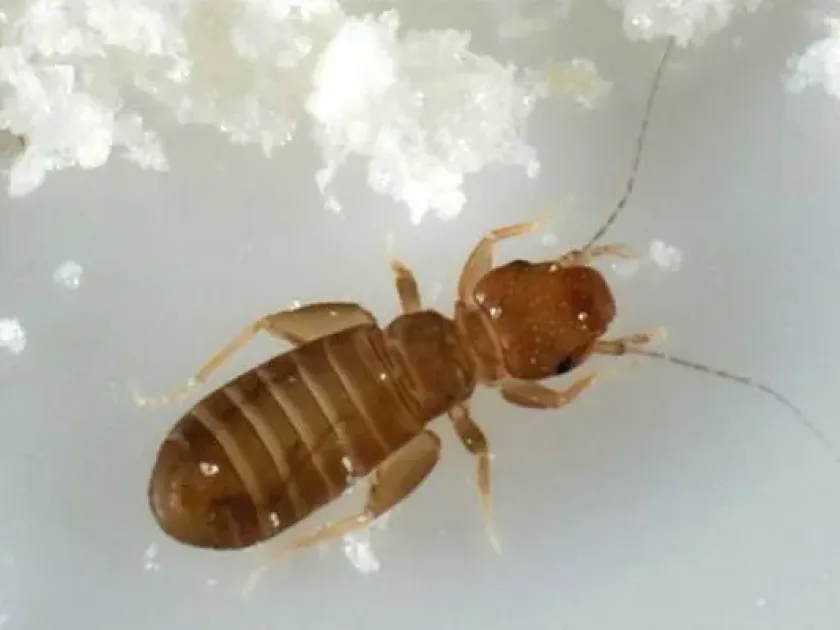
The booklouse (Liposcelis decolor) belongs to the order Psocoptera and the family Liposcelididae. These are extremely small insects, typically measuring between 1 and 2 mm in length.
Their bodies are flattened and pale yellow or light brown in color, adapted for living in cracks and crevices of storage facilities.
Being apterous (wingless) insects, they do not fly, but move rapidly across surfaces when disturbed, making them difficult to detect at low densities.
The mouthparts are of the chewing type, allowing them to feed on organic matter such as grain, starch, and fungal spores.
The life cycle involves incomplete metamorphosis, and the population consists primarily of females that reproduce through parthenogenesis.
What it damages
Booklice are recognized as significant pests in grain silos, mills, and libraries, where they infest stored organic products.
They specifically target the germ of the grain, which negatively affects the viability of seeds intended for future planting.
The pests thrive on fungi associated with damp grain, which exacerbates the spoilage process in stored goods.
Large populations contaminate grain with frass, shed skins, and egg shells, which significantly lowers the commercial quality of the produce.
In addition to agricultural damage, they can infest finished food products, making them a serious issue for food safety and quality management.
When it appears
Booklice are persistent pests that can remain active throughout the year as long as the environmental conditions inside the warehouse are stable.
They require warm conditions and high relative humidity to thrive, usually preferring temperatures above 20°C and humidity above 60%.
Their development is temperature-dependent, with the life cycle from egg to adult taking approximately 3 to 4 weeks under ideal conditions.
Seasonal outbreaks are often observed in the summer and autumn when storage facilities experience increased internal temperatures.
Once conditions become unfavorable, they may enter a period of reduced activity but can quickly rebound when moisture levels rise again.
Signs of infestation
The presence of fine dust on the surface of grain piles or near storage containers is a classic indicator of booklouse infestation.
Visible clusters of small, pale insects crawling on bags or floor surfaces are strong evidence of a significant infestation level.
A musty or earthy odor is often present in infested grain, which is caused by the combination of pest activity and secondary fungal growth.
Using traps or sampling methods such as sieving grain samples is necessary to identify infestations at an early stage.
Damage to cardboard packaging, paper labels, or binding glue in storage areas often indicates a broad presence of this pest.
Control measures
The primary control strategy involves moisture management, as drying grain to below 12% moisture effectively inhibits booklouse reproduction.
Rigorous sanitation of storage areas, including the removal of grain spills, dust, and debris, is essential to deny the pests food and shelter.
Chemical control via fumigation is often necessary for large-scale infestations to ensure total eradication of all life stages.
Proper aeration and temperature management of stored grain help to prevent the conditions that encourage the survival of these pests.
Regular inspections and the use of pheromone or sticky traps provide an early warning system to manage populations before they explode.
Taxonomy
- Latin name
- Liposcelis decolor
- Family
- Liposcelididae
- EPPO code
- LIPODE
Discussion
No discussions yet — be the first.