
Chicken louse
Lipeurus caponis
Description
How to identify
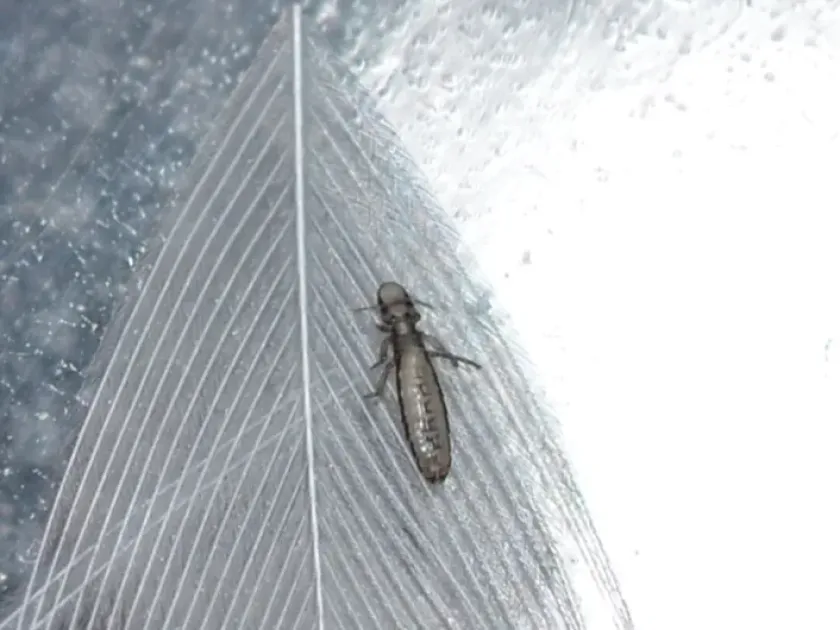
The chicken louse (Lipeurus caponis) belongs to the order Mallophaga, family Philopteridae. These are tiny, wingless insects, typically 1.5–2.5 mm long, with flat, elongated bodies specialized for life on birds.
Physically, they possess a yellowish-grey color and a broad head equipped with strong, chewing mouthparts. They feed on avian epidermal debris, feathers, and skin secretions rather than sucking blood directly.
The entire life cycle occurs on the bird host. Females cement their eggs (nits) to the base of feathers, and the transition from egg to adult takes approximately three to four weeks under optimal conditions.
Lipeurus caponis cannot survive away from the bird host for more than a few days, making direct contact between birds the primary mechanism for transmission within a flock.
These lice are primarily found on the wing and tail feathers, where they utilize specialized claws to grip the feather shafts tightly, allowing them to resist grooming attempts by the bird.
What it damages
This pest affects chickens, turkeys, and other domestic poultry. While not a plant pest, it is a significant concern for the agricultural industry due to its impact on livestock health and production.
Infestations lead to severe irritation, itching, and restlessness in birds. Constant irritation causes stress, which significantly impacts feed conversion rates, weight gain, and total egg production.
Feathers damaged by lice become brittle and lose their structure, leading to a ragged, unkempt appearance. In severe cases, the skin becomes inflamed and covered in open sores due to the bird's aggressive self-grooming.
Young birds are particularly vulnerable; chronic infestation results in stunted growth and a weakened immune system, leaving the poultry more susceptible to other secondary infections.
Financial losses in poultry farming are compounded by the costs of veterinary treatments, potential mortality, and the decreased market value of the meat and plumage quality.
Signs of infestation
The earliest indicator is behavioral: the birds become restless, excessively preen their feathers, and frequently shake their bodies or pick at their wings and backs to alleviate itching.
Upon close inspection, the lice can be seen moving rapidly on the skin when feathers are parted. Egg clusters are also visible as white, gritty deposits near the base of the wing feathers.
The skin in affected areas often shows signs of irritation, crusts, and small lesions caused by the bird's own efforts to relieve the intense discomfort caused by the parasites.
During the night, a quiet house might reveal sounds of the birds shifting and scratching, which is a common sign of a significant lice population impacting their rest.
Feather quality serves as a diagnostic tool; look for ragged feather edges and areas where the barbs have been chewed away, indicating the presence of the parasites.
Control measures
The primary control strategy involves the application of safe, poultry-approved insecticide sprays, powders, or spot-on treatments to eliminate lice populations on the birds.
Preventative measures include providing dust baths containing sand and wood ash. This allows birds to engage in natural grooming behaviors that help to minimize and control lice numbers effectively.
Maintaining high sanitary standards in the coop is crucial. Regular cleaning, disinfecting equipment, and keeping the bedding dry help to break the cycle of infestation.
Total flock management is essential; when treating an infestation, all birds must be treated simultaneously, and the premises must be thoroughly cleaned to prevent re-infestation.
- Systematic application of approved insecticides.
- Proper coop sanitation and maintenance.
- Strict quarantine procedures for any new birds added to the flock.
Taxonomy
- Latin name
- Lipeurus caponis
- Family
- Philopteridae
- EPPO code
- LIPECA
Discussion
No discussions yet — be the first.