
Reed fly
Lipara lucens
Description
How to identify
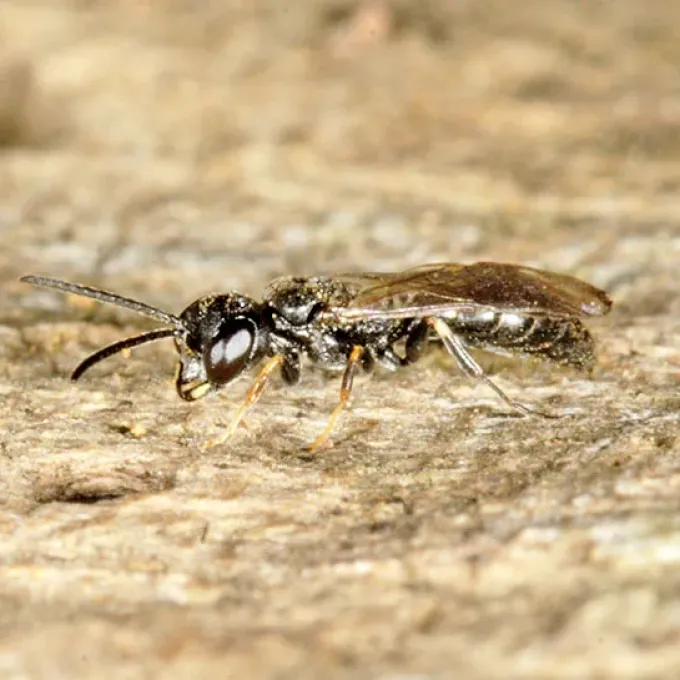
The reed fly, scientifically known as Lipara lucens, belongs to the family Chloropidae within the order Diptera. Adult flies are small, usually measuring between 5 and 7 millimeters.
The body coloration is yellowish-brown, and the head is rounded with distinct, visible bristles on the antennae, which are typical for this family.
Their wings are transparent with a faint yellow tint, allowing them to blend into the surrounding vegetation while in flight.
The larvae are cylindrical, creamy-white in color, and possess specialized mouth hooks designed to burrow into the growing tips of reeds.
Eggs are elongated and oval, usually deposited by the female on the youngest leaves of the host plant during the early growth stage.
What it damages
The primary host for Lipara lucens is the common reed (Phragmites australis), which is ubiquitous in wetlands and pond margins.
The larvae bore into the apical meristem of the plant, disrupting natural tissue formation and causing the development of characteristic galls.
These galls are massive, spindle-shaped thickenings at the top of the reed stem that effectively prevent the plant from elongating further.
As a result of this damage, the reed fails to produce its characteristic flower panicle, leading to complete reproductive failure for that specific stem.
High levels of infestation can significantly suppress the overall growth and density of reed beds, affecting the local ecological structure.
When it appears
Adult flies typically emerge in late spring or early summer, coinciding with the period when reed shoots are actively growing.
Mating and egg-laying occur over a relatively short period, as the flies require soft, juvenile plant tissue for the offspring to survive.
Larval development takes place throughout the summer months within the gall, where the insect feeds on plant nutrients.
Pupation generally occurs towards the end of the summer, as the insect prepares for the transition into the overwintering stage.
They overwinter as larvae or pupae inside the gall, providing them with a protected environment against harsh winter weather conditions.
Signs of infestation
The most prominent sign of infestation is the appearance of cigar-like galls on the tips of the reed stems, which are highly visible.
Infested stems appear shortened and thickened compared to healthy, slender reeds, making them stand out in a colony.
The absence of a flowery panicle at the tip of the stem is a definitive diagnostic feature of Lipara lucens damage.
During the summer, small exit holes may be visible on the surface of the galls, indicating that adult flies have emerged from the chamber.
Internal examination of the gall during winter reveals a hollowed-out chamber containing larval excrement and debris left behind by the insect.
Control measures
The most effective management strategy is mechanical control, specifically cutting and removing the reeds during winter months.
Collected galls should be burned or disposed of away from the wetland to ensure that the overwintering larvae are destroyed.
Biological control methods are difficult to implement and usually rely on natural predators that inhabit the reed bed ecosystem.
Chemical applications are generally discouraged in aquatic habitats due to potential risks to water quality and non-target organisms.
Monitoring reed beds early in the season can help identify infestation hotspots and allow for targeted sanitary removal of the affected stems.
Taxonomy
- Latin name
- Lipara lucens
- Order
- Diptera (flies)
- Family
- Chloropidae
- EPPO code
- LIPRLU
Discussion
No discussions yet — be the first.