
Lipara
Lipara
Description
How to identify
Lipara is a genus of flies belonging to the family Chloropidae (frit flies). These insects are specialized plant-feeders known for their association with common reeds.
The adults are small, typically measuring 3–6 mm in length, with a coloration that varies from yellowish-brown to dark black, typical for this family of dipterans.
Systematically, they belong to the order Diptera. The most well-known species, Lipara lucens, is recognized for its ability to manipulate plant growth through gall formation.
Larvae are maggot-like, legless, and adapted to live endophytically within the stems of host plants, where they feed on the internal tissues.
These insects exhibit a high degree of ecological specialization, strictly tied to the life cycle and growth patterns of the reed Phragmites australis.
What it damages
The primary damage is caused to the terminal growth of the reed, where the larvae feed on the apical meristem.
This feeding activity causes the plant to cease vertical growth, resulting in the development of a characteristic deformed structure known as a gall.
While not a major pest for traditional agriculture, Lipara can negatively impact the biomass and health of reed beds in wetlands and coastal areas.
The infested stems fail to produce the characteristic panicle (inflorescence), which significantly prevents the plant's sexual reproduction.
Localized infestations can weaken the structure of reed stands, making them less resistant to environmental stresses and reducing their commercial value.
When it appears
Adult flies typically emerge in late spring, around May and June, which coincides with the period of rapid shoot growth of the host reeds.
Females lay their eggs on the young leaves or the upper parts of the developing shoots, allowing the newly hatched larvae to access the apical meristem.
The larvae develop inside the stems throughout the summer and autumn, spending the winter in the larval or pupal stage protected within the gall.
Pupation occurs within the gall during the late winter or early spring, ensuring that the next generation emerges just in time for the new growth season.
The entire life cycle takes one year to complete, which is tightly synchronized with the phenology of the reed host.
Signs of infestation
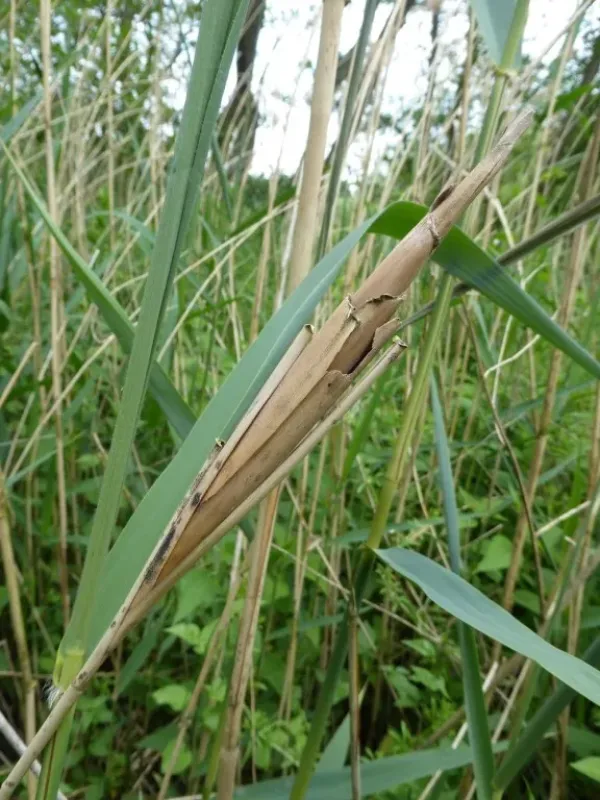
The most distinctive symptom of infestation is the formation of cigar-shaped galls on the tips of reed stems.
- Visible shortening of the apical internodes leading to a thickened stem tip.
- Inability of the plant to produce a panicle or floral parts.
- Abnormal leaf growth surrounding the site of the gall.
- Small circular exit holes in the stem surface, indicating that the adult fly has emerged.
Detection is easiest during the winter or early spring, as the galls remain prominent on the dead or dormant stems.
Control measures
The primary control strategy involves cultural practices, specifically the harvesting and removal of infested reeds during the winter months.
Burning the harvested biomass during the dormant season is a highly effective way to destroy the larvae and pupae residing within the galls.
Biological control through the preservation of natural predators and parasitoids can play a significant role in keeping populations below economic thresholds.
Chemical applications are generally discouraged due to the sensitive nature of wetland ecosystems where reeds are typically found.
Effective management requires monitoring the density of galls in reed stands to assess the need for harvesting or other population-reducing interventions.
Taxonomy
- Latin name
- Lipara
- Order
- Diptera (flies)
- Family
- Chloropidae
- EPPO code
- LIPRSP
Discussion
No discussions yet — be the first.