
Sheep foot louse
Linognathus pedalis
Description
How to identify
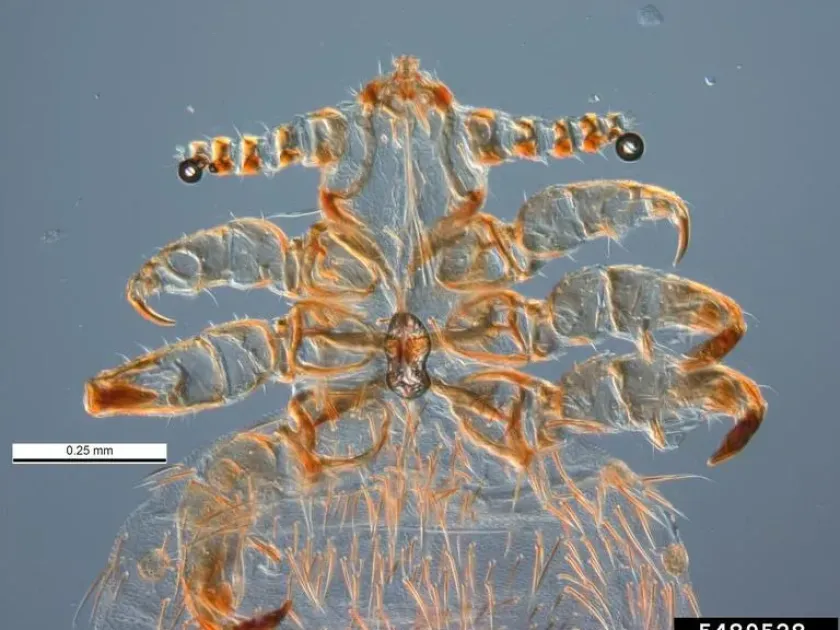
The sheep foot louse (Linognathus pedalis) is a small, wingless insect belonging to the order Phthiraptera, family Linognathidae. It is a highly specialized blood-feeding parasite that spends its entire life cycle on the host animal.
The adult louse is approximately 2 millimeters long, with a broad, flat, greyish-brown body and short legs equipped with claws. These claws are perfectly adapted for clinging to the coarse hair fibers on the sheep's lower legs.
It possesses a piercing-sucking mouthpart designed to feed exclusively on the blood of the sheep. Unlike biting lice, they do not consume hair or skin debris, which directly impacts the nutritional status of the host.
The life cycle involves eggs (nits), three nymphal stages, and adults. The female cements her eggs onto the hair shafts near the skin, primarily in areas with sparse hair coverage to maintain optimal developmental temperatures.
The total development time from egg to adult is typically around 30 days. Because they are permanent parasites, environmental survival away from the host is very limited, usually lasting only a few days.
What it damages
Sheep of all ages are susceptible to infestation. The lice are typically concentrated on the lower limbs, specifically around the coronet, pastern, and dewclaws. In rams, they are also frequently found on the scrotum.
The primary damage is caused by the extraction of blood, leading to anemia, especially in young lambs or immunocompromised animals. The constant irritation caused by bites results in significant distress and restlessness.
Infested animals spend more time scratching and biting their legs rather than grazing, which directly results in reduced weight gain and poor body condition. This behavior leads to economic losses for the farmer.
The skin damage caused by scratching and constant biting creates secondary lesions, inflammation, and potential gateways for bacterial infections. In severe cases, the dermatitis can become quite painful.
While the louse does not transmit viral plant diseases, it creates a persistent veterinary issue. The resulting skin lesions lower the market value of the pelt and decrease the overall productivity of the flock.
Signs of infestation
The most noticeable sign of infestation is behavioral changes. Sheep will frequently stomp their feet, bite at their lower legs, or rub their limbs against fence lines, troughs, or hard objects to alleviate itching.
Visible inspection of the lower limbs often reveals the presence of nits. These appear as small, whitish, oval-shaped capsules firmly attached to the hair shafts, particularly around the coronary band.
Skin irritation, such as redness, papules, and crusts, is commonly observed. If the infestation is chronic, the affected skin may thicken, and the hair may become matted with exudate from the lesions.
General unthriftiness and a failure to thrive are key indicators in a flock. Even in cases where physical signs are not immediately apparent, a drop in production and increased social friction in the herd can suggest a hidden infestation.
- Frequent foot stomping and biting of legs.
- Presence of nits on hair of lower limbs.
- Localized inflammation and crusting skin.
- Decreased appetite and weight loss in lambs.
- Restless behavior during grazing or resting.
Control measures
Effective management of Linognathus pedalis requires the use of specialized ectoparasiticides. Pour-on formulations or plunge dips that ensure full coverage of the lower limbs are particularly effective for this species.
Systemic treatments, such as injectable macrocyclic lactones (like ivermectin), are widely used due to their efficacy against blood-feeding parasites. These treatments kill lice during their blood meal, providing reliable control.
A crucial aspect of any control program is the follow-up treatment. Because most acaricides do not effectively kill eggs, a second treatment must be applied approximately 14 days later to kill the newly hatched nymphs.
Sanitation of the housing area and equipment is an essential secondary measure. While the lice have short survival times off the host, cleaning reduces the risk of immediate re-infestation after treatment.
Strict quarantine protocols for newly introduced stock are vital. All new animals should be inspected and treated if necessary before being allowed into the main flock to prevent the spread of the parasite.
Taxonomy
- Latin name
- Linognathus pedalis
- Family
- Linognathidae
- EPPO code
- LINOPE
Discussion
No discussions yet — be the first.