
Silver fly
Leucopis simplex
Description
How to identify
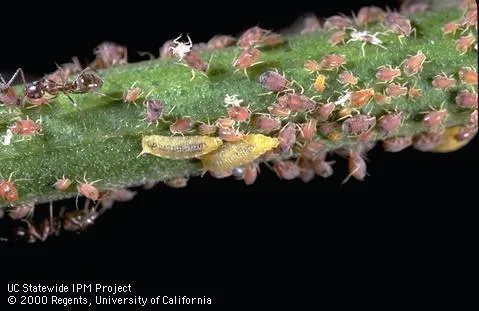
The silver fly, scientifically known as Leucopis simplex, belongs to the family Chamaemyiidae within the order Diptera. These small flies are easily recognized by their distinct silvery-gray appearance, which provides camouflage against tree bark and foliage.
Adult flies possess a compact body covered with dense, powdery hairs, giving them a matte finish. The wings are hyaline, displaying typical venation patterns characteristic of the Chamaemyiidae family.
Their life cycle undergoes complete metamorphosis, consisting of egg, larva, pupa, and adult stages. Depending on local climatic conditions, multiple generations may occur throughout the growing season.
The larvae are typically legless, elongated, and pale, often whitish or yellowish. They lead a cryptic lifestyle, living exclusively within the colonies of their prey, such as aphids, scales, and mealybugs.
While often beneficial as predators of agricultural pests, their presence can indicate a high density of host insects, necessitating careful observation and integrated pest management practices.
What it damages
The larvae of Leucopis simplex primarily cause damage by feeding on colonies of sap-sucking insects, but they can incidentally harm host plants when populations become overly dense.
Affected crops include a wide range of fruit trees, berry bushes, and various ornamental plants that are susceptible to aphid and scale infestations.
Damage is typically concentrated on young, tender shoots and leaf undersides, where host insects gather to feed on plant sap.
The direct impact on the plant includes stunted growth, leaf curling, and the distortion of young shoots, which significantly reduces the photosynthetic efficiency of the plant.
Indirect damage occurs when the stress caused by larvae and their prey makes the plant more vulnerable to secondary infections, such as fungal pathogens that thrive in the honeydew produced by the host insects.
When it appears
Silver fly activity typically begins in early spring as temperatures rise, coinciding with the initial development of aphid populations in orchards and fields.
The peak emergence of adults corresponds with the rapid growth of succulent plant tissues, which serves as an ideal habitat for both the flies and their prey.
During the warm summer months, the metabolic rate of the flies increases, leading to shortened generation times and potentially rapid increases in population density.
As autumn approaches, the flies prepare for winter, entering a state of diapause as pupae or adults, and seeking shelter in the soil or beneath accumulated plant debris.
Understanding these seasonal patterns is crucial for agronomists to time monitoring efforts effectively and implement management strategies before populations reach damaging levels.
Signs of infestation
The most reliable sign of a silver fly presence is the observation of small, pale larvae hidden within aphid colonies or underneath the protective covers of scale insects.
A powdery, silvery residue on leaves, often mistaken for fungal spores or dust, is a common indicator of their presence on the foliage surface.
Plant symptoms include deformed leaves, wilting of young shoots, and the characteristic presence of honeydew, which often leads to the development of sooty mold.
Evidence of larval feeding can be found on plant surfaces as tiny patches of desiccated or shriveled tissue where aphids once resided.
For accurate identification, microscopic examination is recommended, as the specific morphological characteristics of the Chamaemyiidae larvae are distinct from other predator species.
Control measures
Managing the silver fly effectively involves integrated pest management (IPM) strategies, focusing primarily on controlling the primary host insects.
- Regular pruning to improve air circulation within the canopy, reducing habitat for host insects.
- Application of selective biological insecticides that target aphids while preserving beneficial predatory insects.
- Use of yellow sticky traps to monitor adult flight activity and density throughout the growing season.
- Enhancing agricultural biodiversity to support natural predator-prey balance in the field.
- Removal and destruction of crop residues where flies and their hosts overwinter.
Chemical intervention should be used sparingly and only when economic thresholds are exceeded to prevent the disruption of natural predator populations.
Consistent monitoring of plant health allows for early detection and targeted interventions, minimizing the need for broad-spectrum pesticides and protecting overall crop yields.
Taxonomy
- Latin name
- Leucopis simplex
- Order
- Diptera (flies)
- Family
- Chamaemyiidae
- EPPO code
- LEUSSI
Discussion
No discussions yet — be the first.