
Moderliefchen
Leucaspius delineatus
Description
How to identify
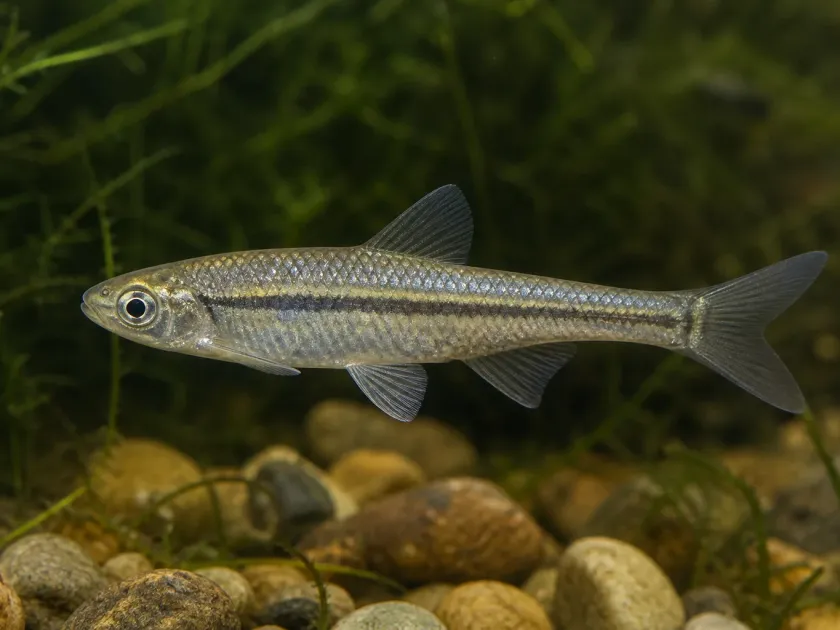
The Moderliefchen (Leucaspius delineatus) is a small, shoaling fish belonging to the Leuciscidae family, order Cypriniformes. It is characterized by an incomplete lateral line that fades after the first few scales, and a superior mouth.
Adult individuals typically grow to a length of 6 to 9 centimeters. Their bodies are covered in silvery scales that shed easily when handled, and their backs are olive-green, allowing them to blend in near the water surface.
This species favors standing or slow-moving water bodies, such as ponds, lakes, and ditches. It is highly resistant to low oxygen conditions, which allows it to thrive in closed aquatic systems where other species might perish.
Reproduction occurs by laying eggs on the underside of aquatic plant leaves. This strategic placement protects the eggs from many predators and contributes to high offspring survival rates in pond environments.
The biology of the species is defined by high plasticity and adaptability. It is a highly successful colonizer, capable of rapidly increasing its numbers when environmental conditions in a pond become favorable.
What it damages
In aquaculture, the Moderliefchen is considered a pest because it acts as a direct food competitor for the fry of valuable commercial fish. It feeds voraciously on zooplankton, which is essential for the growth of carp and other fry.
An overabundance of this species in nursery ponds leads to the depletion of the natural food base. As a result, commercial fish fry experience stunted growth and development, significantly reducing the overall productivity of the farm.
Beyond food competition, the Moderliefchen can act as a vector for various fish parasites and pathogens. Their high mobility within closed water systems facilitates the rapid spread of infections among the stock.
If left unchecked, this species tends to dominate the ecosystem, displacing more valuable fish and altering the ecological balance. This leads to a decline in the overall quality and commercial value of the pond's ichthyofauna.
The impact on the environment also includes disturbances in the plankton composition, which affects the pond's overall ecological status and the health of the surrounding flora that depends on balanced nutrient cycling.
Control measures
The most effective control method is the complete draining and liming of ponds during the off-season. This practice eliminates all life stages of the fish, including eggs attached to aquatic vegetation.
Installing fine-mesh filters on water inlet systems is crucial to prevent the accidental introduction of adults or eggs from external natural water sources into the production ponds.
Biological control involves stocking the ponds with predatory fish such as pike or perch. These natural predators are efficient at regulating the population of the Moderliefchen, thereby protecting the growth of other species.
Regular maintenance of the pond's shoreline, including the removal of excess aquatic vegetation, is recommended. Since the fish uses these plants for spawning, reducing the available substrate inhibits population growth.
In cases of extremely high population densities, selective harvesting using fine-meshed nets is employed. Ongoing monitoring of the pond population is essential for taking timely action before the pest reaches dominance.
Taxonomy
- Latin name
- Leucaspius delineatus
- Family
- Cyprinidae
- EPPO code
- LEUUDE
Discussion
No discussions yet — be the first.