
Camellia scale
Lepidosaphes camelliae
Description
How to identify
The Camellia scale Lepidosaphes camelliae belongs to the family Diaspididae, in the order Hemiptera. This is a tiny insect that lives a hidden life under the protection of a dense waxy shell.
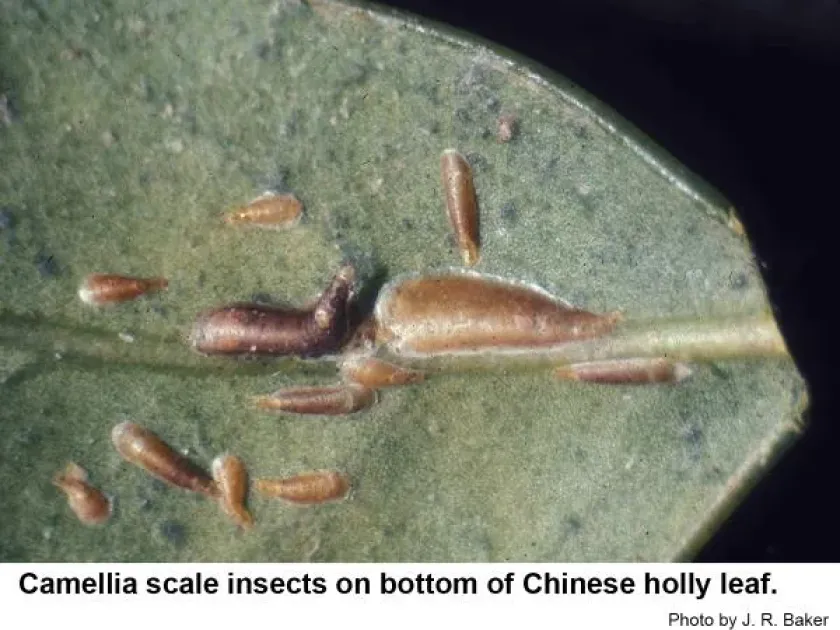
Females of this species have an elongated, pear-shaped body and a dark brown color, making them difficult to spot on the tree bark. Their size rarely exceeds 2–3 millimeters.
Males of the Camellia scale are seen much less frequently than females. They possess wings and are capable of active movement, but they live very short lives, serving solely reproductive purposes.
First-instar nymphs, known as crawlers, are mobile and have a pale yellow color. It is during this stage that the pest actively disperses throughout the plant's canopy.
Adult individuals are sessile and attach themselves firmly to the plant with their mouthparts, essentially becoming a living growth that feeds on the host's sap.
What it damages
The primary hosts of this pest are members of the genus Camellia, specifically Camellia japonica and Camellia sasanqua. Other evergreen ornamental crops may also be affected.
The pest primarily damages the leaves, positioning itself along the central vein, as well as on young shoots. During mass infestations, the scale can also be found on the bark of stems.
By disrupting the integrity of plant tissues, the scale sucks out cellular sap, leading to critical exhaustion of the plant. Photosynthesis and general metabolic processes are severely impaired.
Serious infestation leads to deformation of leaf blades and their premature shedding. Eventually, the plant loses its ornamental value and slows its growth.
In the absence of proper maintenance and protection, heavy infestation can lead to the gradual drying of individual branches or the total death of the affected specimen.
When it appears
The biological cycle of the Camellia scale is closely linked to climatic conditions. In temperate regions, it can produce one or two generations per year.
Fertilized females most often overwinter under their shells. With the onset of consistent spring warmth, at temperatures above 15 degrees, they begin laying eggs.
The emergence of crawlers usually coincides with the start of active plant vegetation. During this period, they are most vulnerable to contact insecticides.
Throughout the summer months, the development of the insects continues continuously if environmental temperatures allow.
By autumn, the population size reaches its peak, after which some individuals die, and the fertilized females enter a state of diapause to survive the winter period.
Signs of infestation
The first visual sign of infestation is the appearance of characteristic dark brown elongated plaques, resembling tiny scales, on the underside of leaves.
Upon detailed inspection, yellowish or chlorotic spots may appear around the feeding sites due to the disruption of plant tissue nutrition.
In late stages of infestation, a sticky residue known as honeydew becomes visible on the leaves; this is secreted by the insects and encourages the development of sooty mold.
Gradual yellowing and curling of leaves, as well as their falling off without visible causes, indicate a critical degree of bush infestation.
- Presence of a "crust" of tiny scales on the bark.
- Disruption of leaf color and deformation.
- General weakening of the shrub's condition.
Control measures
Control of the scale is complicated by the presence of a dense waxy shell, which protects the insect from the effects of most contact pesticides.
The most effective period for treatments is the crawler phase, when the nymphs have not yet managed to form their own protective shell.
It is recommended to use systemic insecticides, which penetrate the plant tissues and make the sap toxic to the pest during feeding.
Preventive measures include regular inspection of plants, removal of heavily damaged branches, and maintaining optimal humidity, as dry air promotes the pest's reproduction.
In cases of mild infestation, one can apply mechanical cleaning of branches with a soft brush using soap-oil emulsions, which clog the insects' respiratory pores.
Taxonomy
- Latin name
- Lepidosaphes camelliae
- Order
- Hemiptera (bugs, aphids, leafhoppers)
- Family
- Diaspididae
- EPPO code
- LEPSCA
Discussion
No discussions yet — be the first.