
Clover Lappet
Lasiocampa trifolii
Description
How to identify
The Clover Lappet (Lasiocampa trifolii) is a moth belonging to the Lasiocampidae family, order Lepidoptera. The adult moth is relatively large, with a wingspan reaching up to 60 millimeters.
The forewings have a reddish-brown or yellowish-brown color with a characteristic pale transverse stripe. The hindwings are typically uniform in color, slightly lighter than the forewings.
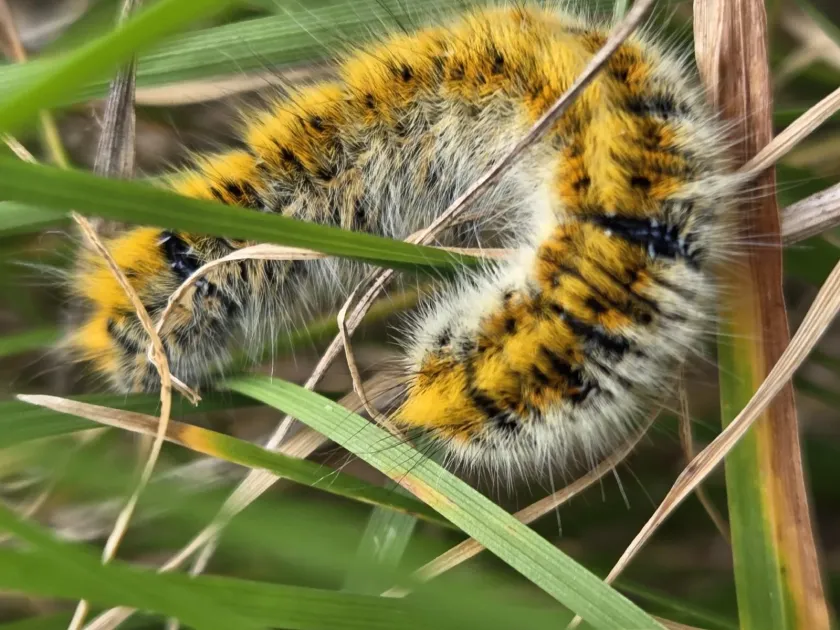
The body of the insect is covered in dense hairs, which is typical for members of this family. The larvae (caterpillars) vary in color from grey to brownish-black, with bright spots on the sides and dense, irritating hairs.
The life cycle includes the egg, larva, pupa, and adult stages. In most temperate regions, there is a single generation per year.
Hibernation occurs at the larval stage, with young caterpillars sheltering in leaf litter or the top layer of soil near the base of host plants.
What it damages
This pest is a polyphage, but it causes significant damage to agricultural fields planted with legumes and cereals. Its preferred hosts include clover, alfalfa, and various meadow grasses.
Despite its common name, the larvae often migrate to cereal crops such as winter wheat, rye, and barley. In cases of food scarcity, they can even feed on certain weed species.
Beyond agricultural fields, this pest is found in pastures, significantly reducing the yield and quality of green forage. Localized outbreaks can lead to complete crop failure in specific areas.
High caterpillar populations during the peak vegetative growth of plants pose the greatest risk, as the leaf surface is at its most tender and nutritious phase.
Crops situated near forest edges are at higher risk due to the migration of moths from natural habitats into cultivated fields.
When it appears
The flight period for adult moths occurs in mid-to-late summer, typically spanning July and August, when mating and egg-laying take place.
Females deposit eggs directly onto plant stems or the soil surface, from which larvae hatch after a short period.
Spring emergence of the larvae coincides with the onset of stable warm temperatures when plants begin their active growth phase.
The period of most intense larval feeding occurs in May and June, as caterpillars accumulate mass before pupation.
Pupation takes place within dense cocoons attached to plant stems or hidden in plant debris, concluding with the emergence of adults in mid-summer.
Signs of infestation
The first sign of infestation is the consumption of leaf blades, starting from the edges and progressing toward the veins, leaving only the structural framework of the leaf.
Under high population density, skeletonization occurs, leaving only the central leaf veins while stems remain stripped and bare.
The presence of the larvae themselves, especially during dawn or dusk, is a clear indicator that control measures should be initiated.
Discovering dense, greyish cocoons on plant stems in late spring serves as evidence that the larvae have transitioned to the pupal stage.
Frass (larval excrement) accumulating under the damaged plants in significant quantities serves as a secondary indicator of high infestation levels.
Control measures
Agrotechnical practices include deep autumn plowing, which helps destroy hibernating larvae residing in the topsoil layers.
Timely mowing of weeds around field margins helps reduce the food supply and limit potential breeding sites for the pest.
When the economic threshold of damage is exceeded, the application of systemic or contact-stomach insecticides is recommended.
Biological control options include the use of entomopathogenic fungi or bacterial preparations, such as Bacillus thuringiensis, which are effective against young larvae.
- Implementing crop rotation with species that are not hosts to this specific moth.
- Regular field monitoring during spring to assess larval population dynamics.
- Using high-quality seeds to ensure rapid crop establishment and vigor.
Taxonomy
- Latin name
- Lasiocampa trifolii
- Order
- Lepidoptera (butterflies)
- Family
- Lasiocampidae
- EPPO code
- LASCTR
Discussion
No discussions yet — be the first.