
Oak Eggar
Lasiocampa quercus
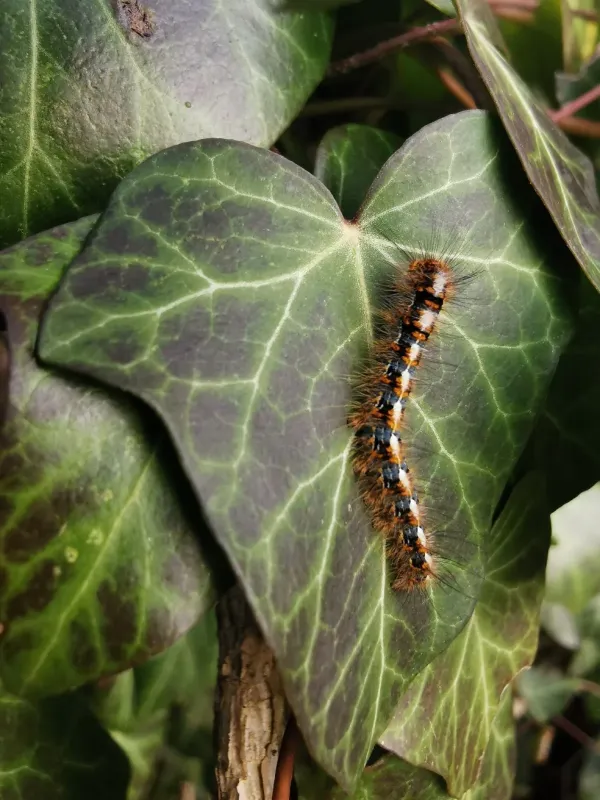
Description
How to identify
The Oak Eggar (lat. Lasiocampa quercus) is a large moth belonging to the Lasiocampidae family. Adult moths have a wingspan of 60–80 mm for females and 50–65 mm for males. They exhibit sexual dimorphism, with males often showing dark brown wings with a distinct yellow band, while females have lighter, ochre-brown wings.
The larvae, or caterpillars, are notable for their impressive size, reaching up to 90 mm in length. They are covered in dense, irritating hairs. Their coloration is striking, often consisting of dark velvety skin patterned with bright yellow or red lateral spots, serving as a warning to predators.
The pupa is formed inside a hard, compact, dark brown silk cocoon. These cocoons are typically hidden among leaf litter, in hedgerows, or attached to twigs of host plants. The durability of the cocoon provides excellent protection against environmental extremes and some predators.
This species has a univoltine life cycle, meaning there is only one generation per year. Larvae overwinter in their early stages within the leaf litter. In spring, they resume feeding, growing rapidly as temperatures rise, which corresponds with the flush of new foliage on their host trees.
Adult moths are primarily nocturnal, but males are often seen flying during the day in search of females. After mating, females disperse eggs across host plants, ensuring that the next generation of larvae will have immediate access to food sources upon hatching.
What it damages
The Oak Eggar is a generalist feeder (polyphagous) that attacks a wide variety of deciduous trees and shrubs. Common host plants include oak, birch, willow, and various fruit trees such as apple, pear, and plum, making it a pest of both forest and orchard environments.
The primary damage is caused by the caterpillars, which have a voracious appetite. In years of high population density, they can completely defoliate branches or entire small trees, leaving only the midribs of leaves remaining.
Severe defoliation significantly reduces the tree's photosynthetic capacity. This stresses the tree, making it susceptible to secondary pests, fungal diseases, and environmental stressors like drought or winter frost, eventually leading to stunted growth or reduced fruit yields.
Young trees are particularly vulnerable to repeated defoliation events. If a tree is stripped of its leaves for several consecutive seasons, it may fail to store enough energy for dormancy, leading to tree decline and eventual death.
The caterpillars also deposit significant amounts of frass (excrement) throughout the canopy. This debris can contaminate fruit and promote the growth of sooty mold or other pathogens on the foliage and branches.
Signs of infestation
The earliest signs of infestation are small, irregular holes in the leaves caused by young larvae. As the caterpillars grow, these holes enlarge, eventually resulting in the complete stripping of the leaf lamina.
The presence of frass on the leaves or falling to the ground beneath the canopy is a clear indicator of active feeding by large larvae. The sound of feeding — a distinct rustling — can often be heard in heavily infested trees during quiet periods.
Finding the characteristic, firm, dark brown cocoons attached to twigs or hidden in the plant base confirms the presence of the moth in the area and indicates that the larvae have completed their feeding stage.
Direct sighting of the large, brightly colored caterpillars is the most obvious sign. They are frequently observed resting on branches or foliage during the day in the late spring and summer months.
- Irregular leaf holes and skeletal leaves.
- Accumulation of frass beneath the tree canopy.
- Sighting of large, hairy, colorful caterpillars.
- Presence of firm brown cocoons on twigs or leaf litter.
Control measures
For small-scale infestations in home gardens, manual collection and destruction of the larvae is a highly effective method. Always wear gloves, as the hairs of the larvae can cause skin rashes or allergic reactions in sensitive individuals.
Biological control using Bacillus thuringiensis (Bt) sprays is an excellent choice for larger areas. This bacterium is specific to caterpillars and effectively manages populations without harming beneficial insects, birds, or mammals.
Chemical insecticides should be reserved as a last resort, used only when the threshold of damage is exceeded. When using chemical control, apply only at the recommended stage of larval development and follow all safety guidelines to protect the local environment.
Enhancing habitat for natural predators is a sustainable management strategy. Encouraging insectivorous birds, parasitic wasps, and predatory beetles in your garden will help maintain the Oak Eggar population at levels that do not cause significant economic damage.
Cultural practices, such as raking and removing leaf litter beneath host trees in late autumn, can destroy overwintering larvae and pupae. This significantly disrupts the life cycle and reduces the number of larvae that will emerge the following spring.
Taxonomy
- Latin name
- Lasiocampa quercus
- Order
- Lepidoptera (butterflies)
- Family
- Lasiocampidae
- EPPO code
- LASCQU
Discussion
No discussions yet — be the first.