
Black-headed gull
Larus ridibundus
Description
How to identify
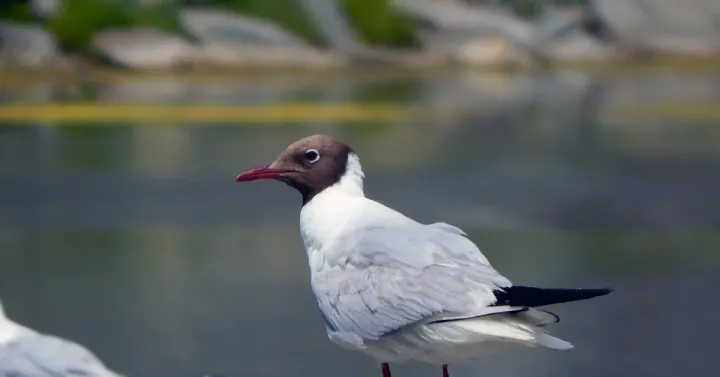
The black-headed gull (Larus ridibundus) belongs to the Charadriiformes order, Laridae family. It is a medium-sized gull easily identified by its chocolate-brown head mask during the breeding season.
Adult birds exhibit a wingspan of up to one meter, with white underparts and pale grey wings, often seen in large groups flying over open agricultural lands.
In winter, the dark head mask fades, leaving white plumage with distinct dark ear spots, which is a key identification feature for field observations during cooler months.
This species is highly intelligent and adaptable, frequently exploiting human-altered landscapes, including commercial fields and irrigation reservoirs, for foraging.
Their colonial nesting behavior leads to concentrated foraging patterns, making them a significant agricultural nuisance in areas adjacent to their colonies.
What it damages
Black-headed gulls cause substantial damage to cereal and vegetable crops by predating on seeds and tender seedlings as they emerge from the soil.
When gulls feed on freshly sown fields, they often pull up the seeds, resulting in patchy emergence and reduced plant density that negatively impacts final yields.
In later stages of plant development, gulls damage ripening soft fruits and vegetables by pecking at them, which leads to immediate loss of commercial quality and rot development.
Heavy foot traffic from large flocks moving across the field compacts the soil and physically crushes fragile crops, further damaging the field's potential.
The accumulation of guano in foraging areas creates localized nutrient imbalances and can lead to foliage scorching, especially in high-density patches.
When it appears
The highest risk period for crop damage occurs during the spring planting season, when seeds are accessible in the upper soil layers or just beginning to germinate.
During the summer months, as fruits and vegetables ripen, gulls frequently attack these crops to satisfy their hydration and nutrient requirements during the breeding cycle.
Post-harvest periods often attract large numbers of birds to fields to forage on residual grain, which inadvertently encourages them to return to the same site next season.
Migratory movements often bring thousands of gulls into agricultural regions, coinciding with the critical germination phases of various important row crops.
Daily foraging activity is most intense during early morning hours, often starting immediately after dawn as flocks move from their nesting sites to agricultural fields.
Signs of infestation
Visible indicators of gull presence include irregular gaps in crop rows, where seed predation has left the soil bare or littered with hulls.
The discovery of characteristic webbed footprints on moist soil, combined with white droppings, confirms that a gull flock has been active in the area.
- Ragged edges on young leaves of sprouted plants.
- Small craters in the soil surface near seed-drilled rows.
- Puncture marks on ripening fruits or succulent vegetables.
- Scattered feathers left behind in the field.
- Decreased plant population counts shortly after emergence.
Aggressive circling of birds over a specific field often indicates active feeding behavior, necessitating an immediate assessment by the field manager.
Control measures
Bioacoustic deterrents that broadcast recorded distress calls are highly effective at disrupting gull feeding habits and discouraging them from landing.
Visual deterrents, such as predator decoys and reflective deterrent tape, should be rotated regularly to prevent the gulls from becoming habituated to them.
Improving seeding techniques, such as deep drilling and effective soil compaction, helps hide seeds from visual detection by gulls, significantly reducing predation.
Deployment of unmanned aerial vehicles (drones) has proven to be a modern and highly efficient method for actively herding birds away from high-value crop fields.
Maintaining clean farm perimeters and minimizing waste disposal sites near fields reduces the overall attractiveness of the area to large gull colonies.
Taxonomy
- Latin name
- Larus ridibundus
- Family
- Laridae
- EPPO code
- LARURI
Discussion
No discussions yet — be the first.