
European herring gull
Larus argentatus
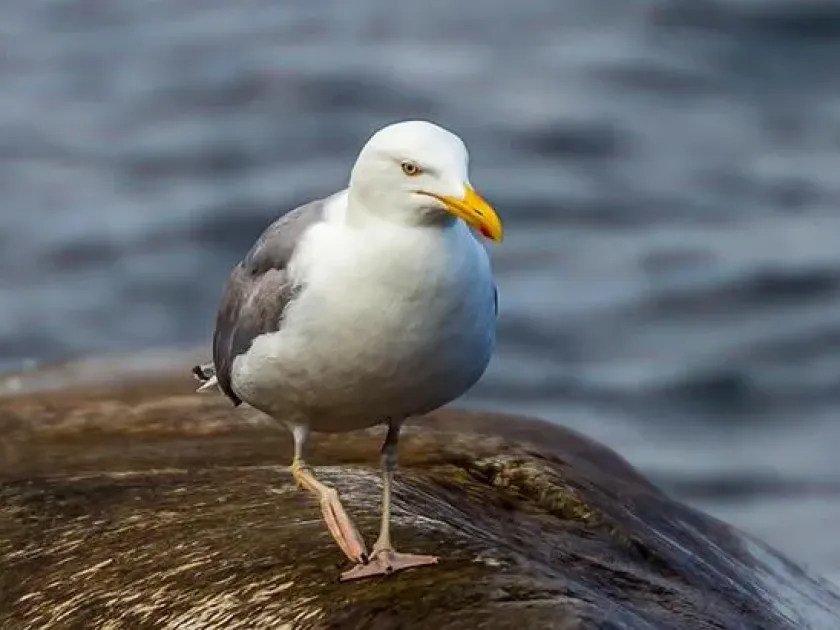
Description
How to identify
The European herring gull (Larus argentatus) is a member of the Laridae family in the Charadriiformes order. It is a large bird with a wide wingspan, known for its opportunistic feeding behavior.
These birds are highly adaptable and have moved from marine environments to agricultural lands, where they exploit crops and soil resources for food.
Their biology involves colonial nesting patterns, which concentrate large numbers of individuals in proximity to farmland, increasing the frequency of agricultural raids.
Gulls are highly intelligent animals capable of learning the timing of planting and harvesting cycles, allowing them to time their feeding visits effectively.
The species shows resilience to environmental changes, making it a persistent agricultural pest that requires long-term management strategies.
What it damages
European herring gulls cause significant damage by consuming newly planted seeds and young seedlings of grain crops, leading to poor plant establishment.
In horticultural operations, they peck at fruits and vegetables such as tomatoes and berries, ruining the marketability of the produce with deep punctures.
Mechanical damage caused by the trampling of plants by large gull flocks can lead to severe stunting or total loss of young, delicate vegetative covers.
The intensity of the damage spikes during the ripening phase, as the birds exploit the sugar-rich fruit as a vital energy source for their colonies.
Additionally, the birds contaminate fields with droppings, potentially introducing harmful bacteria that negatively impact the overall sanitation of food products.
When it appears
Activity is most intense in the spring, when gulls target germinating seeds and young sprouts, which are easy to access before deep soil incorporation.
During the summer months, the focus shifts to vegetable gardens and orchards as fruits reach maturity and become highly attractive food sources.
Autumn feeding occurs on post-harvest fields, where gulls forage for remaining grains, which can interfere with autumn soil preparation and residue management.
The seasonal presence is driven by the bird's breeding cycle, as the nutritional demand for their chicks forces them to maximize foraging time.
Strategic field monitoring is essential throughout the growing season to identify the exact window when deterrence measures need to be implemented.
Signs of infestation
The presence of large white-and-grey birds on fields, coupled with characteristic loud calls, is the most immediate sign of an imminent or active infestation.
Visual inspection of the crop reveals jagged, irregular pecking marks on fruits and vegetables, distinct from the finer bites of smaller pests.
Heavy accumulation of avian feces on foliage and between rows serves as a clear indicator that the site is being used as a primary feeding ground.
The appearance of bare, trampled patches in previously uniform fields suggests that the birds have been congregating and causing significant mechanical damage.
Broken greenhouse materials or torn protective netting are clear signs that the gulls are actively attempting to reach protected produce.
Control measures
Physical exclusion is the most reliable control method; netting installed over berry and vegetable crops prevents birds from making contact with the fruit.
Visual deterrents, such as predator decoys and reflective ribbons, can be effective if rotated frequently to prevent the gulls from habituating to them.
Bioacoustic devices that play alarm calls of gulls or the sounds of natural predators create an environment of stress that discourages them from landing.
Propane cannons, which produce periodic loud blasts, can be useful for protecting large-scale grain fields, though they must be moved regularly for efficacy.
- Regular removal of organic farm waste.
- Consistent rotation of visual deterrents.
- Strategic timing of planting to minimize exposure.
Taxonomy
- Latin name
- Larus argentatus
- Family
- Laridae
- EPPO code
- LARUAR
Discussion
No discussions yet — be the first.