
Blue-legged clerid
Korynetes caeruleus
Description
How to identify
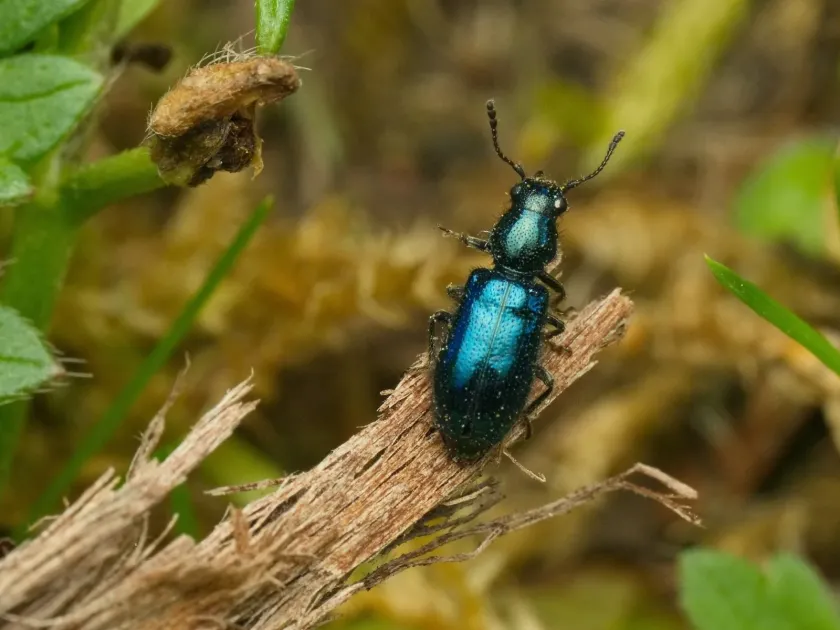
The blue-legged clerid, scientifically known as Korynetes caeruleus, is a predatory beetle belonging to the Cleridae family within the order Coleoptera. It is recognized by its distinct metallic blue or greenish-blue coloration.
The adult beetle typically measures between 3.5 and 7 mm in length. Its body is covered with fine, dense hairs, and the head and pronotum exhibit prominent pitting, which is a key diagnostic feature for the species.
As members of the Cleridae family, these beetles have a complex lifecycle. While adults are predatory, their larvae are specialized wood inhabitants that utilize pre-existing tunnels created by other wood-boring insects.
These insects are highly mobile, especially during the breeding season, when adults actively fly to locate suitable timber where they can lay eggs within crevices or existing insect galleries.
The development cycle can be extended, often taking several years to reach adulthood depending on the environmental conditions, such as the wood species and the surrounding moisture content.
What it damages
This beetle is primarily considered a pest of seasoned or dry wood found in buildings, barns, and storage facilities. It targets structural components including beams, joists, and various wood products.
The damage caused by Korynetes caeruleus is often secondary, as it frequently occupies wood already weakened by primary wood-boring pests like the common furniture beetle or death-watch beetle.
While they are predatory and feed on the larvae of other wood-boring insects, their own larval activity contributes to further structural degradation by extending and widening existing tunnels.
In agricultural settings, the beetle can cause significant damage to timber structures in granaries or sheds, where conditions favor the proliferation of wood-associated insects.
Long-term infestation can lead to the structural failure of wooden beams, making regular inspection and prompt intervention essential to maintaining building integrity.
Signs of infestation
The most common sign of infestation is the presence of small, circular exit holes, approximately 1–2 mm in diameter, on the surface of the timber, indicating that adults have emerged.
Fine wood dust, often called frass, accumulating near holes or on surfaces underneath wooden elements, suggests active larval feeding or tunneling within the wood matrix.
In quiet environments, one might hear faint ticking or scratching sounds caused by the larvae as they gnaw through the wood, which is a distinct indicator of active boring activity.
Observing adult beetles near windows or light sources during the summer months is a strong sign that there is a localized population established within the building structure.
Softened, brittle, or crumbling wood surface indicates that the material has been extensively hollowed out from within, requiring urgent structural evaluation.
Control measures
Preventive measures are highly effective and include maintaining dry conditions in buildings. Keeping wood moisture levels low prevents successful egg-laying and larval development.
Applying borate-based wood preservatives or commercial insecticides to the surface of the timber creates a protective barrier that prevents new infestations and deters adult beetles.
For existing infestations, localized injection of insecticidal solutions directly into the beetle galleries is a precise method to reach and eliminate the larvae concealed inside the wood.
Fumigation is the most intensive treatment option, reserved for severe infestations where pests have spread throughout a building's entire timber framework, ensuring complete eradication.
- Regular inspection of structural timbers in unheated storage areas.
- Sealing cracks and crevices in wood to reduce potential oviposition sites.
- Replacing or treating heavily damaged sections to restore structural safety.
Taxonomy
- Latin name
- Korynetes caeruleus
- Order
- Coleoptera (beetles)
- Family
- Cleridae
- EPPO code
- KORYCA
Discussion
No discussions yet — be the first.