

Pest · Hemiptera (bugs, aphids, leafhoppers) · affects Potato, Winter rapeseed, Apple
Especially harmful
Cabbage aphid
Brevicoryne brassicae
Description
How to identify
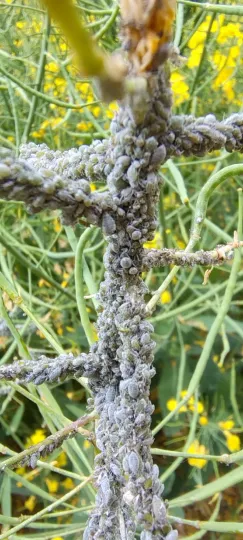
The cabbage aphid (Brevicoryne brassicae) is a small insect belonging to the family Aphididae (order Hemiptera). Wingless females are about 2.3 mm long and are covered in a greyish-white waxy powder.
This waxy coating gives the colonies a distinctive ash-green appearance, making them stand out against the host plant leaves.
Winged forms appear when colonies become overcrowded, allowing the aphids to migrate to new host plants and expand the infestation area.
The species survives the winter primarily in the egg stage, with tiny, shiny black eggs laid on the stalks of host plants or debris.
Reproduction is highly prolific; once the temperature reaches optimal levels, the population can grow exponentially within a few weeks.
What it damages
The primary hosts are members of the Brassicaceae family, specifically cabbage, rapeseed (canola), broccoli, and cauliflower.
Other crops can also be affected, including fodder beet, peas, tomato, potato, hops, and apple trees, particularly when they are growing near heavily infested brassica fields.
The aphids feed by inserting their stylets into the plant's phloem and sucking out the sap, which removes vital nutrients and water from the plant.
This feeding activity causes leaves to yellow, curl, and distort, which severely impairs the plant's ability to undergo photosynthesis.
In young plants, high infestations can cause wilting, stunted growth, or even complete crop loss if left unmanaged.
When it appears
In spring, when temperatures rise above 10°C, the overwintered eggs hatch, giving rise to the first generation of aphids known as "founders."
Summer months, particularly June through August, represent the peak period for population growth as weather conditions favor rapid multiplication.
Winged migratory adults are most active during the mid-summer period, spreading from early-season crops to late-season cabbage plantings.
As autumn approaches, the aphids produce sexual forms that mate and lay the eggs destined to survive the winter season.
The life cycle is closely synchronized with the growth stages of brassica crops, ensuring that food is available throughout the vegetation period.
Signs of infestation
The first sign of an infestation is the appearance of small, pale, or yellowish spots on the upper leaf surface where the aphid has punctured the tissue.
Large, dense, ash-grey colonies located on the undersides of leaves or on flower stalks are the most visible indication of a severe problem.
Leaves often become cupped or twisted, providing shelter for the aphid colonies and making them harder to reach with contact pesticides.
The presence of honeydew—a sticky, sugary substance secreted by the aphids—often leads to the growth of black sooty mold on the foliage.
A failure in head formation in cabbage or stunted development of flowering heads are classic signals of long-term damage caused by these insects.
Control measures
Cultural control is essential; this involves removing and destroying crop residues and controlling cruciferous weeds in and around the field.
Promoting biodiversity helps, as natural predators like ladybirds (coccinellids), lacewings, and hoverfly larvae feed voraciously on aphid colonies.
When the economic threshold is reached, chemical control using systemic insecticides is often necessary to prevent significant yield losses.
It is recommended to monitor fields weekly and target the early stages of infestation to prevent the colonies from becoming established.
Always rotate insecticide modes of action to manage the risk of developing resistance within the aphid population.
In brief
10
Damages crops
Content graph
Damages crops · 10
Content graph
Connections · Cabbage aphid
Most often together:
Marketplace
Products · 16
Biology
Taxonomy
- Latin name
- Brevicoryne brassicae
- Order
- Hemiptera (bugs, aphids, leafhoppers)
- Family
- Aphididae
- EPPO code
- BRVCBR
Community
Discussion
No discussions yet — be the first.