
Black palm scale
Ischnaspis
Description
How to identify
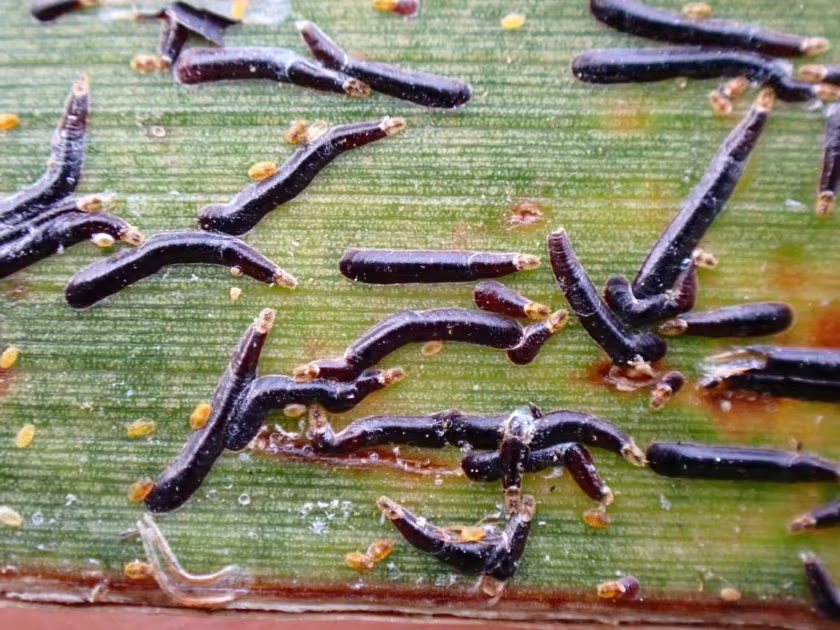
The Black palm scale (Ischnaspis longirostris) is a destructive pest belonging to the family Diaspididae. It is easily recognized by its extremely narrow, elongated, and jet-black armor with a distinct metallic sheen.
Adult females are approximately 3-4 mm long. Because they are so thin and dark, they often blend in perfectly with the leaf veins, making them extremely difficult to detect during the early stages of infestation.
While the females remain stationary, the winged males can move between plants to facilitate breeding. The entire lifecycle is protected by the waxy shield, which acts as a formidable barrier against environmental stressors and many pesticides.
Reproduction occurs throughout the year in indoor conditions. A single female can produce numerous offspring, which, as active "crawlers," search for new feeding sites on the leaf surfaces before establishing their own protective covers.
Identification often requires a magnifying glass or a microscope to distinguish these scales from plant debris or natural leaf markings, as their appearance is quite subtle.
What it damages
This pest primarily attacks various species of palms, including Chamaedorea, Areca, Kentia, and date palms. Beyond palms, it frequently infests tropical ornamental plants such as coffee trees, gardenias, and oleanders.
The scale feeds by sucking cell sap from the plant tissues, leading to severe nutrient depletion. This feeding process results in chlorosis, necrotic spots, and significant deformation of the leaves.
Heavy infestations lead to the yellowing and premature dropping of foliage. Once the plant's metabolic processes are severely compromised, its growth slows down, and it becomes susceptible to secondary infections or death.
The secretion of honeydew is a major issue, as it promotes the growth of sooty mold. This black fungal coating covers the leaves, further blocking photosynthesis and weakening the overall health of the specimen.
In greenhouses and indoor environments, the infestation spreads rapidly from one plant to another, posing a significant threat to entire collections if not managed promptly and effectively.
When it appears
In greenhouses and interior settings, the Black palm scale is active year-round. Consistent temperatures between 22-28 degrees Celsius create the perfect conditions for continuous breeding cycles.
Peak crawler activity usually aligns with the plant's active growing season, particularly during spring and summer, when light levels and temperature promote metabolic growth. This is the period when plants are most vulnerable to colonization.
Low humidity levels, often caused by indoor heating systems during the winter, exacerbate the problem. Dry air stresses the plants, making them less resistant to the scale's feeding activity.
Although the pest's metabolism slows during cooler months, it does not stop feeding. Constant monitoring is necessary throughout the year to prevent the establishment of large colonies.
The life cycle can be completed in as little as a few weeks, meaning several generations can occur within a single year, making it essential to maintain a rigorous and persistent control strategy.
Signs of infestation
The most prominent sign is the presence of small, thin, black, needle-like scales on the leaves. These are often neatly arranged along the main leaf veins or near the leaf margins.
Sticky honeydew on the leaves or the surface underneath the plant is a clear indication that sap-sucking insects are present. Even if the scales are not immediately visible, the stickiness confirms their activity.
The development of sooty mold, appearing as a wipeable black soot on the foliage, is a secondary sign. This usually indicates that the infestation has reached a critical stage and requires immediate action.
Stunted growth or leaves that fail to unfurl properly are common indicators that the plant is suffering from chronic nutrient loss caused by the scales' feeding.
- Yellow or marbled spots on foliage.
- Sticky residue on leaves and pots.
- Leaf drop and general wilting of the plant despite regular watering.
Control measures
Mechanical removal is the first line of defense. Gently scrub the leaves with a soft brush or a cloth dampened with a mild soap or alcohol solution to physically dislodge the stationary adult scales.
Systemic insecticides are the most effective solution for larger infestations. These chemicals are absorbed into the plant's sap, poisoning the scales when they feed. Products containing imidacloprid are commonly used.
Multiple treatments are strictly necessary because systemic insecticides rarely kill eggs protected under the scale cover. Schedule applications every 10-14 days to capture new crawlers as they emerge.
Quarantine all new plants for at least 3-4 weeks before introducing them to your primary collection. This practice is the most successful method for preventing new scale outbreaks.
In large-scale greenhouse operations, biological control using parasitic wasps is an option, but for home gardeners, a combination of mechanical cleaning and appropriate chemical treatment remains the standard approach.
Taxonomy
- Latin name
- Ischnaspis
- Order
- Hemiptera (bugs, aphids, leafhoppers)
- Family
- Diaspididae
- EPPO code
- ISCPSP
Discussion
No discussions yet — be the first.