
Grape black moth
Illiberis nigra
Description
How to identify
The grape black moth (Illiberis nigra) belongs to the Zygaenidae family, within the order Lepidoptera. It is a small moth, typically with a wingspan of 25–30 mm.
The adult insect features a characteristic black coloration with a subtle bluish or metallic sheen. The wings are narrow and sparsely covered with scales, giving them a translucent appearance.
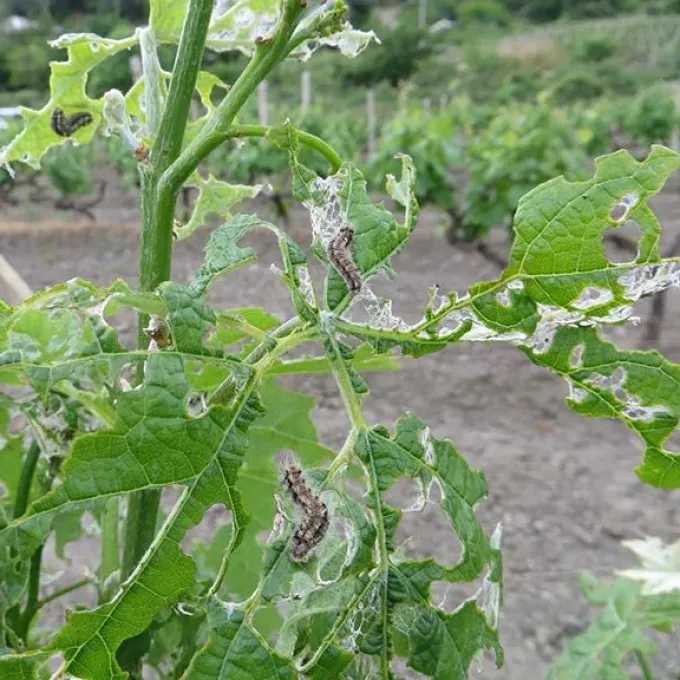
Larvae (caterpillars) are grayish-yellow or pinkish, covered in short hairs. They possess the typical body structure of the family with well-developed thoracic and abdominal legs.
Pupae develop within dense, whitish or yellowish cocoons, which the insect spins in the crevices of grapevine bark or among fallen leaves.
Females deposit eggs in small clusters, usually on the underside of leaves; the eggs are oval-shaped and light-colored, making them difficult to detect in the early stages.
What it damages
The primary food source for this pest is the grapevine (Vitis vinifera). The grape black moth can cause significant damage to commercial vineyards and home gardens alike.
In addition to cultivated grapes, the insect can be found on certain wild plants within the Vitaceae family, which helps sustain the population near cultivated areas.
The greatest damage is caused by the larvae, which begin feeding immediately after hatching, destroying leaf tissue and significantly reducing the photosynthetic area of the vine.
During periods of mass infestation, the moth can damage not only the foliage but also young fruit clusters, leading to a substantial decrease in yield and poor berry quality.
Severe infestations weaken the plant, resulting in poor wood maturation and reduced overall winter hardiness for the grapevine in the following season.
When it appears
This pest primarily overwinters as larvae of various instars, hiding in sheltered locations such as under peeling bark, in crevices of old wood, or within leaf litter.
In spring, as sap begins to flow and buds break, the larvae emerge from their overwintering sites and begin active feeding on young leaves.
The flight of the first generation of moths typically occurs in late spring or early summer. Depending on the climate, the pest may complete one or two generations per year.
The peak activity of the pest often coincides with the period of rapid foliage growth, making control efforts during this time critical for protecting the future crop.
In autumn, late-instar larvae enter diapause to prepare for winter, a factor that must be considered when planning autumn agrotechnical measures.
Signs of infestation
The first sign of the grape black moth is the presence of small holes in the leaves, which eventually expand into large skeletonized patches.
A characteristic sign is the presence of the larvae themselves, which often coil into a ring or drop to the ground when disturbed.
Excrement clusters, appearing as small dark granules, can be found on damaged leaves and often attract secondary pests or encourage fungal infections.
During dormant season inspections, remnants of cocoons can be observed on the vines, serving as an indicator of a population present in the previous season.
In areas of high infestation, premature yellowing and leaf drop can be observed, visually distinguishing damaged vines from healthy ones.
Control measures
Mechanical control includes cleaning vine trunks of loose, old bark where larvae and pupae often overwinter, followed by the proper disposal of plant debris.
Agrotechnical practices, such as regular thinning and canopy management, improve airflow and light penetration, creating conditions less favorable for moth reproduction.
Biological control involves the use of specialized entomophagous insects and bacterial formulations based on Bacillus thuringiensis, which are effective against early-instar larvae.
Chemical control strategies are based on applying systemic and contact insecticides during the peak periods of larval hatching and early adult feeding activity.
- Timely monitoring of populations using pheromone traps.
- Adherence to pesticide application protocols during the pre-flowering stage.
- Use of selective pesticides to minimize impact on beneficial insects.
Taxonomy
- Latin name
- Illiberis nigra
- Order
- Lepidoptera (butterflies)
- Family
- Zygaenidae
- EPPO code
- ILLINI
Discussion
No discussions yet — be the first.