
Grape leaf skeletonizer
Illiberis
Description
How to identify
The grape leaf skeletonizer (Illiberis vitis) is a moth belonging to the family Zygaenidae. It is a small insect that can cause significant damage to vineyards.
Adult moths are characterized by slender bodies and wingspans ranging from 20 to 25 mm. They typically exhibit a dark, metallic blue or black coloration.
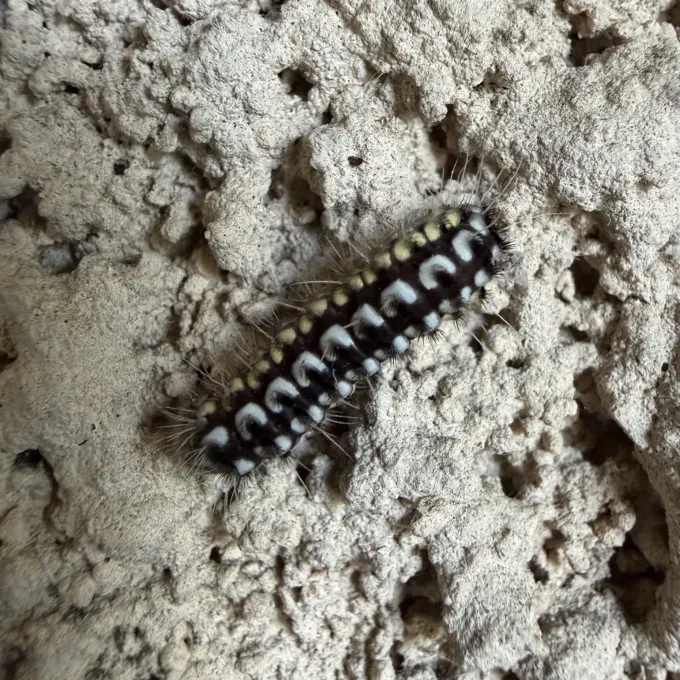
Larvae are roughly 15 mm in length and are covered in short, fine hairs. Their body color ranges from pale yellow to gray with distinct dark spots along their sides.
The life cycle includes four stages: egg, larva, pupa, and adult. This complete metamorphosis allows the species to thrive and adapt to various environmental conditions.
The larvae overwinter in protective locations such as bark crevices, plant debris, or soil at the base of the vine, awaiting favorable spring temperatures.
What it damages
This pest primarily attacks grapevines (Vitis vinifera). While cultivated vines are the main target, wild grape species may also serve as secondary hosts.
The larvae start feeding early in the season by consuming swelling buds. This destruction of buds directly reduces the number of shoots and eventual yield.
As the season progresses, they transition to the leaves, feeding on the tissue and leaving the vein structure intact, a process known as skeletonization.
Heavy infestations can lead to the destruction of flowers and developing fruit clusters, significantly compromising the overall quality of the harvest.
Severe defoliation weakens the grapevine, reducing its vigor and leaving it more susceptible to various fungal diseases and harsh winter conditions.
When it appears
Larval emergence typically occurs in the spring, coinciding with the bud-break phase of the grapevines, which is usually in April or May.
The larval feeding period lasts for several weeks, after which the insects form cocoons on the vine structure to transform into the pupal stage.
Adult moths usually emerge in early summer. The flight period is when mating occurs, and females lay eggs on the undersides of the leaves.
A second generation of larvae may appear mid-summer, continuing to feed on the foliage until the autumn temperatures signal the onset of winter.
The cycle concludes as the mature larvae seek shelter in crevices or under bark to enter diapause, effectively surviving the winter until the following spring.
Signs of infestation
The most noticeable early sign is the presence of damaged or hollowed-out buds that fail to develop properly during the early growing season.
Leaves display characteristic patterns where the soft green tissue is missing, leaving behind a delicate skeleton composed of the major leaf veins.
Frass (larval excrement) is often found on the leaf surfaces or in the crotches of the vines, serving as a reliable indicator of recent feeding activity.
By inspecting the undersides of the leaves during the day, one can often find clusters of larvae resting or feeding, particularly on younger foliage.
Finding grayish, oval-shaped cocoons attached to the bark or stems in late summer is a clear sign that the pest population has established itself on the site.
Control measures
Removing loose bark from the vine trunks during the dormant season is an effective way to destroy overwintering sites for the larvae and cocoons.
Manual removal of larval clusters during the initial stages of an infestation is a non-chemical method that can significantly lower the pest population.
Biological control agents, such as Bacillus thuringiensis sprays, are highly effective against young larvae while being safe for beneficial insects.
Chemical insecticides should be applied strategically, targeting the window after bud burst and before significant leaf damage occurs, following local regulations.
- Cultivating the soil around the vines to disturb pupae.
- Using pheromone traps for monitoring and early detection.
- Maintaining healthy vines to improve resilience against pest attacks.
Taxonomy
- Latin name
- Illiberis
- Order
- Lepidoptera (butterflies)
- Family
- Zygaenidae
- EPPO code
- ILLISP
Discussion
No discussions yet — be the first.