
Channel catfish
Ictalurus punctatus
Description
How to identify
The channel catfish (Ictalurus punctatus) belongs to the Ictaluridae family. It is a large, freshwater fish known for its remarkable adaptability to various environments.
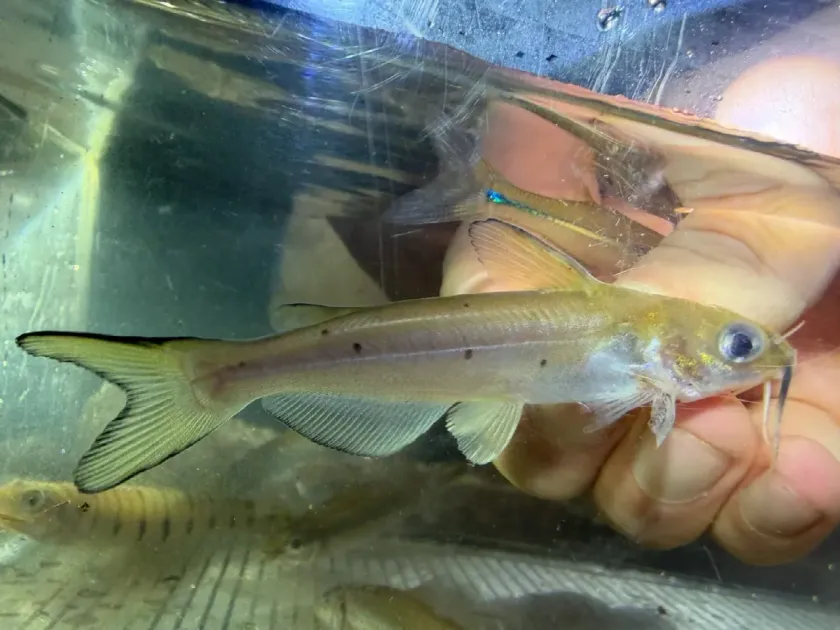
The body is elongated, scaleless, and covered in a thick layer of mucus. It possesses eight barbels surrounding the mouth, which act as sensory organs.
The coloration ranges from blue-grey to olive, usually marked with small black spots along the sides, which fade in older, larger individuals.
Its fins contain sharp spines that can cause painful puncture wounds, making the fish difficult and dangerous to handle without proper equipment.
It thrives in stagnant or slow-moving water and can tolerate low oxygen levels that would prove fatal to many other species of fish.
What it damages
In an agricultural context, the channel catfish acts as an invasive species that disrupts pond ecosystems and irrigation networks.
It competes aggressively for food with commercially valuable species, often eradicating local fish populations due to its superior adaptability and hunger.
In irrigation systems, channel catfish cause significant structural damage by burrowing into the banks of ditches, levees, and canal embankments.
This burrowing activity weakens the soil structure, leading to leaks, collapse of irrigation channels, and loss of water intended for crop fields.
Their presence significantly reduces the efficiency of water management systems and complicates the maintenance of agricultural hydraulic infrastructure.
When it appears
The channel catfish is most active during the spring and summer months when water temperatures rise above 20 degrees Celsius.
The spawning season occurs in late spring, during which the fish become highly territorial and protective of their nesting sites in the mud.
Throughout the warm season, they engage in continuous foraging, moving throughout connected water systems in search of nutrients.
As autumn approaches, activity patterns shift toward storing energy for the winter months spent in deeper, more stable water areas.
During winter, they exhibit reduced activity but can wake quickly during warm spells, resuming their destructive behaviors in water channels.
Signs of infestation
A primary indicator of their presence is a sharp decline in native fish populations and disappearance of fish feed from managed ponds.
Visible signs of damage include holes and undercuts in the banks of irrigation canals, suggesting the presence of catfish burrows.
At night, using a flashlight near the water surface often reveals the distinct, reflective glow of their eyes, confirming a high population density.
Frequent equipment malfunctions, such as clogged pipes or torn filtration screens, often occur due to their physical size and sharp spines.
Excessive turbidity in irrigation water, unrelated to rain or soil erosion, is a classic sign of catfish stirring up sediment on the pond floor.
Control measures
The most effective control measure is draining ponds completely and allowing the bed to dry out to eliminate eggs and juveniles.
Installing fine-mesh screens at the intake points of irrigation systems prevents the migration of catfish into critical water distribution networks.
Biological control, such as introducing predatory fish like pike or bass, can help manage the catfish population by preying on smaller individuals.
Regular, intensive trapping and net harvesting are necessary to maintain low population levels in private or commercial water systems.
Reinforcing bank edges with stone or geotextiles is essential to prevent the burrowing behavior that damages irrigation infrastructure.
Taxonomy
- Latin name
- Ictalurus punctatus
- Family
- Ictaluridae
- EPPO code
- ICTAPU
Discussion
No discussions yet — be the first.