
Channel catfish
Ictalurus
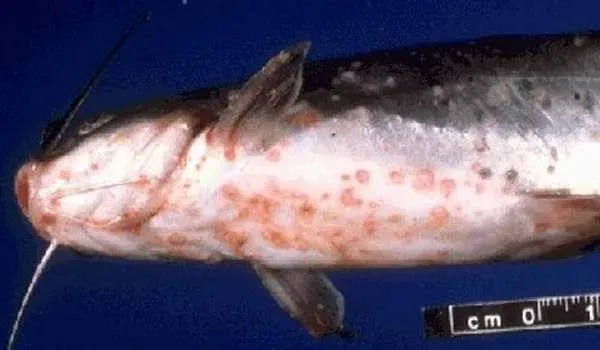
Description
How to identify
The channel catfish (Ictalurus punctatus) belongs to the order Siluriformes and the family Ictaluridae. It is a robust freshwater species often considered an invasive threat to agricultural structures.
Key identification features include a scaleless body, a forked tail, and a well-defined lateral line. The presence of sharp pectoral and dorsal spines is a distinct trait.
Younger individuals are distinguished by small black spots scattered along their sides, which may fade as the fish matures into a darker, slate-gray adult.
They possess four pairs of barbels (whiskers) around the mouth, which are highly sensitive sensory organs used to forage in turbid water environments.
Due to their adaptation to low-oxygen environments, they can thrive in irrigation canals and agricultural reservoirs where other species might struggle.
What it damages
The primary economic damage caused by channel catfish in agriculture is the destruction of direct-seeded rice crops, as they actively consume seeds and tender shoots.
Their burrowing behavior in the mud of rice paddies and irrigation embankments compromises the structural integrity of dikes, leading to water loss.
Uncontrolled water drainage, caused by breached embankments, significantly disrupts irrigation schedules, resulting in reduced grain yield and uneven crop development.
Furthermore, they create turbidity in the water column, which can negatively affect the light penetration required for rice growth during the early stages.
In mixed-use water systems, they compete for resources with native or stocked fish species, complicating the management of agricultural ecosystems.
When it appears
The activity of the channel catfish is heavily influenced by water temperature, with peak foraging occurring during the spring and summer months when rice fields are flooded.
Spawning occurs when water temperatures reach approximately 21-29 degrees Celsius, prompting movement into shallow, vegetated areas of irrigation networks.
During these peak periods, the risk of infestation in agricultural plots increases significantly as adults move into flooded fields to feed and spawn.
In autumn, as water temperatures drop, the catfish tend to migrate to deeper, more stable environments, making them less of an immediate threat to the standing crop.
Predicting seasonal shifts allows managers to implement barrier controls before the fish population reaches the sensitive zones of the rice farm.
Control measures
Effective management focuses on physical exclusion methods, such as installing fine-mesh screens at intake points to prevent the entry of fry and adults.
Annual dewatering of irrigation canals during the winter months serves as a vital method for reducing the local population and disrupting breeding cycles.
Trapping and harvesting programs can be employed to manage existing populations within larger irrigation systems to mitigate damage to embankments.
- Regular maintenance and reinforcement of dike structures.
- Application of specialized monitoring to detect early invasion.
- Collaborative efforts with regional fisheries to manage invasive dispersal.
Using these combined mechanical and integrated management approaches helps ensure the longevity of irrigation infrastructure and the protection of rice seedlings.
Taxonomy
- Latin name
- Ictalurus
- Family
- Ictaluridae
- EPPO code
- ICTASP
Discussion
No discussions yet — be the first.