
Hypogastrura tullbergi
Hypogastrura tullbergi
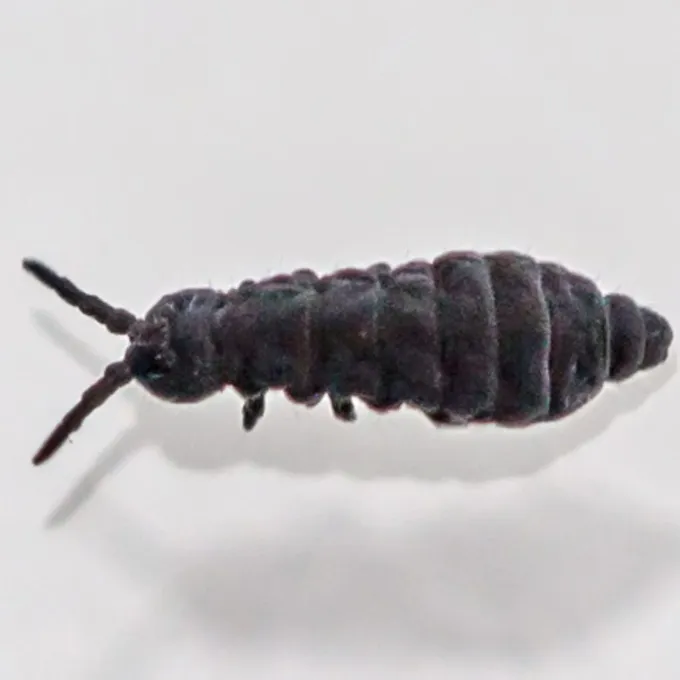
Description
How to identify
Hypogastrura tullbergi belongs to the phylum Arthropoda, class Entognatha, order Collembola (springtails), and family Hypogastruridae.
Adult specimens are tiny arthropods measuring 1 to 2 mm in length, characterized by an elongated body that is typically grey, dark blue, or nearly black.
A distinctive feature of this genus is the presence of a spring-like organ called the furcula located on the abdomen, which allows them to perform rapid jumps when threatened.
Detailed identification of the species requires microscopic examination, as they are macroscopically indistinguishable from many other springtail species inhabiting topsoil.
In natural ecosystems, they play a vital role in soil formation by feeding on decaying organic matter; however, in high-moisture agricultural environments, they become significant pests.
What it damages
This pest primarily damages young seedlings, seeds, roots, and underground stem tissues of various vegetable, floral, and ornamental crops.
Hypogastrura tullbergi causes the most severe damage in greenhouses and nurseries, where high humidity levels favor the rapid proliferation of collembolans.
They pose a particular threat to cucumber, tomato, and lettuce seedlings, as they feed on cotyledon tissues and graze on the delicate root systems of young plants.
Crops with weakened immune systems or those in the crucial germination stage are the most susceptible to mass infestations by this pest.
In waterlogged soil, the population can grow exponentially, leading to the destruction of a significant portion of the crops in a very short timeframe.
When it appears
The activity of Hypogastrura tullbergi is directly linked to soil moisture regimes, with peak activity occurring during periods of excessive irrigation.
In indoor environments, these pests can remain active year-round, provided there is high substrate humidity and sufficient organic matter for feeding.
During cooler spring and autumn periods, if water stagnation occurs, the physiological processes of springtails may slow down, but they retain their ability to reproduce.
Reproduction takes place within the soil, where females lay eggs; the larvae resemble miniature versions of the adults and pass through several developmental stages.
The lifecycle is highly temperature-dependent, with warmer, moist conditions accelerating larval development and triggering population explosions within weeks.
Signs of infestation
The primary sign of infestation is the presence of tiny, jumping insects on the surface of moist soil or in seedling trays.
Damage to seeds or emerging sprouts manifests as small ulcers, pits, or holes that eventually coalesce into larger necrotic lesions.
Plants affected by Hypogastrura tullbergi exhibit stunted growth, yellowing foliage, and roots that appear grazed or in early stages of decay.
Upon inspecting the root zone, one may observe clusters of dark, tiny insects that scurry or jump away rapidly when disturbed.
The presence of these pests is often accompanied by a musty or damp odor, as they gravitate toward soil areas with excess decomposing organic content.
Control measures
The most important control measure is strict irrigation management: avoid water stagnation and excessive moisture in the top layer of the soil substrate.
An effective agrotechnical practice is allowing the top layer of the soil to dry out between waterings, which creates an inhospitable environment for springtails.
If an infestation is detected, dusting the soil surface with dry sand or wood ash can help impede the movement and feeding of the insects.
For large-scale control, contact or systemic insecticides approved for use on the specific crop may be applied according to label instructions.
- Regular sterilization of potting mixes before planting.
- Prompt removal of plant debris that attracts collembolans.
- Ensuring adequate ventilation in greenhouses to reduce humidity levels.
Taxonomy
- Latin name
- Hypogastrura tullbergi
- Family
- Hypogastruridae
- EPPO code
- HYPGTU
Discussion
No discussions yet — be the first.