
Purple springtail
Hypogastrura purpurascens
Description
How to identify
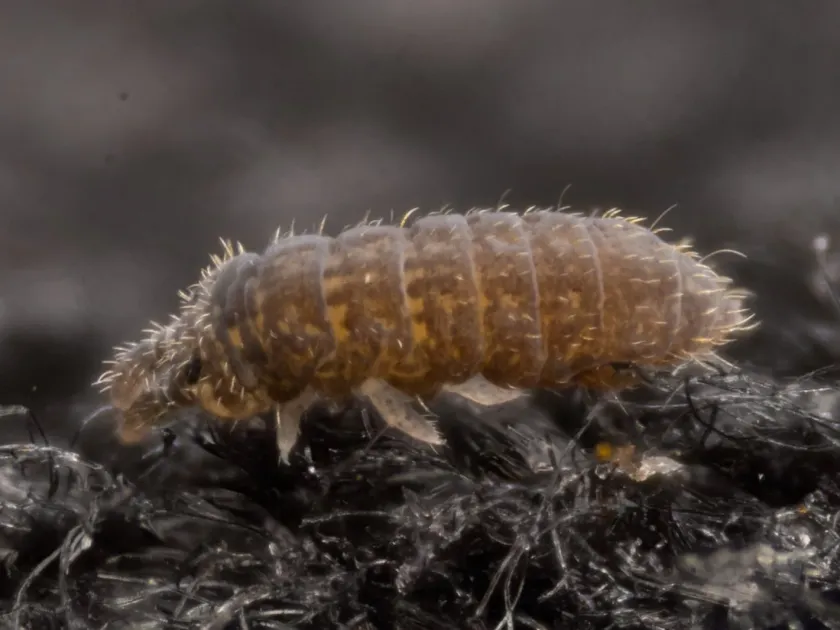
The purple springtail (Hypogastrura purpurascens) is a member of the order Collembola, family Hypogastruridae. These are tiny arthropods, typically measuring only 1 to 2 millimeters in length.
They are characterized by a deep purple to dark blue color and possess a specialized tail-like appendage called a furcula, which allows them to jump when disturbed.
These organisms are generally soil-dwelling and thrive in environments with high moisture levels and a steady supply of decomposing organic matter.
Their life cycle is relatively simple, without a pupal stage, allowing them to produce multiple generations quickly, especially in climate-controlled greenhouse environments.
Collembola populations often remain hidden deep within the soil profile until the population density becomes high enough to cause them to migrate toward the surface.
What it damages
While springtails are primarily decomposers, they can become significant pests when they feed on the delicate roots and root hairs of germinating seeds and young seedlings.
Feeding damage by these springtails weakens the root system, often providing entry points for various soil-borne pathogens and fungi that cause root rot.
Greenhouse-grown crops are most susceptible to damage, as the constant humidity and warmth create an ideal breeding ground for these persistent insects.
High population densities can cause severe stunting and even death of delicate seedlings, leading to significant economic losses in nursery and greenhouse operations.
Established plants with vigorous root systems are usually able to withstand minor infestations, but younger, smaller plants are at significant risk of failing to thrive.
When it appears
Springtail activity is directly linked to moisture availability; therefore, they are most active during the spring when seedlings are being started and frequently watered.
In greenhouses and indoor environments, they can remain active throughout the year, provided that the growing media stays damp and organic materials are present.
Periods of prolonged, excessive watering in potting mixes provide the necessary conditions for rapid population expansion, leading to noticeable infestations.
Temperature fluctuations are generally secondary to moisture, but steady, moderate temperatures often observed in indoor plant collections favor their continued presence.
You may notice a peak in surface activity immediately following irrigation, as the insects move upward when the lower soil horizons become waterlogged.
Signs of infestation
The most common sign of an infestation is the appearance of tiny, jumping purple insects on the surface of the soil immediately after irrigation or in drainage saucers.
Plants affected by springtail feeding often show signs of overall decline, including chlorosis (yellowing leaves) and stunted growth, which may be misidentified as nutrient deficiency.
In heavy infestations, you may see a dark, dusty-looking layer on the surface of the soil, consisting of countless individuals gathered in a single spot.
Inspecting the root ball of a struggling plant often reveals minor abrasions or feeding damage on the fine roots, which may show signs of decay or browning.
- Jumping insects appearing on wet soil surfaces.
- Slowed growth and general decline of seedlings.
- Dark, granular-looking patches on the substrate surface.
- Increased incidence of root rot in pots and trays.
Control measures
The most effective strategy for managing springtails is to regulate soil moisture; allowing the top layer of substrate to dry out between waterings disrupts their life cycle.
Ensure that only high-quality, sterilized potting mixes are used and avoid adding raw organic materials that could serve as a breeding source for the pests.
If an infestation is severe, applying a systemic insecticide suitable for soil application can effectively reduce the population to manageable levels.
Improving greenhouse ventilation and drainage is crucial to reduce the overall humidity levels that support the colonization of these arthropods.
Biological control options, including the introduction of entomopathogenic nematodes, can provide a targeted and environmentally friendly way to curb population surges.
Taxonomy
- Latin name
- Hypogastrura purpurascens
- Family
- Hypogastruridae
- EPPO code
- HYPGPU
Discussion
No discussions yet — be the first.