
Great silver water beetle
Hydrophilus piceus
Description
How to identify
The Great silver water beetle (Hydrophilus piceus) is one of the largest aquatic beetles found in Europe and parts of Asia. It belongs to the family Hydrophilidae, in the order Coleoptera.
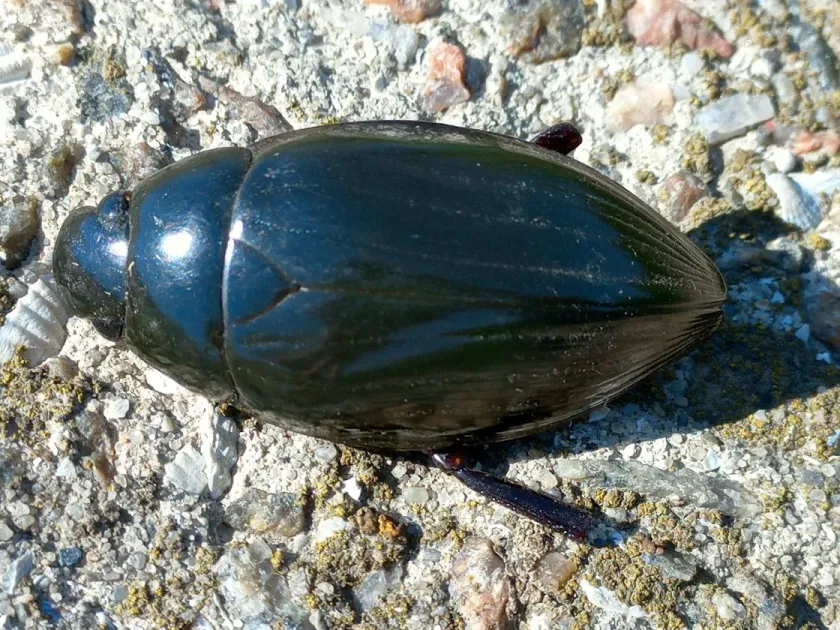
Adult beetles can reach a length of 40–50 mm, featuring a smooth, oval, jet-black body with a slight greenish sheen. They have a specialized fringe of hairs on the underside that traps air, allowing them to breathe while submerged.
Their larvae undergo three stages of growth, eventually reaching significant sizes of up to 70–80 mm. They are equipped with strong, hooked mandibles, making them highly efficient predators in stagnant water environments.
Reproduction typically occurs in spring. The female constructs a silk-like cocoon for her eggs, which she attaches to floating or submerged aquatic vegetation near the water surface.
While adult beetles are primarily herbivores, consuming algae and water plants, the larvae are strictly carnivorous, which poses a significant management challenge for aquaculture professionals.
What it damages
The primary economic damage caused by the Great silver water beetle occurs in fish farms and fry-rearing ponds. The larvae are voracious predators that feed on young fish, tadpoles, and other aquatic organisms.
In high-density fish production environments, a localized infestation of these larvae can result in a significant mortality rate among fry, particularly affecting sensitive carp populations.
The larvae capture their prey using their mandibles and inject digestive juices, which liquify the internal tissues of the prey. This makes them dangerous even to fish that are larger than themselves.
Adult beetles, although mostly herbivorous, can damage valuable aquatic vegetation used for pond filtration or habitat, leading to decreased oxygen levels and poor pond health.
Overall, the presence of these beetles reduces the net productivity of the aquaculture system, necessitating active monitoring and population management strategies.
When it appears
The activity of the Great silver water beetle is strongly dictated by water temperature. Adults begin to emerge and increase activity as spring temperatures rise, typically starting when water temperatures exceed 10–12 degrees Celsius.
The peak period for egg-laying and cocoon construction is between May and June. This is the critical window when fish farmers should be most vigilant regarding the protection of their young stock.
Larval activity is most pronounced during the warm summer months, as these insects require significant energy to grow and mature. They are most dangerous when ponds are well-warmed.
By late summer or early autumn, the larvae migrate to the damp soil along the pond banks to pupate, marking the end of their most destructive phase in the water.
Adults overwinter in the mud at the bottom of ponds or in protected areas of the shoreline, awaiting the return of spring to restart their life cycle.
Signs of infestation
One of the most obvious signs of a Great silver water beetle presence is the visual observation of large, black, oval-shaped beetles rising to the surface to replenish their air supply.
A sudden and unexplained loss of fish fry, not correlated with disease symptoms, often serves as a key indicator of larval predation in nursery ponds.
The presence of larvae can be confirmed by using fine-mesh nets to sample the vegetation along the pond edges, where the insects hide while waiting for prey.
Evidence of larval activity includes finding partially consumed fry remains or evidence of internal fluid extraction, which indicates the work of the larvae's digestive enzymes.
The observation of silk-like egg cocoons attached to aquatic plants during late spring is a clear sign that a local population is establishing itself within the water body.
Control measures
Mechanical removal remains the most practical and immediate method of control. This involves using specialized nets to collect adult beetles and removing egg cocoons from the vegetation before they hatch.
Managing the density of aquatic vegetation is essential; by thinning out overgrown plants, farmers can reduce the number of hiding spots for larvae and sites for cocoon attachment.
Draining and drying the ponds at the end of the harvest season is highly effective at disrupting the life cycle of the beetle and eliminating overwintering larvae and adults.
Biological controls include maintaining healthy populations of larger predatory fish, which can naturally suppress the number of beetle larvae by consuming them as food.
Chemical intervention is generally avoided in aquaculture settings due to the high toxicity of most insecticides to fish and the risk of unbalancing the pond's natural ecosystem.
Taxonomy
- Latin name
- Hydrophilus piceus
- Order
- Coleoptera (beetles)
- Family
- Hydrophilidae
- EPPO code
- HYDHPI
Discussion
No discussions yet — be the first.