
Great silver water beetle
Hydrophilus
Description
How to identify
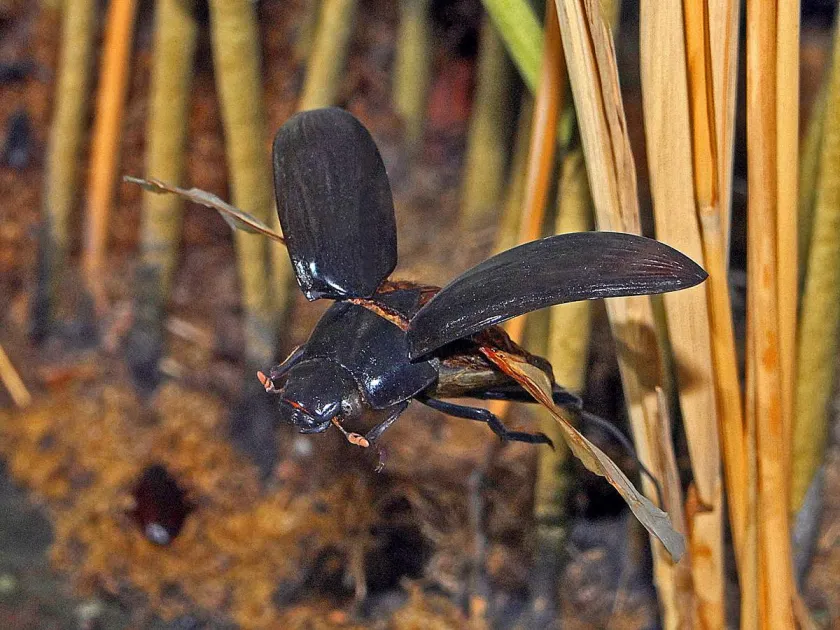
The great silver water beetle (Hydrophilus piceus) is a member of the Hydrophilidae family within the order Coleoptera. It is one of the largest aquatic beetles, reaching 40-50 mm in length.
The beetle has an oval, convex body with a shiny black color. The underside is covered in fine, dense hairs that trap a layer of air, allowing the insect to breathe while submerged.
It possesses short, clubbed antennae used for sensing the environment. The hind legs are adapted for swimming, featuring flattened structures with fringes of swimming hairs.
The larvae are worm-like, growing up to 80 mm in length. They are characterized by a large head and strong, sharp mandibles, which they use as active predators.
The species undergoes complete metamorphosis, including egg, larval, pupal, and adult stages. Adults are strong flyers and can disperse between bodies of water at night.
What it damages
The great silver water beetle is primarily predatory, but in fish farming operations, it can cause significant economic losses by attacking fish fry.
The larvae are particularly harmful, as they use their mandibles to prey on young fish, often killing more than they consume in aquaculture ponds.
Adult beetles can occasionally feed on soft plant tissues, causing minor mechanical damage to aquatic vegetation used in ornamental or commercial ponds.
While not a major pest for traditional terrestrial crops, their impact is concentrated in flooded agricultural areas like rice paddies or fish nurseries.
The cumulative effect of a dense larval population can disrupt the balance of small, closed water systems, leading to high mortality rates in aquaculture stock.
When it appears
The active season begins in spring when water temperatures rise sufficiently to trigger the emergence of adults from their wintering sites in the mud.
Mating and oviposition typically occur during late spring and early summer (May-June), when females attach egg cocoons to aquatic plant leaves.
Larval development occurs throughout the summer months, coinciding with the peak period of vulnerability for fish fry in aquaculture settings.
Adult beetles exhibit high mobility at night, allowing them to colonize new ponds throughout the warm season.
Pupation takes place towards the end of summer in the moist soil of the pond bank, after which the new generation of adults returns to the water to hibernate.
Signs of infestation
One of the first signs of an infestation is the presence of silk-like egg cocoons attached to the undersides of floating or emergent plant leaves.
Visual identification of large, dark-colored beetles surfacing periodically to breathe at the water's surface is a clear indicator of the species' presence.
Sudden declines in fish fry numbers without signs of disease often point to predation by large aquatic insect larvae, including Hydrophilus.
Mechanical damage to aquatic plant leaves, such as irregular holes or frayed edges, can indicate feeding activities by adult beetles.
A high density of larvae can be confirmed by observing the pond edges or using specialized sweep nets during the warmer months.
Control measures
The most effective management strategy involves the regular removal of dense aquatic vegetation to reduce egg-laying sites for the beetles.
Mechanical collection of adult beetles using nets during their peak spring activity significantly reduces the reproductive potential of the population.
Chemical control is generally discouraged in aquatic environments due to the extreme risk posed to fish, amphibians, and other non-target species.
Encouraging natural predators, such as waterfowl, can help maintain beetle numbers below the economic injury level in larger ponds.
Draining and drying out nursery ponds between seasons can effectively eliminate larval populations that rely on permanent water bodies for development.
Taxonomy
- Latin name
- Hydrophilus
- Order
- Coleoptera (beetles)
- Family
- Hydrophilidae
- EPPO code
- HYDHSP
Discussion
No discussions yet — be the first.