
Dagan rice grasshopper
Hieroglyphus daganensis
Description
How to identify
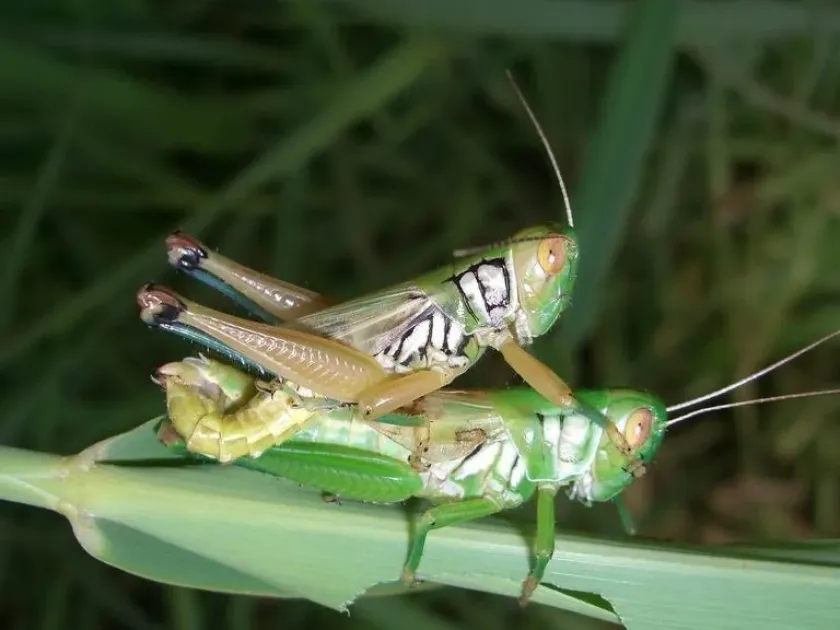
The Dagan rice grasshopper (Hieroglyphus daganensis) belongs to the order Orthoptera, family Acrididae. This large insect is adapted to survive in the humid conditions of flooded rice fields.
Adults possess a characteristic greenish-yellow coloration, providing effective camouflage among rice stems. Their body is elongated, equipped with strong hind legs adapted for jumping.
Nymphs resemble the adults morphologically but are smaller and lack fully developed wings. They undergo several molting stages, gradually increasing in size during their growth cycle.
The species exhibits specific morphology of the head and pronotum, allowing entomologists to accurately distinguish it from other grasshopper species in African agroecosystems.
The grasshopper's sensory organs enable it to efficiently locate host plants within large rice fields by sensing moisture levels and chemical cues from the vegetation.
What it damages
The primary host plant for this species is cultivated rice (Oryza sativa). This insect causes significant damage to plantations throughout regions of Western and Central Africa.
The pest can also feed on wild grasses growing along the edges of rice paddies, which act as reservoirs for the population during off-season periods.
Besides rice, the grasshopper may infest other cereal crops if they are within range. However, rice remains the preferred host due to its high moisture content.
Mass outbreaks of this pest can lead to total crop failure on infested plots, as the insects are highly voracious during all stages of their life cycle.
Damage to rice crops reaches catastrophic levels once the economic injury threshold is crossed, necessitating immediate intervention from agricultural specialists.
When it appears
The life cycle of this species is closely synchronized with seasonal rainfall. Activity begins with the onset of the rainy season, which triggers the hatching of nymphs from eggs.
The period of mass reproduction coincides with the active growth phase of rice. During this time, the population increases rapidly, boosting the density of individuals per hectare.
The overwintering stage consists of eggs laid in the soil. These eggs exhibit high resistance to adverse environmental conditions and temperature fluctuations.
Post-harvest, the activity of the pest gradually declines. Insects enter a dormant state, preparing to survive the dry season in the soil.
Adult grasshoppers are most active during daylight hours when ambient temperatures are optimal for flight and intensive feeding on plant tissues.
Signs of infestation
The first sign of infestation is the appearance of ragged, chewed edges on rice leaves. Grasshoppers actively consume leaf blades, leaving only the tough, central veins.
Under heavy infestation, mass damage to rice panicles is observed. Insects feed on developing grains, often leading to the formation of empty, sterile heads.
Clusters of pest excrement are often visible at the base of rice plants or floating on the surface of the water in paddy fields.
Visual inspection of the field reveals the presence of adult grasshoppers, which perform sudden jumps or short flights when disturbed by humans.
Yield loss is accompanied by a decline in the overall condition of the crops, including yellowing of damaged patches and premature drying of rice stems.
Control measures
Population density monitoring is the foundation of management. When the economic injury threshold is exceeded, systemic insecticide spraying is required.
Agronomic practices include weed control, as wild grasses serve as an alternative food source between rice growing cycles, as well as proper tillage.
Biological control is an important aspect of protection, utilizing natural predators such as birds and carnivorous insects to regulate grasshopper numbers.
Strategic draining of fields during specific stages of rice development can disrupt the nymphal development of the grasshopper, lowering survival rates.
Coordinated regional control measures prove most effective in preventing the migration of the pest from abandoned lands to cultivated rice fields.
Taxonomy
- Latin name
- Hieroglyphus daganensis
- Order
- Orthoptera (locusts)
- Family
- Acrididae
- EPPO code
- HIEGDA
Discussion
No discussions yet — be the first.