
Rice grasshopper
Hieroglyphus banian
Description
How to identify
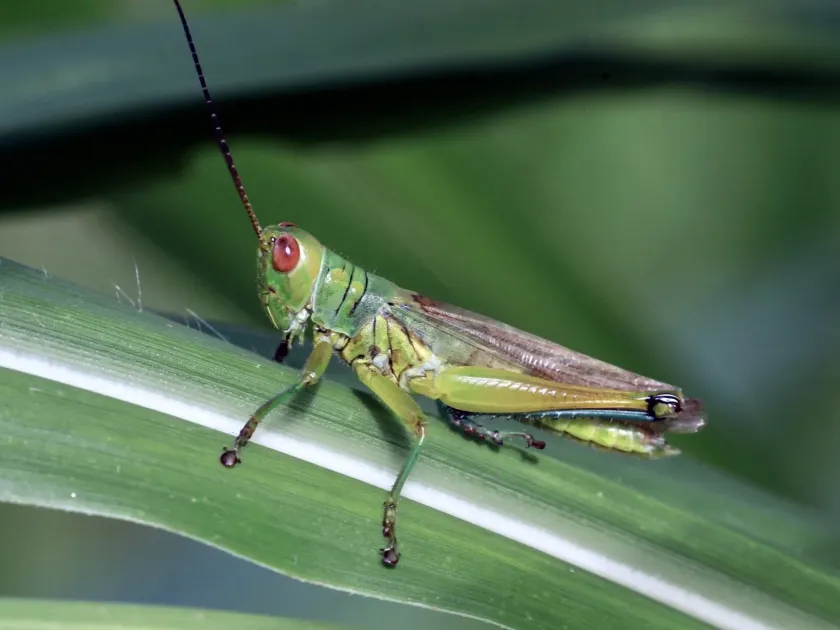
The rice grasshopper (Hieroglyphus banian) belongs to the order Orthoptera and the family Acrididae. It is a robust insect, typically measuring 40–60 mm in length, with a green to yellowish-green body.
Adults possess well-developed wings, allowing for significant migratory flights. A key diagnostic feature is the presence of spines on the hind tibiae, which is a common characteristic of the Hieroglyphus genus.
Nymphs resemble the adults but are smaller in size and lack fully formed wings. Their coloration varies from light green to brownish depending on the developmental stage and environmental factors.
This species is native to tropical and subtropical regions of Asia. It thrives in high-moisture environments, which aligns perfectly with its life cycle on flooded rice paddies.
For accurate identification, one should observe the distinct dark bands on the pronotum and the somewhat cylindrical shape of the pronotum, which helps distinguish it from other related grasshopper species.
What it damages
The primary crop damaged by this pest is rice (Oryza sativa). When populations reach outbreak levels, the rice grasshopper can cause extensive damage to rice fields.
Beyond rice, this insect feeds on various wild grasses such as barnyard grass and sedges, which are commonly found on field borders, irrigation ditches, and nearby wasteland areas.
Both nymphs and adults cause damage. They possess strong mandibles that allow them to consume large quantities of leaf tissue very rapidly, leading to severe defoliation.
During mass outbreaks, they may migrate to wheat, maize, or sugarcane crops if these are grown in close proximity to rice systems, although rice remains their preferred food source.
The level of yield loss depends heavily on the crop growth stage; damage during the tillering and panicle initiation stages is particularly critical and leads to significant yield reduction.
When it appears
The life cycle of Hieroglyphus banian is univoltine (one generation per year). The pest overwinter in the egg stage, which females deposit in the soil at a depth of 5–10 cm at the end of the cropping season.
Mass hatching of nymphs occurs at the beginning of the rainy season or following initial field irrigation. Nymph appearance coincides with the active growth phase of young rice seedlings.
Development involves five to six nymphal instars. This process typically takes 40 to 60 days, depending on temperature and humidity levels in the paddy environment.
Adults emerge during the flowering and grain-filling stages of rice. This is the period of peak activity, during which they feed intensely on both vegetative and generative parts of the rice plants.
At the end of the season, females prepare for oviposition, creating egg pods in the soil along field boundaries and irrigation channels, ensuring population survival for the following year.
Signs of infestation
The first sign of infestation is the characteristic "window" damage on rice leaves. Nymphs chew away the leaf blade tissue while leaving the veins intact, creating a net-like appearance.
Under severe pressure, total defoliation occurs, leaving only the midribs of the leaves. This drastically reduces the plant's photosynthetic capacity and weakens overall development.
Damage to the panicles is observed as partial or complete grain loss when grasshoppers chew through the pedicels or young ovaries, leading to sterility and reduced grain weight.
Visual detection of the insects is possible during early morning field inspections when their activity is slightly lower and they can be observed resting on the upper stems.
In dense rice stands, the presence of the pest is often signaled by the sound of stridulation during daylight hours and the presence of droppings accumulating on the water surface or on lower leaves.
Control measures
Agronomic control includes deep plowing of fields after harvest. This action exposes the egg pods in the soil to the sun and predators, significantly reducing the survival rate for the next season.
Managing weeds on field bunds and irrigation channels is essential, as these areas serve as the primary egg-laying sites and reservoirs for the grasshopper population.
- Application of entomopathogenic fungi, such as Metarhizium anisopliae, for biological suppression of population densities.
- Encouraging natural enemies, including birds and predatory insects, which can help regulate grasshopper populations under natural conditions.
Chemical control is applied when the economic threshold is exceeded. Insecticides from the organophosphate or pyrethroid classes are typically used, applied as sprays during early morning or late evening.
Monitoring using light traps and regular field scouting allows for timely intervention, preventing the spread of the pest from surrounding areas to the main crop fields.
Taxonomy
- Latin name
- Hieroglyphus banian
- Order
- Orthoptera (locusts)
- Family
- Acrididae
- EPPO code
- HIEGBA
Discussion
No discussions yet — be the first.