
Rice grasshopper
Hieroglyphus anulicornis
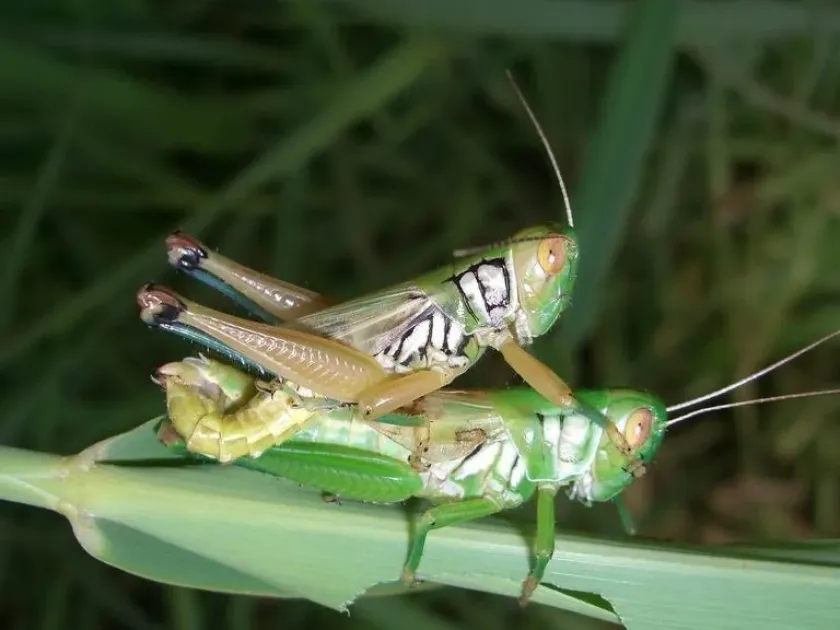
Description
How to identify
The rice grasshopper (Hieroglyphus anulicornis) is a member of the order Orthoptera and the family Acrididae. It is a specialized insect well-adapted to the humid environments characteristic of paddy fields.
Adults exhibit an elongated body, typically green or yellowish-brown, providing excellent camouflage within the dense foliage of rice plants. They possess powerful hind legs designed for jumping.
Females are generally larger than males and deposit eggs in the soil within protective pods, which ensures the survival of the next generation through harsh environmental conditions.
Nymphs resemble smaller versions of the adults but lack fully developed wings. They undergo several molting stages, gradually increasing in size until reaching maturity.
The insects are highly mobile and rely on their cryptic coloration to remain hidden, making detection difficult until populations reach significant levels.
What it damages
This pest primarily attacks rice but is also known to feed on other cereals such as sorghum and sugarcane, posing a threat to various agrarian sectors.
Grasshoppers consume leaves by chewing on the edges or creating holes, which drastically reduces the photosynthetic surface area of the plant.
During the heading phase, they may attack the developing panicles, leading to significant yield loss or complete destruction of the grain quality.
High population densities can lead to severe defoliation, leaving only the midribs of the leaves, which significantly weakens the rice plants.
Secondary infections often follow the mechanical damage caused by these pests, further deteriorating the health and vigor of the crop.
When it appears
The life cycle of Hieroglyphus anulicornis is closely aligned with the rice growing season and the presence of irrigation, which provides necessary humidity for egg development.
Nymphs usually emerge from overwintered eggs at the beginning of the rice vegetative stage, ensuring a steady food supply for the developing generation.
Peak activity of adult insects occurs in mid-to-late summer, coinciding with the reproductive phase of the grasshoppers and the intensive feeding period.
After mating, females lay eggs in the soil, which enter a state of dormancy until the environmental conditions become favorable again in the following season.
Climate factors such as heavy rainfall or extreme temperature variations during the emergence period can significantly impact the population dynamics.
Signs of infestation
The most prominent sign of an infestation is the presence of irregular, notched feeding patterns along the edges of the rice leaves.
During field inspections, the sudden movement or jumping of insects in the vegetation is a clear indicator of a resident grasshopper population.
Frass (insect excrement) found on the leaves and at the base of the plants confirms active feeding and high localized density of the pest.
Affected fields may show areas of yellowing or scorched-looking foliage, which indicates prolonged feeding and severe plant stress.
- Tattered leaf edges caused by adult chewing.
- Damaged panicles with missing or scarred grains.
- Egg pods found in the soil during post-harvest sampling.
Control measures
Effective management involves an integrated pest management approach that combines cultural, biological, and chemical methods.
Cultural practices, such as deep plowing of the fields after harvest, are essential to destroy egg pods buried in the topsoil.
Managing weeds along the canal banks and field edges reduces the secondary habitats where grasshoppers can thrive and reproduce.
Chemical control using authorized insecticides is recommended when population levels exceed the economic injury threshold, targeting nymphs in early stages.
Regular field scouting is critical for early detection, allowing for spot treatments and preventing the spread of the infestation throughout the entire area.
Taxonomy
- Latin name
- Hieroglyphus anulicornis
- Order
- Orthoptera (locusts)
- Family
- Acrididae
- EPPO code
- HIEGAN
Discussion
No discussions yet — be the first.